Let's be direct: most businesses in the MENA region treat a digital marketing agency like a vendor. They hire one to run some ads, make a few social media posts, and hope for the best. This is a recipe for wasted budgets and frustration.
A modern agency isn't a vendor; it's a growth architect. Their real value isn't in managing isolated tasks but in engineering your entire customer journey—from a potential client in Riyadh discovering you on Google to a loyal customer in Dubai making their tenth purchase. Their job is to ensure your sales, marketing, and customer experience operations function as a single, revenue-generating machine, not as disconnected silos.
The Architect of Your Customer Journey
Forget the old model where marketing chases "likes," sales chases leads, and support handles complaints. A high-impact agency acts as an orchestrator, blending MENA-specific strategy with the right technology to build predictable systems for growth.
This means moving past vanity metrics and focusing squarely on what drives your business: revenue, customer lifetime value (LTV), and return on investment (ROI).
This shift is non-negotiable in the UAE and Saudi markets. A strategy that works in North America will fail if it ignores local consumer behavior—like the dominance of WhatsApp, the nuances of Arabic dialects, or the need for compliant, on-premise solutions in regulated industries. This is where a specialized agency proves its worth.
Moving Beyond Simple Services to Integrated Systems
The conversation is no longer about buying a list of services. It's about investing in an operational asset. A top-tier agency doesn't just "do SEO"; they build a complete system to solve your biggest business challenges.
Let's look at real-world MENA scenarios:
Problem: A B2B tech company in Saudi Arabia has an unpredictable lead flow.
Old Solution: Throw money at generic LinkedIn ads and hope.
Modern Solution: Engineer an end-to-end lead generation machine. This involves identifying target accounts, creating compelling Arabic-first content (not just a lazy translation), automating follow-up sequences on WhatsApp and email, and integrating it all into a CRM like SalesMfast AI. The result? You can track ROI from the first click to the signed contract.
Problem: A medical clinic in Dubai gets website traffic but few actual appointment bookings.
Old Solution: A cosmetic website redesign.
Modern Solution: Optimize the entire patient acquisition journey. This means analyzing user data to find drop-off points, implementing an AI-powered chatbot that understands Gulf Arabic to answer questions instantly, and using automated WhatsApp reminders to slash no-shows.
The goal isn’t to check off a list of marketing tasks. It's to build a valuable, operational asset for your business—a growth engine that runs systematically and is fine-tuned for the unique customer behaviors across the MENA region.
The Orchestrator of Technology and Strategy
A modern agency is also a technology consultant. They don't just use a random collection of tools; they architect a smart, cohesive tech stack that breaks down data silos. In the GCC, this often means building systems that can seamlessly handle a bilingual, mobile-first audience that lives on WhatsApp.
For more information on how this works in practice, you can explore our approach to integrated digital marketing agency services.
This is about connecting the dots. Your advertising platforms, sales automation software (like SalesMfast AI), and your contact center solution (like CXMfast AI) must communicate. A customer service chat on WhatsApp should instantly update their CRM profile, which could then trigger a relevant marketing message.
It’s this seamless orchestration that separates a simple service provider from a true strategic partner—one that can deliver scalable, sustainable growth.
What a Digital Marketing Agency Actually Does to Grow Your Business
A top-tier digital marketing agency isn't just a vendor selling a menu of services. They act as a growth partner, building an integrated system where every part works together to hit your specific business goals. It's crucial to understand how these core components connect, because that’s how you move from random acts of marketing to a predictable engine for growth.
Think of a modern agency as the central nervous system connecting your sales, marketing, and customer experience teams into one cohesive, goal-driven unit.
This is what that relationship looks like in practice.
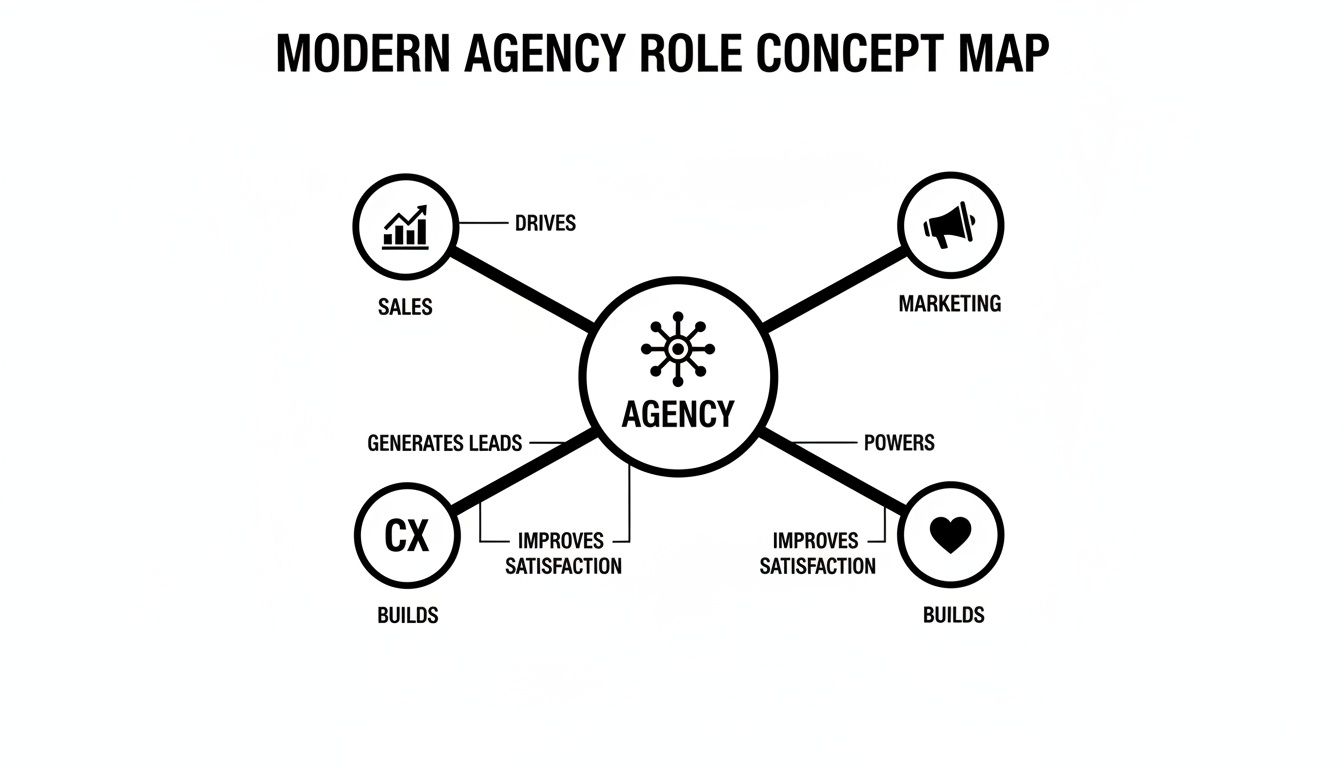
As you can see, real growth happens when marketing activities directly feed your sales pipeline, and both are backed by a stellar customer experience. A skilled agency is the one orchestrating that entire cycle.
The Foundation: Getting Found by the Right People
Before you can make a sale, your customers in the UAE, Saudi Arabia, and across the MENA region must be able to find you when they are actively looking. This is ground zero.
Search Engine Optimization (SEO): This is the science of getting your website to the top of Google for valuable search terms. It’s not about tricks. It’s about structuring your site and content to answer your audience’s questions in both Arabic and English. For a dental clinic in Dubai, this means showing up for "best dental implants in Dubai," not generic keywords.
Content Marketing: Content is the fuel for your marketing engine. This means creating genuinely useful articles, guides, and case studies that solve your audience's problems. For a B2B tech company in Riyadh, this could be an in-depth guide on "AI-powered supply chain automation for Saudi manufacturing," establishing them as the expert.
The Accelerators: Driving Immediate Action and Leads
While the foundation builds long-term value, you also need leads now. That's where growth accelerators come in. They are designed to drive targeted traffic and conversions quickly.
A huge mistake we see is businesses focusing on just one or the other. The best strategies blend the long-game of SEO with the immediate reach of paid ads. One builds your digital real estate while the other sends qualified traffic to it, day in and day out.
Paid Media (PPC): This is about running targeted ads on platforms like Google, LinkedIn, and Meta. The magic of paid media is its precision. You can target people based on their job titles, interests, and location. This is how an e-commerce brand can show ads for a new abaya collection only to women in Jeddah who have recently shown interest in high-end fashion.
Email & WhatsApp Marketing: In the MENA region, the conversation has moved to messaging apps. This isn't just about sending newsletters; it's about building and nurturing contacts with personalized, automated sequences. A real estate developer can use WhatsApp to send instant property updates and appointment reminders, cutting through the noise and achieving far greater engagement than email alone.
The System: Automation That Ties It All Together
This is where a truly modern agency earns its keep. It’s about turning individual activities into a seamless, automated system that connects marketing directly to sales results.
Marketing Automation: This is using software like SalesMfast AI to automate repetitive marketing jobs and nurture leads. Instead of your sales team manually following up with every download, you can build smart workflows that send targeted messages based on user behavior. Our expertise in lead generation automation is built around creating systems that qualify leads and book sales meetings automatically.
Customer Experience (CX) Orchestration: This ensures every interaction with your brand is smooth—from the first ad they see to a support ticket they raise six months later. This means integrating your CRM with your contact center so a support agent using a tool like CXMfast AI instantly has the customer's full history. Every touchpoint becomes a chance to build loyalty.
Let’s break down how these services translate into tangible business results. The table below connects each service area to its core purpose, the metrics we use to measure success, and a practical example of how it’s applied in the MENA region.
Core Digital Marketing Services and Their Business Impact
Ultimately, the goal isn't just to "do marketing." It's to build a cohesive system where each component amplifies the others, creating a predictable and scalable path to growth.
Why a MENA-Specific Digital Marketing Strategy is Your Secret Weapon
Let's be blunt: a generic, one-size-fits-all approach to digital marketing is a fast track to failure in the Middle East. The strategies that crush it in North America or Europe often land with a thud here. Hiring a big global agency without deep, on-the-ground experience in the MENA region isn't just a poor investment—it's a serious liability.
The difference between success and another wasted ad budget comes down to understanding the unique cultural, technological, and regulatory landscape of this market. It's about moving beyond lazy translations to build genuine connection and trust.
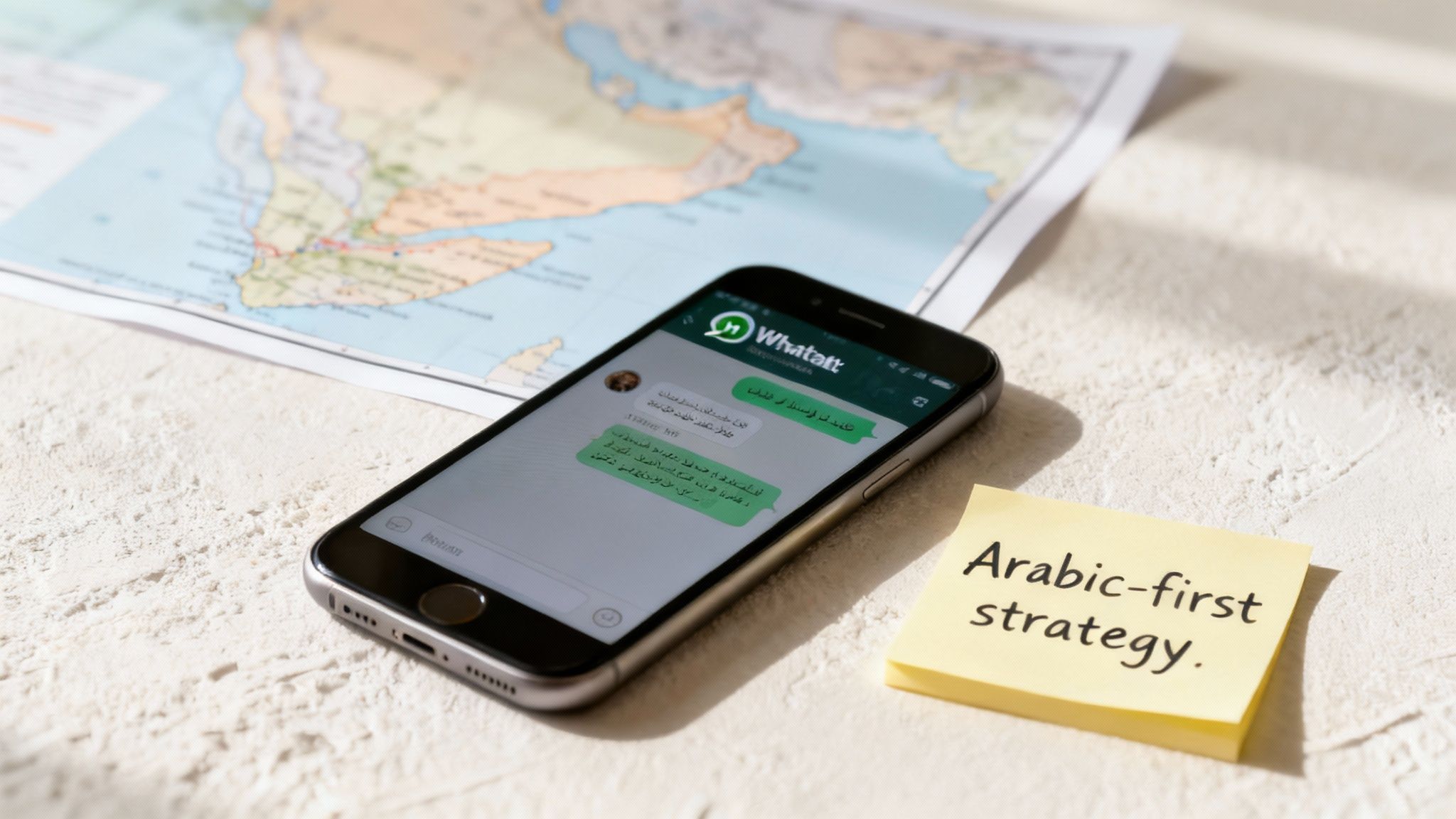
Beyond Translation to a True Arabic-First Mindset
Too many international agencies treat Arabic as an afterthought. This is a massive mistake. A winning MENA strategy must be Arabic-first, which means mastering the subtle but powerful differences in communication styles and dialects from the start.
An AI chatbot trained on Modern Standard Arabic might be technically correct, but it will feel cold and robotic to a customer in Riyadh or Dubai who communicates in a distinct Gulf dialect.
A specialized agency knows that a campaign for the UAE must feel different from one for Saudi Arabia. They sweat the details—dialectal nuances, local cultural references, and even when to use "Arabizi" (writing Arabic with English letters) in chat automations and ad copy. This level of detail isn't a "nice-to-have"; it's the foundation of building a real relationship with your audience.
This level of detail isn't a "nice-to-have." It's everything when it comes to building a real relationship with your audience.
The Unshakeable Power of WhatsApp
In most Western markets, email is a key business channel. Here in the MENA region? WhatsApp is king. It's not just a messaging app; it’s the center of gravity for personal and commercial conversations.
Any digital marketing agency that doesn't have a sophisticated WhatsApp strategy is already playing from behind. This must include:
- Conversational Commerce: Letting customers browse, ask questions, and buy products—all within the WhatsApp chat.
- Automated Nurturing: Building smart workflows that send timely follow-ups, appointment reminders, and helpful content via WhatsApp.
- Instant Customer Support: Using AI-powered bots trained on local dialects for 24/7 support to handle common questions instantly, freeing up your human team for complex issues.
Ignoring WhatsApp's central role is like trying to do business in the 1990s without a phone. For a deeper look at this, check out our guide on breaking into the Middle East market by mastering these essential channels.
Navigating a Maze of Local Regulations
The digital landscape in the GCC is evolving rapidly, bringing a complex web of data privacy laws and industry-specific regulations, especially in sectors like healthcare, finance, and government.
An agency that doesn't understand these local laws can expose your business to significant risk. Data sovereignty laws in some countries dictate where customer data must be stored, making a cloud-only solution a non-starter for many regulated businesses.
A MENA-focused agency lives and breathes these requirements. They know when a bank’s contact center needs an on-premise solution like CXMfast AI or how a clinic in Dubai must manage patient data to meet DHA rules. This isn't bonus knowledge; it's a fundamental requirement for operating safely.
The market's explosive growth makes this expertise even more critical. As GCC companies boosted their digital ad spending from USD 5.5 billion in 2022 to an expected USD 25.5 billion by 2024, the fight for customer attention has become incredibly intense. This massive investment, fueled by initiatives like Saudi's Vision 2030, means generic campaigns are drowned out almost immediately. You can dig into the numbers in this comprehensive market analysis.
Measuring Success Beyond Vanity Metrics
How do you know if your digital marketing agency is delivering real value? It's time to move past surface-level numbers like likes, impressions, and follower counts. These are vanity metrics; they look nice on a report but have a weak connection to your bottom line.
Real success is measured by the KPIs that drive business growth. A great agency partner doesn’t chase clicks—they build strategies designed to move the needles on core business metrics, giving you a clear line of sight from their work to your financial results.

The Three Metrics That Truly Matter
To hold your agency accountable and see a real return, you must focus on three core financial metrics.
Customer Acquisition Cost (CAC): This is your total sales and marketing cost to acquire one new customer. A lower CAC means higher efficiency. Your agency's job is to systematically lower this number with smarter ad campaigns, better conversion rates, and effective SEO that generates high-intent organic traffic.
Customer Lifetime Value (LTV): This is the total revenue you expect from a single customer over their entire relationship with you. A high LTV signifies happy, loyal customers. A good agency boosts LTV with smart CX automation, personalized communication, and loyalty initiatives that reduce churn.
Return on Investment (ROI): This is the ultimate measure of success, answering the question: "For every dirham or riyal we spend, how many are we getting back?" Answering this requires end-to-end tracking across the entire customer journey.
The demand for this level of analysis is exploding. The digital marketing analytics market in the Middle East and Africa was valued at USD 90.36 million in 2024 and is expected to grow at a staggering 20.6% annually through 2031. Businesses in the UAE and Saudi Arabia are no longer satisfied with guesswork; they demand data-backed decisions.
Connecting Agency Actions to Financial Outcomes
Any agency worth hiring should be able to draw a straight line from its activities to these key financial metrics. Remember, view counts are often vanity metrics. A million views mean nothing if no one buys.
Here’s how their services should directly impact your finances:
- Paid Media & SEO: These are your primary levers for influencing CAC. A well-run Google Ads campaign or a top-ranking organic position means you spend less to attract each new customer.
- CX & Marketing Automation: These systems are built to increase LTV. Seamless support and timely, relevant messages give customers more reasons to stay and buy again.
- A Unified System: Tying it all together is what truly drives ROI. When your ads, website, and WhatsApp channels work in harmony, you create an efficient growth engine. We've written a guide on why your ads, emails, and website aren't working together that digs into this.
The fundamental shift is from asking, "How many clicks did we get?" to "How did those clicks impact our Customer Acquisition Cost and Lifetime Value?" That is the conversation a true growth partner wants to have.
By focusing on these core financial outcomes, you can have smarter conversations with your agency, set more meaningful goals, and ensure your marketing budget is treated as a powerful investment, not an expense.
How to Choose the Right Agency for Your Business
Picking a digital marketing agency is one of the most critical decisions for your business. The right partner acts as an extension of your team, driving measurable growth. The wrong one burns through your budget with little more than vanity metrics and broken promises.
So, how do you get it right? Look past the slick sales pitch and ask the tough questions that reveal an agency's true capabilities.
This isn’t about being wowed by a flashy website. It’s about finding a partner with a proven, systematic approach that aligns with your goals within the unique MENA market.
The Vetting Checklist: Questions You Must Ask
Before signing a contract, do your homework. A great agency will welcome these questions; a weak one will offer generic answers.
- Industry & Market Experience: "Show us case studies from businesses like ours, specifically within the UAE or Saudi Arabia." Vague global examples don't count. You need proof they understand your industry in your home market.
- Strategic Approach: "Walk me through your process for the first 90 days. What are the key milestones, and how will you define success?" You're listening for a structured plan (discovery, strategy, implementation, optimization), not a lazy promise to "start running ads."
- Technology & Systems: "What is your core technology stack for automation, CRM, and analytics? How do you ensure it handles Arabic dialects and integrates with our existing systems?" Their answer reveals their technical depth. An agency that only knows basic off-the-shelf tools will stumble with the complexities of bilingual automation and orchestration.
- Reporting & Accountability: "What KPIs will you report on, and how often? Show us a sample report." If they lead with impressions and clicks, be cautious. The conversation must revolve around Customer Acquisition Cost (CAC), Lifetime Value (LTV), and Return on Investment (ROI).
Agency Vetting Checklist: Red Flags vs. Green Flags
As you evaluate potential partners, patterns will emerge. Some signal a disciplined, results-obsessed partner; others are clear warning signs.
This checklist isn't exhaustive, but it provides a solid foundation. An agency that checks the "Green Flag" boxes is far more likely to be a strategic partner invested in your long-term success.
The Ultimate Litmus Test: Can They Build a System?
The single biggest differentiator is whether an agency sells services or builds systems. Any agency can run a campaign. A true growth partner builds a predictable, automated engine for your business—one that connects every touchpoint, from the first ad click to a long-term, loyal customer.
This philosophy is the bedrock of our own agency services at SMOrchestra. We don't just manage campaigns; we design, build, and operate the entire growth machine for you.
The biggest mistake is hiring an agency that focuses only on top-of-funnel activities like traffic. Without a robust, automated system to nurture those leads and deliver an excellent customer experience, you're just pouring water into a leaky bucket.
When you find an agency that talks more about systems, workflows, and ROI than they do about clicks and impressions, you've likely found a partner who understands what it truly takes to scale a business in the modern MENA economy.
Frequently Asked Questions
When you're looking for a digital marketing partner in the MENA region, you're bound to have a lot of practical questions. Let's tackle some of the most common ones we hear, giving you the straightforward answers you need to make a smart decision.
How Much Does a Digital Marketing Agency Cost in Dubai or Riyadh?
This is usually the first question, but there’s no single price tag. In hubs like Dubai and Riyadh, agency pricing generally falls into three models:
Monthly Retainer: The most common model for ongoing growth. You pay a set fee each month for a specific scope of work—like SEO, content, and paid media management. Retainers can start around AED 10,000 for basic services and exceed AED 100,000 for complex, multi-channel strategies at the enterprise level.
Project-Based Fee: Ideal for a one-off project with a clear deliverable, such as a website overhaul, a CRM implementation (like SalesMfast AI), or building a specific automation sequence with a tool like SMooR. You agree on a fixed price upfront.
Performance-Based Model: Some agencies tie a portion of their fee to hitting specific targets, like generating a certain number of qualified leads or achieving a target Return on Ad Spend (ROAS). This model ensures the agency's success is directly aligned with yours.
The right model depends on your goals. A retainer is perfect for steady, long-term growth, while a project fee is best for a defined task.
What Is the Difference Between an Agency and Hiring In-House?
This is a strategic fork in the road with significant trade-offs. The right call depends on your company’s size, resources, and growth stage. It’s the classic "buy versus build" dilemma.
An agency gives you immediate access to a team of specialists for the cost of one senior hire. An in-house team offers deep company knowledge but comes with higher overheads and a longer ramp-up time.
Let's lay out the key differences.
The decision often boils down to this: if you need specialized skills and want to move fast without the burden of building an entire department, an agency is the more efficient path. For more common questions about digital marketing strategies and tools, you can explore our comprehensive FAQ section.
How Quickly Can I Expect to See Results?
The honest answer is: it depends on the strategy. Any credible agency will manage expectations by differentiating between quick wins and long-term growth.
Short-Term Results (1-3 Months): You can see early momentum. A well-run paid media campaign on Google or Meta can start generating traffic and leads within the first month. Implementing a conversational AI bot can immediately boost lead capture.
Long-Term Growth (6-12+ Months): Foundational strategies like Search Engine Optimization (SEO) and content marketing are investments. They build value over time. It may take six months or more to rank for competitive keywords, but the organic traffic and authority you build will pay dividends for years.
The smartest approach is a mix of both. A good agency will use paid channels for immediate results while simultaneously building the long-term SEO and content assets that become your most powerful and cost-effective marketing channels.
Ready to move from random tactics to a predictable growth system? At SMOrchestra, we don't just run campaigns; we design, build, and operate the unified sales and marketing engine your business needs to scale in the MENA market.
Book a discovery call today to see how our AI-powered orchestration can deliver the results you've been looking for.
Article created using Outrank

Read Our latest
Lorem ipsum dolor sit amet, consectetur adipiscing elit.