Let's get straight to the point. A traditional agency often feels like a gym membership—you pay a flat fee every month, whether you show up and get results or not. A true performance marketing company is more like a personal trainer whose pay is tied directly to your success. They only win when you hit specific, measurable goals, like new sales or qualified leads.
Their entire business model is built on delivering tangible outcomes, not just clocking in hours.
What a Performance Marketing Company Actually Does
Think of a performance marketing company as a strategic partner, not just a service provider. Their payment is directly linked to achieving your core business objectives. They don't get paid for simply being busy—posting on social media, sending out emails, or running ads. They get paid for results that actually grow your revenue.
This is a massive departure from the old-school retainer model. Instead of getting bogged down in fuzzy concepts like "brand awareness," a performance partner is obsessed with data and metrics that have a real impact on your bottom line.
Their world revolves around a few key numbers:
- Cost Per Acquisition (CPA): How much does it cost, in total, to land one new paying customer? This is the ultimate test of marketing efficiency.
- Return On Ad Spend (ROAS): For every dollar you put into advertising, how many dollars do you get back in revenue? This tells you, in no uncertain terms, if your marketing is profitable.
- Cost Per Lead (CPL): What's the exact cost to generate one high-quality lead? This could be a clinic booking an appointment or a B2B company requesting a demo.
The Focus on Results Over Vanity Metrics
Too many agencies in the MENA market still celebrate vanity metrics—things like likes, shares, and impressions. These numbers can look impressive on a PowerPoint slide, but they often mean very little for your actual business. A performance marketing company cuts through that noise.
Their job is to build a predictable, scalable engine for growth, not just to maintain a busy-looking social media feed. If you want to dig deeper into this, we break it all down in our guide on what to look for when hiring a digital marketing agency.
This shift toward accountable, results-first advertising is changing the game here in the region. In fact, the MENA advertising market is projected to grow by 8 percent in 2025, hitting a massive $6.3 billion. And get this: a staggering 65.9 percent of that will come from digital channels like search and social, where every click and conversion can be tracked. This is precisely why a skilled performance marketing partner is no longer a "nice-to-have" for businesses in the UAE and Saudi Arabia—it's essential for survival and growth. You can see the full analysis of how MENA's ad market growth is being driven by performance-based strategies.
In essence, you are not just hiring a vendor; you are forming a partnership. The success of a performance marketing company is intrinsically linked to your own, creating a powerful alignment of interests that drives real, measurable growth.
Decoding Performance Marketing Pricing Models
How you pay a performance marketing company tells you everything you need to know. If the contract is confusing or based entirely on a monthly retainer, you're likely paying for a to-do list, not for actual results. True performance partners, especially here in the UAE and Saudi Arabia, build their fees around your success.
This isn't about just paying a flat management fee every month and hoping for the best. The entire conversation should shift to pricing that connects directly to the money your business is making. For any company, but especially those searching for a digital marketing agency in Dubai, getting this right is non-negotiable.
The Core Performance Models
The three most common ways to pay for performance are all tied to a specific action you can actually count. Each one is built for a different kind of business, so picking the right one depends entirely on what you want to achieve.
Cost Per Lead (CPL): Simple and effective. You pay a set price for every qualified lead that comes through the door. This is a perfect setup for service businesses, like a dental clinic in Dubai that just needs to fill its appointment book. The key here is agreeing on what makes a lead "qualified" before you start, so you’re only paying for real potential customers.
Cost Per Acquisition (CPA): This is also called Cost Per Sale (CPS), and it means the agency only gets paid when someone actually buys something. It’s the go-to model for an e-commerce brand in Saudi Arabia because it ties every dirham of marketing spend directly to revenue. With CPA, the agency takes on nearly all the risk; if they don't drive sales, they don't get paid.
Revenue Share: Here, the agency earns a slice of the revenue they help generate. This model creates a true partnership—the agency’s success is literally tied to yours. It’s a great fit for businesses that can easily track where their sales come from and have a high customer lifetime value.
This chart breaks down the fundamental choice you have to make: are you buying activities or are you buying results?
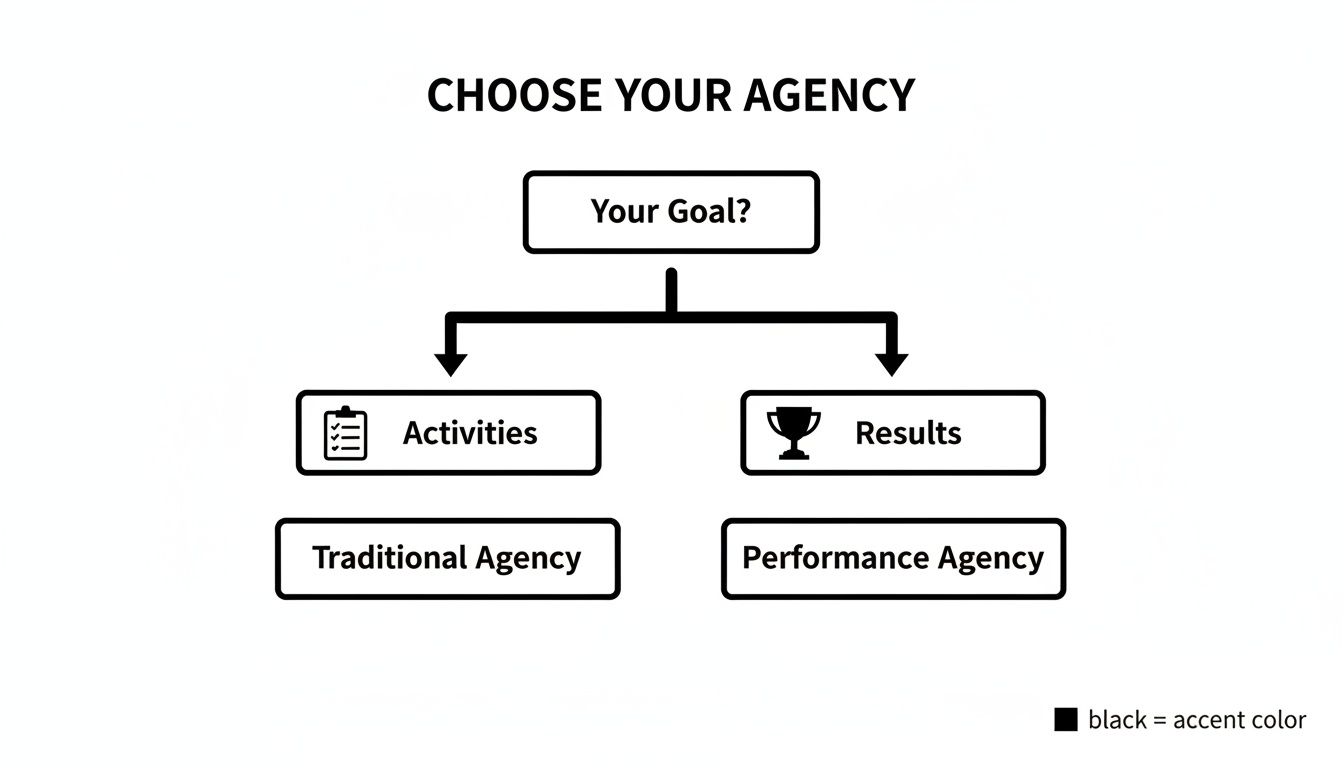
As the flowchart shows, if measurable business outcomes are what you’re after, a performance agency is the only logical path. If you just need tasks completed, a traditional agency might fit.
Comparing Performance Marketing Pricing Models
To help MENA businesses choose the right structure, this table breaks down how each model works and who carries the risk.
Ultimately, the best model aligns the agency's compensation directly with your most important business goals, ensuring everyone is pulling in the same direction.
What About Hybrid Models and Retainers?
Now, seeing a fixed fee isn't always a red flag. Sometimes, a hybrid approach just makes sense. A performance marketing company might propose an initial setup fee or a small monthly retainer, and that's often fair. This usually covers the heavy lifting upfront—the deep-dive strategy, data analysis, and technical setup needed to get sophisticated campaigns off the ground.
A retainer makes sense when it pays for foundational strategy and technical setup. It becomes a problem when it's the only way the agency makes money, because it kills their motivation to drive real performance.
Transparency is what matters. Your partner should be able to tell you exactly what any fixed fee is for and show you how the bulk of their earnings will come from hitting your performance targets. When you're looking at different payment structures, it can be helpful to see how other companies communicate value, like in Mindstamp's pricing models.
Always dig into how ad spend is handled. Ask if their fee is a percentage of your media budget. That can create a massive conflict of interest, where their main incentive is to get you to spend more, not smarter. A real partner wants to make you more money, not just spend more of yours.
The Performance Marketing Channels That Actually Work in the MENA Region
If you want to succeed here, you need to go where your customers are. A generic, one-size-fits-all strategy of just running a few search and social ads won't cut it in the MENA region. A performance marketing partner who understands which platforms truly connect with local audiences isn't a luxury; it's a necessity.
It’s all about showing up in the right place, at the right time, and—crucially—speaking the right language, which often means using specific local dialects and even Arabizi. The aim is to create a seamless presence across multiple channels that feels completely natural to your audience.
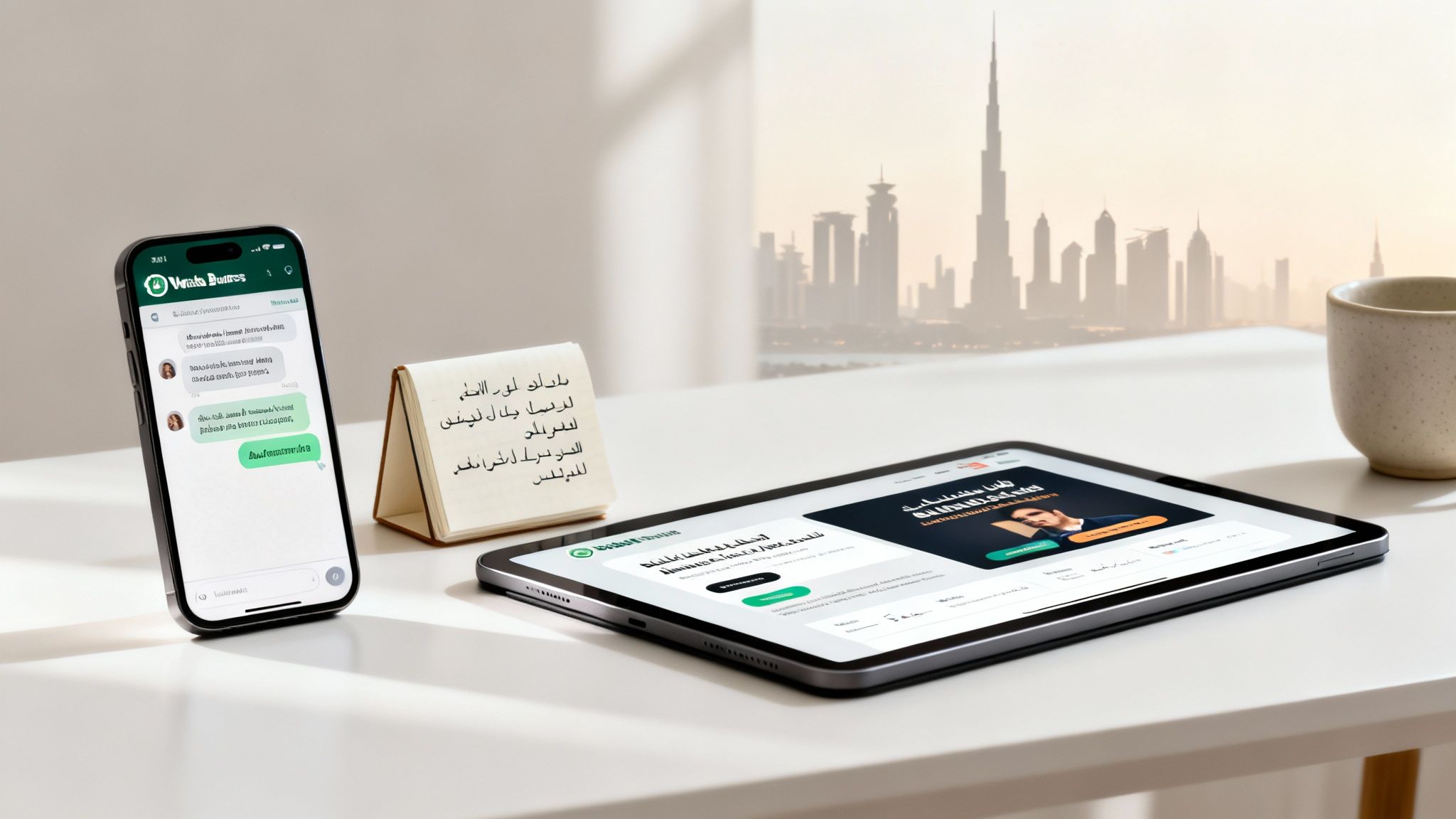
This kind of setup, blending mobile and direct communication, points to the rise of conversational commerce—an absolutely vital channel for building real customer relationships in the MENA region.
Conversational Commerce: It All Happens on WhatsApp
In places like the UAE and Saudi Arabia, WhatsApp is more than just a messaging app; it's the primary way business gets done. While many Western markets are still stuck on email, here, email often feels like an afterthought.
For clinics, real estate firms, and any service-based SME, automating WhatsApp Business is essential. It's the platform where you send appointment reminders, use AI bots to answer questions instantly, and have actual sales conversations. Any performance strategy that overlooks WhatsApp is simply leaving money on the table.
Search and Social: Beyond Simple Translation
Everyone runs ads on Google and Instagram. But to make them work in the MENA region, you need a deep understanding of the culture and language. Just translating your English keywords into standard Arabic won't get you very far.
A sharp performance marketing partner will dive into keyword research for different dialects—like Gulf, Levantine, or Egyptian. They'll also create ad copy and visuals that resonate with local customs and values. This attention to nuance is what separates an ad that converts from one that's completely ignored.
Programmatic Advertising: Hitting the Bullseye
When you need to reach a very specific, high-value audience—think potential buyers for luxury properties in Dubai—programmatic advertising is your best bet. This isn't about basic demographic targeting; it’s about using automated tech to buy ad space and target users based on incredibly detailed data signals.
The market for programmatic advertising in the Middle East and Africa is exploding. It's expected to hit USD 20.05 billion in 2025 and is on track to reach USD 30.10 billion by 2030. This growth is fueled by industries like healthcare that are using rich data to connect with patients in a more meaningful way.
In the Gulf, your most valuable customers aren't just sitting around waiting for a generic Google ad to pop up. You have to reach them through sophisticated, data-driven channels that understand their unique behaviors and interests.
Affiliate Marketing: Paying for Real Results
Affiliate marketing is a fantastic performance channel, but only if you set it up correctly. This isn't about getting a few bloggers to mention your brand. It’s about building a network of partners who have a real financial incentive to drive sales for you.
For an e-commerce store or a B2B software company targeting the Gulf, this means finding credible influencers and publications whose followers are a perfect match for your ideal customer. The key is to structure the commission around completed sales (CPA) or qualified leads (CPL), so you only ever pay for concrete results.
This transforms affiliate marketing from a vague branding exercise into a core part of a scalable lead generation strategy. When you combine these channels, you stop running disconnected campaigns and start building an integrated performance engine that delivers real, measurable growth.
The Technology That Powers Performance Marketing
Behind every great performance marketing campaign, there’s a rock-solid technology stack. Gone are the days of vague, high-level reports from traditional agencies. A real performance marketing company doesn't just run ads; it meticulously builds a connected system to track, measure, and optimize for results you can actually see.
The focus isn't on the tech for tech's sake. It's all about one thing: precise attribution. This is the secret sauce. It means knowing, without a shadow of a doubt, which ad, keyword, or even which WhatsApp message brought in a specific sale or a qualified lead. Without that level of clarity, you’re essentially just throwing money at a wall and hoping some of it sticks.
From Pixels to Profits: The Core Tech Stack
The right technology stack is what transforms marketing from a cost center into a predictable revenue machine. It creates a direct line between your ad spend and your sales pipeline, giving you a real-time view of what's actually driving the business forward.
Here are the non-negotiable components:
Tracking Pixels and APIs: Think of these as the foundational building blocks. They are small snippets of code placed on your website or integrated with your apps that track every single user action—from the very first ad click all the way to the final purchase. For any performance marketing firm, an effective Google Ads conversion tracking setup is the critical first step. It's how you prove your ad spend is tied directly to real results.
CRM and Marketing Automation: This is the central nervous system of your entire operation. A properly integrated CRM does so much more than just store contact info. It connects every touchpoint to a customer's profile, paving the way for sophisticated lead nurturing, automated follow-ups via WhatsApp and email, and a clear picture of each customer's lifetime value.
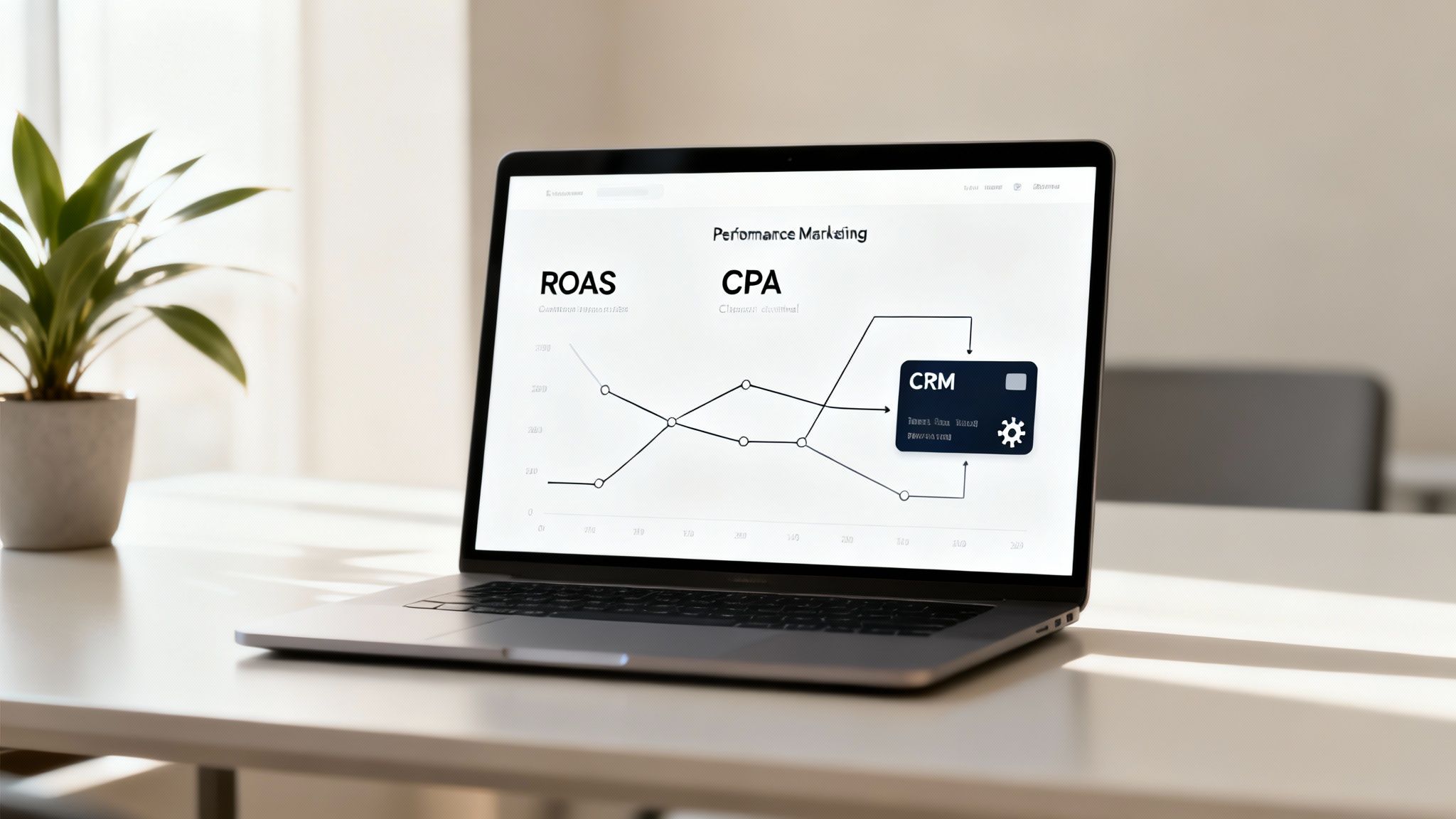
This kind of infrastructure is seeing huge investment for a reason. The Middle East's marketing technology market was valued at USD 8,290.37 million in 2024 and is on track to grow at a CAGR of 20.2 percent. This spending boom is what enables the laser-focused targeting and measurement that defines modern performance marketing.
The Power of an Integrated System
A tech stack with disconnected parts is basically useless. If your ad platforms, website analytics, and CRM aren't talking to each other, you're blind to the full customer journey. An expert performance partner spends the time connecting these systems to create a single source of truth.
The goal is to build a closed-loop reporting system. You should be able to look at a dashboard and see exactly how many dirhams you spent on a campaign and precisely how many dirhams it generated in return.
This integrated approach is what really separates a modern performance partner from a traditional agency. Instead of a monthly report filled with fuzzy "vanity metrics," you get a live dashboard showing you the numbers that actually matter: ROAS, CPA, and customer LTV. This transparency is crucial, especially when picking foundational tools for your business. For a closer look, check out our guide on choosing the best CRM for a small business.
Ultimately, all this technology serves one simple purpose: to take the guesswork out of marketing. It makes every decision a data-driven one and provides the undeniable proof that your investment is directly fueling your company's growth.
How to Evaluate and Choose the Right Partner
Picking a performance marketing partner is easily one of the most important decisions you'll make for your business. Get it right, and you've got an extension of your team, driving predictable, scalable growth. Get it wrong, and you can burn through your budget with almost nothing to show for it.
This is where you have to shift from just understanding the concepts to making a smart, decisive choice. You need a solid framework for this, one that goes beyond a slick sales pitch and gets to the heart of a potential partner's real-world capabilities—especially how well they grasp the unique landscape of the MENA market.
Moving Beyond the Sales Deck
Let’s be honest, the first few calls with any performance marketing company will be full of their greatest hits and big promises. Your job is to dig deeper. You need to ask the tough questions that peel back the curtain on their actual processes and expertise.
A genuine partner will welcome this kind of scrutiny. Why? Because they're confident in their ability to deliver the goods.
Here are the key areas to really zero in on:
- Real MENA Experience: Don't just ask for case studies; ask for specific, anonymized examples from businesses just like yours in the UAE or Saudi Arabia. A success story from a US market means very little if they don't get the nuances of Arabic dialects or the dominance of WhatsApp in daily life here.
- Technical Chops: How do they actually handle tracking and attribution? Ask them to walk you through their standard procedure for setting up conversion tracking or integrating with a CRM. If you get vague, hand-wavy answers, that’s a huge red flag.
- Reporting Clarity: What will you actually see every week or month? Ask for a sample report. If it’s cluttered with vanity metrics like impressions and clicks instead of the numbers that matter—like CPA and ROAS—they aren’t a true performance agency.
The single most revealing question you can ask is: "Can you walk me through a campaign that failed and tell me what you learned from it?" A team that's honest about its failures shows a culture of learning and data-driven improvement. That’s far more valuable than a polished list of wins.
Your Vendor Evaluation Checklist for MENA Businesses
To bring some structure to this process, use a simple scoring system. This helps take the emotion out of the decision and gives you a clear, data-backed way to compare your options. Grade each potential partner on a scale of 1-5 for these make-or-break criteria.
A methodical approach like this ensures you're comparing agencies based on what truly drives performance. For companies poised to scale, SMOrchestra offers a complete set of performance-driven agency services built from the ground up for the specific demands of the MENA market.
Critical Red Flags to Watch Out For
Knowing what to look for is only half the battle; you also have to know what to run away from. Certain promises and behaviors are dead giveaways of a vendor who’s more focused on their sales commission than your long-term success.
Be very skeptical of any performance marketing company that:
- Guarantees Results: Performance marketing deals in probabilities and intelligent optimization, not certainties. Any agency promising a specific ROAS or lead count from day one is not being straight with you.
- Touts a "Secret Sauce": There are no secrets in this game. There are only proven frameworks, rigorous testing, and solid, disciplined execution. Claims of a magical, proprietary algorithm are usually just marketing fluff to hide a weak process.
- Uses a One-Size-Fits-All Approach: If they pitch you the exact same strategy for a Dubai dental clinic that they pitched to a Saudi e-commerce brand, they don’t have the strategic depth needed to win in this diverse region.
- Downplays Your Role: A real partnership is a two-way street. If they tell you to just sit back and be completely hands-off, they don't value your deep business expertise—which is absolutely essential for crafting campaigns that actually work.
Ultimately, choosing the right partner means finding a team that is just as obsessed with your business metrics as you are. They should be strategic advisors who challenge your thinking and bring fresh ideas to the table, all grounded in cold, hard data. Use this framework to find a partner who will build a genuine growth engine for your business.
From Handshakes to Hard Numbers: Real Results in the MENA Region
It's one thing to talk about frameworks and strategies, but what really matters is turning those ideas into actual, measurable growth. A true performance marketing company doesn’t just set up campaigns and send you a report. They build a partnership that connects every dirham you spend to a concrete result that hits your bottom line.
Let's move past the theory and look at what this actually looks like for businesses here in the UAE and Saudi Arabia. These aren't just feel-good stories; they're proof of how a performance-first mindset, combined with the right tech and deep local know-how, can create a reliable growth machine.

Case Study 1: The Dubai Dental Clinic
We started working with a top-tier dental clinic in Dubai that had a real problem: their cost to acquire a new patient was through the roof. They were running standard search ads, but any inquiry that came in after 5 PM or over the weekend was a lost opportunity. Good leads were simply vanishing.
Our fix was a localized, Arabic-first WhatsApp automation system.
- The Play: We set up an AI-powered chatbot on their WhatsApp business line. It worked 24/7, instantly answering common questions and booking consultations directly into the clinic's schedule. No more missed calls or delayed replies.
- The Tech: This wasn't just a chatbot; it was a system that linked their ad campaigns straight to their CRM. It triggered automated follow-ups and appointment reminders, all happening on the app their patients were already using.
- The Payoff: Within 90 days, the clinic saw a massive 40% drop in their cost per new patient. Even better, their front-desk team was no longer bogged down with endless follow-ups and could focus on creating a great experience for patients in the clinic.
Case Study 2: The KSA B2B Tech Firm
A Riyadh-based B2B tech company had a great product but a frustratingly long sales cycle. They were getting leads from LinkedIn, but turning those names into qualified sales meetings was a grind. Their sales team was wasting valuable time chasing prospects who weren't ready to talk.
We shifted the focus to an automated nurturing workflow designed to educate and qualify leads before they ever spoke to a human.
- The Play: We built a multi-channel nurturing system using a mix of hyper-targeted emails and WhatsApp messages. We sent out useful content—think case studies and ROI calculators—based on what each lead showed interest in.
- The Tech: By integrating their CRM with a marketing automation platform, we could "score" leads based on how they engaged with the content. Only the hottest, most "sales-ready" leads were automatically passed over to the sales team.
- The Payoff: The company hit a 5x Return On Ad Spend (ROAS) and boosted their sales meeting booking rate by over 30%. The sales team was happier and more effective.
These examples highlight a crucial point: performance marketing isn't just about tweaking ads. It’s about building a complete system where your tech, channels, and strategy all work in concert to deliver a specific, measurable business outcome.
This is how marketing stops being a cost center and becomes the primary engine driving your revenue. A great performance marketing partner doesn't just manage your campaigns; they architect the growth engine your business needs to scale with confidence.
Frequently Asked Questions
Let's tackle some of the most common questions we hear from businesses across the MENA region when they're thinking about hiring a performance marketing company.
What’s the Difference Between a Digital Agency and a Performance Marketing Company?
The biggest difference boils down to one word: accountability. A traditional digital agency often gets paid for the work they do—things like posting on social media or running brand awareness campaigns. Their success is measured in metrics like impressions or engagement, but their fee is usually fixed regardless of the outcome.
A performance marketing company, on the other hand, lives and dies by the results it drives. We're talking about tangible, bottom-line impact like qualified leads, booked appointments, and actual sales.
Our success—and a good chunk of our payment—is directly tied to hitting those specific goals. This means we have real skin in the game, making us a true partner invested in your growth, not just another vendor.
How Much Should I Budget for Performance Marketing?
There's no magic number, but it’s crucial to split your budget into two parts: your ad spend and the agency's fees.
- Ad Spend: This is the cash you'll pay directly to platforms like Google, Meta, or LinkedIn. You can start with a few thousand dollars a month and scale up once you see a positive return on your investment.
- Agency Fee: This could be a fixed monthly retainer, a percentage of your ad spend, or a true pay-for-performance model where you pay a set price for each qualified lead we generate.
A good partner will be completely transparent about their pricing and how it aligns with your goals. The conversation should be about how your total investment will generate a profitable return, not just how to spend your budget.
How Long Does It Take to See Results from Performance Marketing?
You might see a few leads trickle in during the first month, but the real, optimized results usually take about 90 days to materialize. It's tempting to want instant success, but rushing the process is a surefire way to burn through your ad budget with little to show for it.
That initial period is vital. It’s when we gather data, test different ad creative and messaging, and really dial in on the right audience.
A trustworthy performance marketing company won't promise you the world overnight. Instead, they'll set clear 30, 60, and 90-day milestones, managing your expectations by focusing on building a sustainable growth engine.
Solid, long-term growth is always built on a foundation of data and smart iteration, not on guesswork.
At SMOrchestra, we don't just run campaigns; we build predictable growth engines for MENA businesses. Our approach combines localized strategy with powerful AI automation to deliver tangible results like booked sales calls and a higher lead-to-sale conversion rate. Discover how our performance-driven systems can scale your business at https://smorchestra.com.

Read Our latest
Lorem ipsum dolor sit amet, consectetur adipiscing elit.