Missed a call? You just lost a lead. AI voice agents for inbound sales calls are automated systems designed to solve this exact problem. They answer your phone 24/7, qualify callers, book appointments directly into your calendar, and sync everything to your CRM. Think of it as a fully automated front desk that never sleeps, ensuring every inbound inquiry from a motivated prospect is captured and converted.
For clinics and sales teams, every unanswered ring after hours or during a busy lunch break is a direct revenue leak. High-intent prospects who are ready to book an appointment don't leave voicemails—they call your competitor. This guide evaluates how AI voice agents plug that leak permanently.
Why Your Clinic or Sales Team is Losing Revenue from Missed Calls
The sting of a missed call is the sting of lost opportunity. For service-based businesses like clinics, every inbound call is a potential high-value appointment. When that call goes to voicemail or a busy receptionist can't give it full attention, you're not just losing a prospect; you're losing the lifetime value of that client. This problem is most acute after business hours, on weekends, or during peak times when your staff is already overwhelmed.

Your inbound call line is a direct pipeline to new revenue. When that pipeline has cracks—like calls ringing out or staff being unable to qualify and book a caller on the spot—you lose motivated leads who were ready to act. This is precisely where AI voice agents for inbound sales calls provide a solution. They ensure every lead is captured, qualified, and actioned the moment they reach out.
A Modern Solution to an Age-Old Problem
Forget the clunky, frustrating "Press 1 for sales..." systems of the past. Modern AI voice agents are built for natural, two-way conversations and are designed to perform high-value tasks that directly feed your sales funnel.
Here's how they solve the missed call problem:
- 24/7 Lead Capture: They are always on, capturing calls from different time zones or from prospects researching your services after your office has closed.
- Instant Lead Qualification: The AI asks predefined qualifying questions to determine if a caller is a serious prospect, ensuring your sales team's time is spent on high-potential leads, not tire-kickers.
- Seamless Appointment Booking: They integrate directly with your team’s calendars (e.g., Google Calendar, Outlook) to find available slots and book appointments instantly, shortening the sales cycle from days to minutes.
- Multilingual Support: For markets like the MENA region, a key differentiator is the ability to switch between Arabic and English effortlessly, providing a comfortable experience for every caller.
The Power of Integration: Beyond Answering Calls
An AI voice agent's true power lies in its ability to connect the phone call to your entire sales and marketing ecosystem. When a call concludes, a properly integrated AI should:
- Automatically log call notes, transcripts, and contact details directly into your CRM.
- Trigger automated follow-up sequences via WhatsApp, SMS, or email.
- Assign the qualified lead to the correct sales representative or practitioner.
The table below outlines the core capabilities that transform a simple phone answering service into a powerful sales automation engine.
Core Capabilities of Modern AI Voice Agents
This level of integration creates a closed-loop system where no lead can be lost. It turns every inbound call into structured, actionable data inside your sales pipeline. For this to work, systems must be connected correctly; our guide on linking lead capture pages to CRM pipelines provides more detail on building these automated workflows. It is this connected ecosystem that transforms a phone call from a liability into a reliable growth engine.
How an AI Voice Agent Turns a Phone Call Into a Booked Appointment
What actually happens when a potential client calls your business and an AI answers? Far from a simple answering machine, a well-configured AI voice agent for inbound sales calls executes a precise, multi-step process designed to convert interest into a tangible sales opportunity.
Let's trace the journey of a typical call. It’s a seamless process where multiple technologies work in concert, turning a prospect's spoken words into a confirmed appointment in your CRM in under a minute.
Step 1: Speech-to-Text (STT) - The AI's Ears
The moment the call connects, the first critical technology activates: Speech-to-Text (STT). The AI listens to the caller's voice—regardless of accent, dialect, or speech speed—and instantly transcribes it into written text. Whether a caller in Dubai says, "I need to book a consultation," or someone in Riyadh asks, "When is your next available appointment?", the STT engine captures it with high accuracy. This step is the foundation for all subsequent intelligence.
Step 2: Natural Language Understanding (NLU) - The AI's Brain
With the words transcribed, the core intelligence takes over. Natural Language Understanding (NLU) analyzes the text to grasp the intent behind the words. It differentiates between:
- "What are your operating hours?" (An informational query)
- "Can I schedule an appointment for next week?" (A clear booking intent)
- "How much does the initial consultation cost?" (A pricing question)
This ability makes the conversation feel fluid and intelligent, not robotic. The AI isn't rigidly following a script; it's understanding the caller's goal and dynamically adjusting its responses to meet that need.
Step 3: Lead Qualification - The AI's Filter
Not every caller is a qualified lead. The AI acts as an intelligent gatekeeper, executing the qualification criteria you've defined. It can ask targeted questions to determine if the caller is a good fit for your services.
For a clinic, the AI might ask, "Are you a new or an existing patient?" and "Which service are you interested in today?" This simple triage routes inquiries correctly and ensures your practitioners only speak with high-quality, relevant prospects.
This automated vetting process saves hundreds of staff hours. It allows your human team to focus exclusively on revenue-generating activities like consultations and closing sales. For a deeper look at this process, explore our guide on AI-assisted sales automation systems.
Step 4: System Integration - The AI's Hands
Once a lead is qualified, the AI takes the final, crucial action: booking the appointment and logging the data. Through API integrations, the voice agent accesses your team’s calendars (e.g., Google Calendar, clinic management software) in real-time, finds available slots, offers them to the caller, and confirms the booking.
Simultaneously, it pushes all relevant data—caller name, phone number, qualification answers, and a full call transcript—directly into your CRM. Your team receives an instant notification of a new, pre-qualified lead with an appointment already scheduled, all without any manual intervention. This process transforms a routine phone call into a perfectly structured, high-value asset. To learn more, check out this comprehensive guide to AI phone answering service solutions.
The Business Impact: ROI for Clinics and Sales Teams
Let's move beyond the technology and focus on the bottom line. What is the measurable return on investment (ROI) when you deploy AI voice agents for inbound sales calls? For businesses in the MENA region, the impact is direct, substantial, and addresses critical points in the sales funnel. You are effectively converting an operational cost (staffing phone lines) into a revenue-generation machine.
The most immediate benefit is 100% call capture. Every missed call represents a potential client who is now likely calling your competitor. In a competitive market like Dubai or Riyadh, prospects expect instant service. An AI agent guarantees that every inbound lead receives an immediate, professional response, plugging a major revenue leak from day one.
This isn't just a convenience; it's a strategic necessity. The AI market in the MENA region is projected to hit USD 1,414 million in 2025. This growth is driven by high internet penetration and a tech-savvy population that demands instant, personalized service. For a deeper analysis, see this report on the rise of voice AI in MENA's contact centers on Verloop.io.
Key Performance Indicators (KPIs) That Will Improve
Adopting an AI voice agent delivers tangible improvements to the metrics that matter most to your business.
- Cost Per Lead (CPL): By automating top-of-funnel tasks like call answering and basic qualification, you significantly reduce the human hours required per lead, directly lowering your CPL.
- Lead Response Time: The AI answers on the first ring, 24/7. Your lead response time drops from minutes or hours to zero. This is critical, as immediate engagement drastically increases conversion rates.
- Appointment Booking Rate: The AI seamlessly moves a qualified caller from conversation to a booked appointment on the spot. This eliminates the friction and drop-off that occurs when a human needs to call back to schedule.
- Sales Team Productivity: Your expert sales staff and practitioners are your most valuable assets. Freeing them from administrative tasks allows them to focus 100% on high-value consultations and closing deals, boosting both efficiency and morale.
This visual illustrates the streamlined process the AI follows to convert a call into a booked meeting.
This simple three-step flow—Call, Qualify, Book—eliminates manual handoffs and delays, radically accelerating the entire sales cycle.
A Real-World Scenario for a MENA Clinic
How does this play out for a local business?
Imagine a popular aesthetic clinic in Dubai that receives dozens of calls after 6 PM from potential clients asking about services and availability. Instead of these calls going to voicemail, an AI voice agent answers each one. It qualifies the caller based on the desired treatment, confirms they are a new patient, and books them a consultation directly into the appropriate practitioner's calendar for the following day. The clinic's schedule for the next morning is already filling up overnight, automatically.
This is not a futuristic concept; it is happening now. The technology directly translates into more booked appointments, higher revenue, and a vastly more efficient operation. The data from every call, synced to your CRM, becomes a goldmine of insights. To capitalize on this, having the right central system is crucial, which is why choosing the best CRM for small businesses is a critical decision.
Implementation Playbook: How to Deploy an AI Voice Agent
Ready to deploy an AI voice agent for inbound sales calls? The process is more straightforward than you might think. This playbook provides a step-by-step guide, from defining your goals to launching a system that automatically captures leads and books appointments.
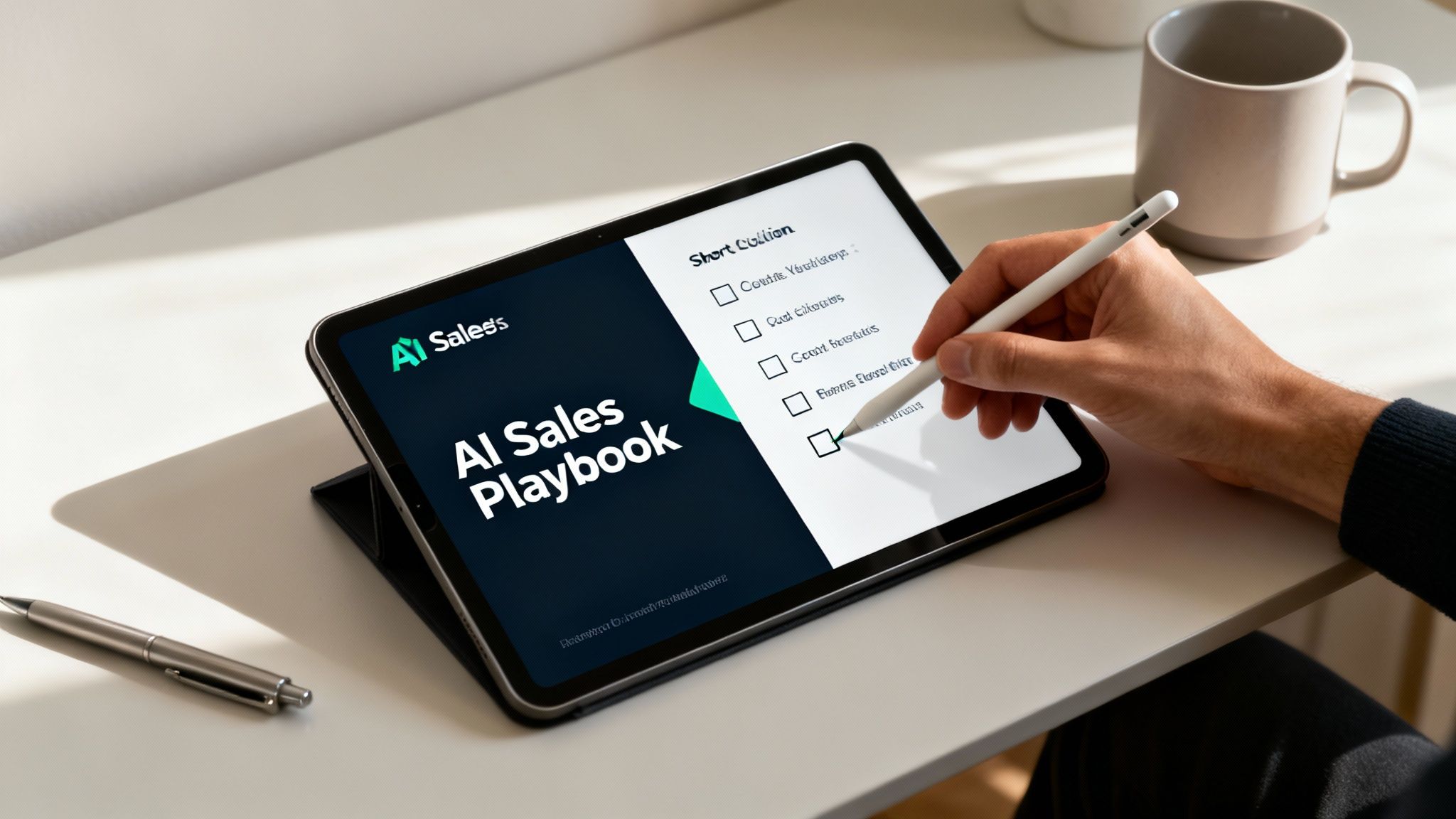
Follow these phases to build an AI sales machine that is perfectly tuned to your business needs, helping you avoid common pitfalls and achieve a faster return on investment.
Phase 1: Define Goals and Design the Conversation Flow
Before touching any technology, you must be crystal clear on what you want the AI to achieve. A well-defined objective is the foundation of successful automation.
Start by defining your primary business goal. Are you trying to:
- Capture 100% of after-hours calls to stop lead leakage?
- Automate lead qualification so your team only engages with high-intent prospects?
- Streamline appointment booking to fill your sales team's or practitioners' calendars?
With a clear goal, you can design the conversational flow—the script and logic the AI will follow. For the MENA market, this must be bilingual from the outset. You will need parallel flows for English and Arabic to ensure a seamless experience for every caller.
For example, a clinic's flow might start with, "Thank you for calling [Clinic Name]. To direct your call, are you a new or an existing patient?" This single question instantly segments callers and guides them down the appropriate conversational path.
Phase 2: Integrate the AI with Your Core Systems
An AI voice agent's effectiveness multiplies when it is connected to your existing business tools. The two most critical integrations are your CRM and your telephony system.
1. CRM Integration: Connect the AI directly to your CRM, whether it's HubSpot, Salesforce, or a specialized clinic management software. This allows the agent to automatically create new contacts, log call transcripts, and update lead statuses in real-time, eliminating manual data entry.
2. Telephony Integration: The AI needs to be connected to your business phone number. This is typically done using SIP trunking, which routes incoming calls from your telecom provider to the AI platform. The setup is generally straightforward and allows the AI to answer your main business line seamlessly.
Proper integration is what turns a simple phone call into a complete, trackable sales event, transforming conversations into clean, actionable data.
Phase 3: Train the AI and Go Live
The final step is to "train" the AI on the specifics of your business. This doesn't involve coding; it's about providing the AI with a knowledge base.
This training data should include:
- Business Information: Hours of operation, location(s), and a list of services or products offered.
- Frequently Asked Questions (FAQs): The answers to common questions your team handles daily.
- Qualification Criteria: The specific questions the AI must ask to determine if a caller is a qualified lead. Our guide on lead scoring and auto-routing in your CRM explains how to define these rules effectively.
After training, conduct thorough testing. Call your number multiple times to interact with the AI, checking for accuracy, flow, and tone. Once you are satisfied with its performance, you can go live and let it begin handling your inbound calls.
How to Choose the Right AI Voice Agent Partner
Selecting a provider for your AI voice agents for inbound sales calls is a critical decision that extends beyond features and price. The right partner provides technology that understands your specific sales process and customer base. The wrong one leads to frustrated callers and a failed implementation.
Especially in the MENA region, nuances like dialect and cultural context are paramount. A successful partnership hinges on finding a vendor whose technology can deliver a seamless, professional experience with every call.
Core Evaluation Criteria for Clinics & Sales Teams
To make an informed decision, evaluate potential partners against these five non-negotiable criteria.
- Accuracy with Regional Dialects: The AI must flawlessly understand diverse Arabic dialects (e.g., Khaleeji, Levantine, Egyptian) and handle code-switching. A system trained only on Modern Standard Arabic will fail in real-world conversations.
- Seamless CRM & Omnichannel Integration: The agent must integrate natively with your CRM and be able to trigger follow-ups on other channels like WhatsApp and SMS. The goal is a unified customer journey, not isolated interactions.
- Customization and Flexibility: Your sales process is unique. The platform must allow you to easily customize conversational flows, qualification questions, and escalation rules without requiring a developer.
- Security and Compliance: As you are handling sensitive customer data, the vendor must adhere to regional data protection laws and demonstrate robust security protocols.
- Scalability and Reliability: The platform must be able to handle your peak call volume without latency or dropped calls and scale with your business as it grows.
This structured evaluation ensures you choose a partner who understands the regional market. For context on how these tools fit into a broader strategy, it's useful to review the landscape of modern cloud-based contact centre solutions.
Vendor Selection Checklist
Use this checklist to compare providers and focus on what truly matters for a business operating in the MENA region.
Choosing the right partner is crucial. The global Voice AI market is projected to grow at a 37.2% CAGR from 2024-2029, with adoption in the MENA region accelerating even faster. This enables local contact centers to handle complex queries in regional dialects, which can reduce call handling times by 35% and improve first-call resolution to 78%. If you need expert guidance, our guide on working with an AI automation agency provides practical advice.
Frequently Asked Questions
Business owners evaluating AI voice agents often have the same critical questions. Let's address these common concerns directly.
Will my callers know they're talking to an AI?
This is the most common concern. Modern AI voice agents for inbound sales calls use advanced text-to-speech (TTS) and NLU models that sound remarkably human. They understand conversational nuances, handle interruptions, and maintain a natural pace and tone. The objective isn't to deceive callers, but to provide an experience so efficient and smooth that the caller is focused on their goal—like booking an appointment—not on who they are talking to.
How difficult is the setup process? Do I need an in-house tech team?
No. Most leading platforms are designed for business users, not developers. They often feature intuitive, drag-and-drop interfaces for designing conversation flows. The typical setup process involves:
- Defining the Goal: Clarifying the primary objective (e.g., booking appointments, qualifying leads).
- Designing the Conversation: Mapping out the ideal conversational path.
- Integrating Systems: Connecting the agent to your CRM and phone number.
- Training and Testing: Providing the AI with business-specific information and running test calls.For most small to medium-sized businesses, a fully functional system can be deployed in a matter of days.
What is the typical pricing model?
Pricing structures vary. The most common models are:
- Monthly Subscription: A flat fee based on call volume tiers or the number of features you require. This is predictable and good for businesses with consistent call traffic.
- Pay-as-you-go: Billing is based on the number of minutes the AI is actively on a call. This can be more cost-effective for businesses with fluctuating call volumes.Analyze your average monthly call volume to determine which model offers the best value for your specific needs.
What happens if the AI can't answer a question?
No AI is infallible. A well-designed system includes a clear escalation path. When the AI encounters a question it cannot answer or detects frustration in the caller's tone, it is programmed to seamlessly transfer the call to a live human agent. Crucially, it passes the full context of the conversation, so your team member can pick up exactly where the AI left off without forcing the caller to repeat themselves.
Ready to stop losing leads to missed calls? SMOrchestra builds AI sales machines that turn every inbound inquiry into a booked appointment. Our AI agents work 24/7 across phone, WhatsApp, Instagram, and SMS to capture, qualify, and convert every lead, guaranteed.
Book a discovery call today to see how we can automate your growth.

Read Our latest
Lorem ipsum dolor sit amet, consectetur adipiscing elit.