So, what exactly is an AI automation agency? It’s not your typical consultant that just gives advice. Think of them more like an architect for your company's growth engine. They design and build interconnected systems that put your most important business functions—from sales and marketing to customer support—on autopilot. The goal is to turn random activities into predictable, scalable results.
What an AI Automation Agency Actually Builds
An AI automation agency builds custom ‘machines’ for your business. We're not talking about isolated tools like a simple chatbot that answers one or two questions. We’re talking about end-to-end systems designed to solve specific revenue and efficiency problems, especially within the unique context of the MENA market.
A real automation partner doesn't just install software; they architect systems that deliver tangible outcomes. For a business in the UAE or Saudi Arabia, this means creating processes that truly understand how local customers think and act.
Architecting for Local Realities
The real challenge isn't just plugging in a new piece of technology. It’s making that technology work in a region where WhatsApp is king and Arabic dialects can change from one city to the next. A good agency builds systems that can:
- Capture and Nurture Leads: Imagine automatically engaging with prospects the second they click on your social media ad. These systems can nurture them through smart WhatsApp and email sequences—in both Arabic and English—and book qualified meetings straight into your sales team’s calendars. No more leads slipping through the cracks.
- Automate Customer Support: You can deploy intelligent bots that understand local Arabic dialects and handle the most common customer questions instantly. This can slash manual support tasks by over 60%, freeing up your team to handle the more complex issues that require a human touch.
- Unify Business Operations: Instead of marketing, sales, and support operating in silos, an agency can build a central engine for your revenue operations. This connects your marketing spend directly to sales results and customer feedback, giving you a clear picture of what's working.
To get a better sense of the moving parts, it's helpful to understand the fundamentals of how AI is used in marketing. That context helps show how an agency takes those principles and builds them into a cohesive, powerful system for your business.
From Manual Tasks to Automated Systems
Here is how an AI automation agency transforms key business functions from traditional, labor-intensive processes into streamlined, efficient systems.
This shift from manual effort to automated precision is where the real value lies. The focus moves from doing the work to designing the system that does the work for you.
At the end of the day, the technology itself isn't the prize. The real win is the predictable, consistent results it delivers. You can see how these automated systems come to life by exploring a range of digital services for MENA businesses designed for this purpose.
The Core Services That Drive Real Business Results
A good AI automation agency doesn’t just patch holes with isolated bits of tech. They build a complete, integrated system that covers the entire customer journey, from the first "hello" to a long-term loyal relationship. Think of it as creating a well-oiled machine for predictable growth.
The whole approach is built on three core pillars that work together. Marketing finds the right people, sales turns them into customers, and customer experience keeps them happy. When these are connected, your business gets a self-sustaining engine that just works.
This simple flow chart breaks down how an agency turns initial interest into actual revenue.
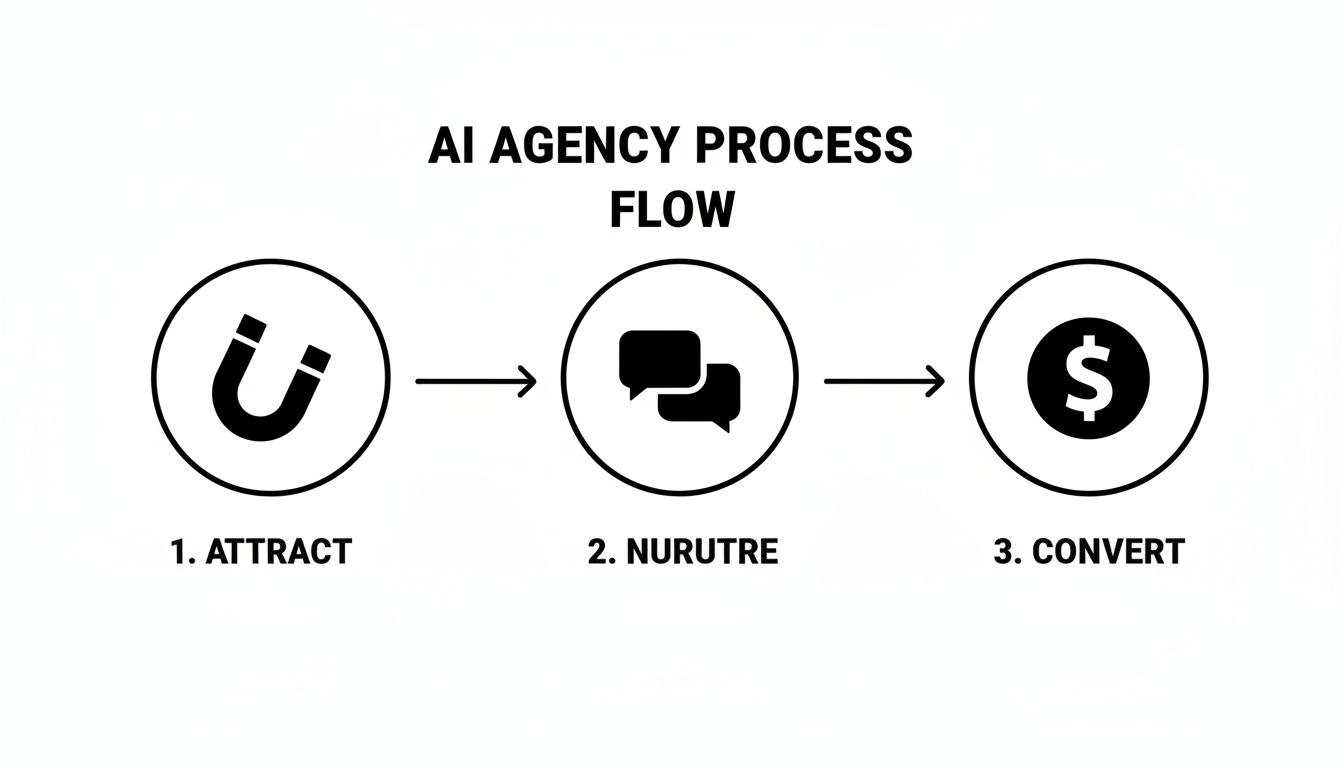
It’s a clear path: attract prospects, nurture them with smart, automated conversations, and then convert that relationship into a sale.
Sales Automation
The first pillar is Sales Automation. Its whole purpose is to make sure you never, ever miss a lead. It involves setting up systems that follow up with new leads instantly, keep your CRM updated with every touchpoint, and book qualified meetings straight into your sales team’s calendars.
For businesses in the UAE and Saudi Arabia, this is huge. It means you can engage a new lead on WhatsApp the very second they inquire. By automating these critical first moments, we’ve seen clients achieve a 30-50% lift in lead-to-sale conversion rates. They're not doing anything magical—they're just faster and more consistent than their competitors. You can get a closer look at how automated systems for lead generation are built for this.
Marketing Automation
Next up is Marketing Automation. If sales automation is about the immediate follow-up, marketing automation is about playing the long game. This involves building personalized journeys across email, SMS, and WhatsApp that gently guide prospects toward making a purchase.
This isn’t about blasting your list with generic offers. It's about being helpful. For example, if someone downloads a brochure for a specific service, the system can automatically send a few follow-up messages with relevant case studies or answers to common questions. It’s all about building trust and showing you know your stuff.
Customer Experience (CX) Automation
Finally, we have Customer Experience (CX) Automation, which closes the loop. This pillar is all about delivering instant, 24/7 support using AI-powered chatbots and automated workflows. These bots can handle the bulk of common questions, like "Where's my order?" or "How do I change my appointment?"
A huge differentiator in the MENA region is having deep expertise in Arabic language processing. A truly effective AI chatbot has to understand different dialects and the common use of Arabizi. This is a major stumbling block where generic, off-the-shelf bots almost always fall short.
By automating up to 60% of these routine questions, you free up your human agents to handle the complex, sensitive issues where they’re needed most. This doesn't just cut down on operational costs; it dramatically boosts customer happiness by giving people instant answers on their favorite channels. We're talking 10x faster response times on a critical platform like WhatsApp.
An AI automation agency’s real value is in weaving these three pillars together into one seamless machine that runs your business.
Why the MENA Region Is a Prime Ground for AI Automation
The Middle East, and the GCC in particular, isn't just adopting new technology; it's experiencing a massive digital overhaul. This isn't a passing trend. It's a deliberate, top-down push driven by ambitious government goals and serious investment. This unique environment gives businesses, from local health clinics to B2B giants, a chance to skip over clunky, outdated systems and build hyper-efficient modern operations from day one.
This forward momentum has opened up a unique window of opportunity. For any business trying to ride this wave, partnering with an AI automation agency that gets the local dynamics is non-negotiable. They can build systems designed specifically for regional customer habits and language needs, turning high-level national AI strategies into real-world business results.

A Confluence of Growth Factors
So, what's fueling this fire? Several key factors are converging to accelerate the demand for smart automation across the MENA region.
First, you have major government-led initiatives like Saudi Vision 2030 and the UAE's National Strategy for Artificial Intelligence. These aren't just paper policies; they are actively pushing both public and private organizations to innovate and adopt new tech. This creates an incredibly supportive environment where technology can thrive.
Second, the population here is young, digitally fluent, and lives on their phones. In markets like the UAE and Saudi Arabia, smartphone penetration is among the highest globally. Customers don't just prefer to connect with businesses on their favorite channels—they expect it. And that channel is, overwhelmingly, WhatsApp. For any business, automating conversations on this platform is no longer a "nice-to-have." It's fundamental to survival.
The GCC’s AI market is projected to skyrocket from roughly $3.4 billion to $15.5 billion by 2030. That’s a staggering compound annual growth rate (CAGR) of 28.6%. This explosion highlights just how urgent it is for businesses to get smart automation in place to claim their piece of the pie. You can find more insights on the rise of AI in the Middle East on digitalbricks.ai.
Overcoming Local Challenges with Automation
Beyond the incredible growth opportunities, automation also offers a practical solution to some distinctly regional hurdles. The linguistic diversity is a big one. Think about the subtle differences between Arabic dialects and the widespread use of Arabizi (Arabic typed out using Latin characters). Generic, Western-built AI tools simply can't handle this complexity. A specialized agency, however, can implement systems trained on local language data, ensuring communication is always smooth and natural.
Many businesses in the region also still lean heavily on manual, relationship-first processes. While that personal connection is a huge asset, it's incredibly hard to scale. An AI automation agency can help digitize and automate these workflows without sacrificing the personal touch that defines the local business culture. It’s all about helping companies grow efficiently while keeping their customer relationships strong.
This is the kind of strategic thinking that separates a simple service provider from a true growth partner. Getting these dynamics right is a core theme in our guide on what to look for when hiring a digital marketing agency in today's market. The right partner knows how to turn regional complexities into your biggest competitive advantages.
Measuring the Real-World Impact of Your AI Investment
Putting money into AI automation isn't about buying the latest shiny tech; it's about hitting specific, concrete business goals. A successful partnership with an AI agency comes down to one thing: moving past fuzzy metrics like clicks and impressions and focusing on the numbers that actually grow your revenue.
A good agency will work with you to define these Key Performance Indicators (KPIs) before a single line of code is written. They’ll set clear benchmarks and deliver transparent, regular reports that show you exactly what you’re getting for your money. Honestly, it's the only way to know if your automation engine is truly driving growth.
Key Metrics for Sales Automation
When it comes to sales, success is all about the quality and quantity of opportunities your system creates. The aim is to build a predictable pipeline that feeds your sales team genuinely good appointments, letting them ditch the cold prospecting and do what they do best—close deals.
- Number of Qualified Appointments Booked: This is the North Star metric. It’s a simple count of how many meetings with real decision-makers the automated system sets up for your team each week or month.
- Lead-to-Sale Conversion Rate: This number tells you how efficient your entire sales process is. If this rate starts climbing, you know the system isn't just booking more meetings, it's booking the right meetings.
Key Metrics for Marketing Automation
Marketing automation needs to do more than just get likes and shares—it has to generate real, measurable revenue. This means tracking how efficiently every dollar you spend turns into a paying customer who stays with you.
- Cost Per Acquisition (CPA): This is the bottom line for your campaigns. It tells you exactly how much it costs to win a new customer. A great agency partner will be obsessed with pushing this number down over time.
- Customer Lifetime Value (CLV): Smart automation builds relationships, turning one-time buyers into loyal, repeat customers. A rising CLV is a powerful signal that your marketing is creating long-term value, not just short-term sales.
For a closer look at how these metrics fit into a bigger picture, our guide on what to look for in a performance marketing company has some great insights.
Key Metrics for Customer Experience Automation
In customer support, automation has two jobs: boost efficiency and make customers happier. The system should handle the simple, repetitive questions perfectly, freeing up your human team for the complex, high-touch conversations where they really shine.
- Percentage of Inquiries Automated: You should be aiming high here. A well-built system can often resolve over 60% of common customer questions without needing a human at all.
- Average Response Time: Customers hate waiting. Automation should provide answers almost instantly, especially on channels like WhatsApp and web chat where expectations are high.
- Customer Satisfaction (CSAT) Scores: This classic metric is as important as ever. Good AI should actually make your CSAT scores go up, proving that automation is helping your customer experience, not hurting it.
The data backs this up, especially right here in the region. A major IBM study of 500 UAE executives revealed that a massive 77% saw significant productivity gains from AI—blowing past the EMEA average of 66%. The biggest wins were in software development (34%), advertising and marketing (33%), and customer service (28%). You can explore the full findings on the Race for ROI study from IBM. It’s clear proof that a focused, data-driven approach is what separates the talkers from the doers.
How to Choose the Right AI Automation Partner
Picking the right AI automation agency is probably the most important call you’ll make in this entire process. The market is absolutely flooded with generalist agencies just reselling software built for Western markets. If you choose wrong, you’re not just looking at wasted time and a torched budget—you’re looking at a dead-end project that soured everyone on the whole idea of automation.
The trick is to sidestep anyone selling a generic, one-size-fits-all package. What you need is a specialist, someone with a thick portfolio of real-world work in your industry and, crucially, your region. This is where the real evaluation starts.
Asking the Right Questions
Don't let a slick sales pitch full of vague promises about "transformation" fool you. Your job is to dig for concrete proof and see if their strategy actually lines up with your business goals.
Here’s how to cut through the noise:
- Regional Expertise: Start with this knockout question: "What’s your specific experience with Arabic language automation, including dialects and the use of Arabizi?" This one question will filter out a surprising number of contenders right away.
- Proven Results: Follow up with, "Can you show me case studies from companies like mine here in the UAE or Saudi Arabia? I want to see measurable business outcomes." If they can't produce hard numbers—not just fluffy metrics—that’s a major red flag.
- Technology Stack: Ask them, "What tech are you actually using?" Are they just another reseller pushing a global platform, or do they have tools built for this market? For instance, are they recommending a generic CRM or something like SalesMfast AI, which is a localized CRM alternative built for SMEs, B2B, clinics, and eCommerce? The answer tells you if they truly get the nuances of doing business here, as it includes Arabic templates and pre-built automation workflows with systems baked in—no configuration needed.
Evaluating Their Operational Model
Here’s something that really separates the pros from the amateurs: what happens after the system goes live? A lot of agencies will build you something, hand over the login details, and then vanish. That’s a guaranteed recipe for failure. Automation isn’t a one-and-done setup; it needs constant tweaking and optimization to deliver results.
You’re looking for a partner, not just a builder. The best agencies will actually run the systems they build for you until the performance is proven. This "we run it until it works" model means their success is tied directly to yours, which completely de-risks the investment on your end.
A truly sophisticated agency has a model for creating repeatable, scalable systems. It shows they're focused on efficiency and a long-term relationship, not just banging out one-off projects.
Take a look at this screenshot. It shows a model designed for exactly that—turning custom work into reusable, efficient assets.
This visual shows the shift from slow, bespoke projects to a systemized approach. By using SMOrchestra's BOT Model, an agency can turn custom client work into repeatable systems. The model, which stands for Build Once, Template, can cut delivery time by an incredible 60-80% by allowing the agency to build a solution once and deploy it infinitely for similar clients. Those are massive efficiency gains that should translate into better value for you.
To help you systematically vet potential partners, use this checklist. It’s designed to help you look past the sales pitch and focus on what truly matters for a successful partnership in the MENA region.
Agency Evaluation Checklist
Think of this checklist as your guide. A great partner will have solid, confident answers for every point in the "What to Look For" column. If you’re hearing a lot of responses that fall into the "Red Flags" column, it’s best to walk away.
Ultimately, the right AI automation agency becomes an extension of your own team. They’re not just tech vendors; they’re specialists who understand the unique pulse of your market and are committed to hitting real financial targets. Their model should be built on performance and partnership, ensuring the systems they create become permanent assets for your business. Anything less is just a project with an expiration date.
Real-World AI Automation Examples from the MENA Region
Theory is great, but results are what matter. A top-tier AI automation agency doesn't just talk about concepts; they build tangible systems that tackle the specific, real-world business headaches you face in the MENA market. These aren't off-the-shelf bots, but custom-built engines designed for local challenges.
Let's look at a few scenarios where a smart automation system becomes the engine for serious growth and efficiency.
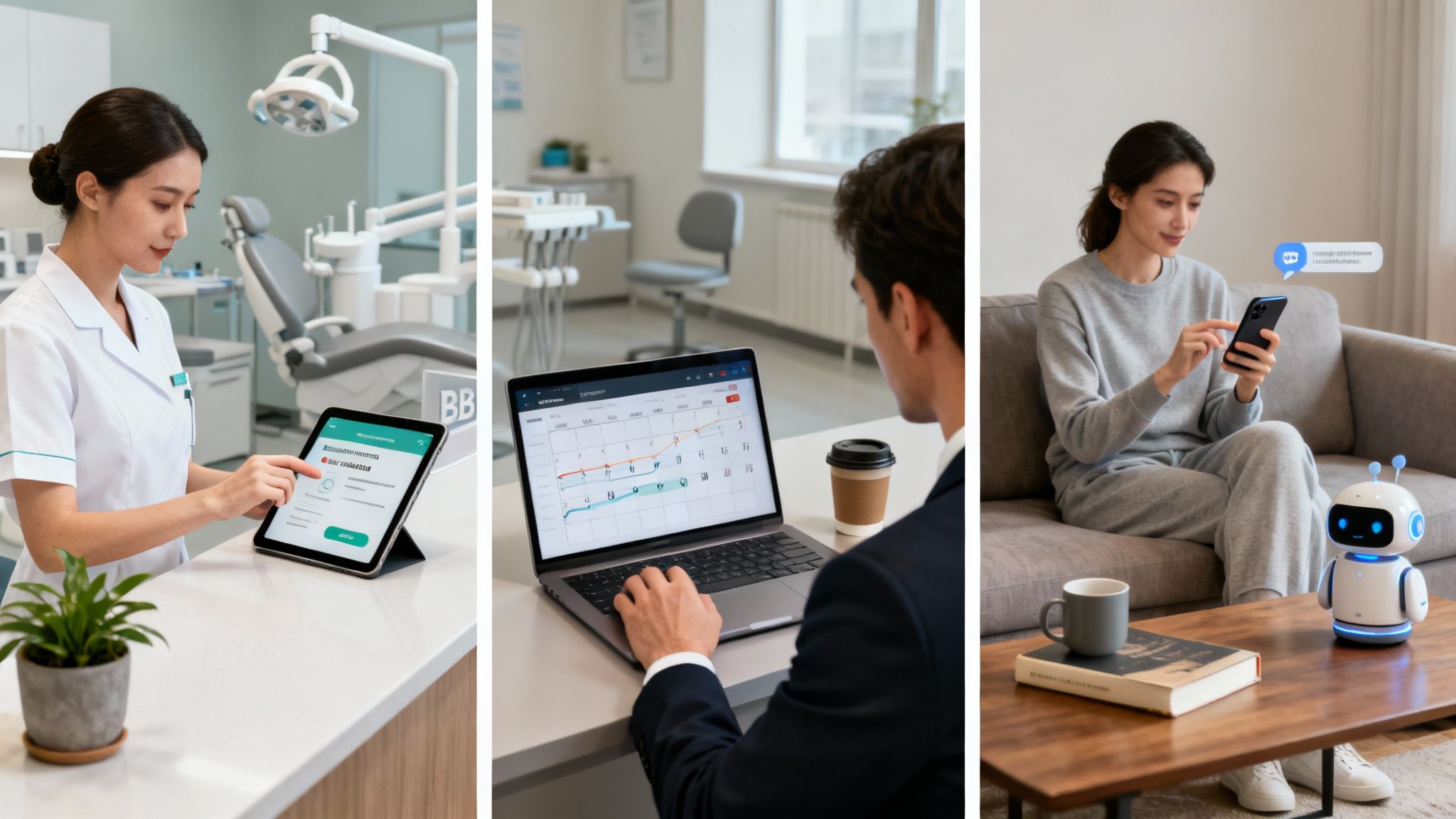
Healthcare: Keeping Appointments Full
Imagine a dental clinic in Dubai. They can build a complete patient acquisition machine. It starts the moment a lead comes in from a social media ad, instantly engaging them on WhatsApp in fluent, natural-sounding Arabic. From there, the system manages everything—booking the appointment, sending reminders, and confirming attendance—all without a single person lifting a finger. The result is a seamless experience for the patient and a consistently packed calendar for the clinic.
B2B Sales: Generating Qualified Meetings on Autopilot
For a B2B tech company in Saudi Arabia, the grind of finding qualified meetings is constant. An outbound prospecting machine can be designed to pinpoint ideal customer profiles on platforms like LinkedIn, start personalized outreach campaigns, and book confirmed meetings right into a sales rep's calendar. This turns a slow, manual chore into a reliable pipeline of high-value leads.
E-commerce: Providing 24/7 Service That Sells
An e-commerce brand based in the UAE can set up a 24/7 chatbot that masterfully handles both English and Arabic. This bot can do more than just answer FAQs; it can run abandoned cart recovery sequences, answer detailed product questions with incredible accuracy, and know exactly when to hand a complex issue over to a human agent. This means more sales and happier customers, without having to hire more support staff.
Real Estate: Winning the Race for Leads
Dubai's real estate market moves at lightning speed, and instant follow-up is non-negotiable. With automation, every single lead from property portals can be contacted within seconds on WhatsApp. The system can qualify their interest, answer basic questions, and even schedule a viewing automatically. In such a competitive field, that speed is often the difference between closing a deal and losing out.
For a closer look, check out our guide on how a real estate CRM can transform lead management.
The key takeaway from these examples is simple: real automation isn't about plugging in a single tool. The true power is in creating an integrated system where different parts of your business—marketing, sales, and service—work together in one seamless, automated flow that delivers predictable results.
This systematic approach is critical, especially in industries on the brink of major change. The MEA AI in industrial automation market, for instance, is projected to explode from $1.3 billion to over $7.0 billion by 2033, reflecting a massive 20.6% CAGR. This shows just how big the opportunity is for businesses that adopt smart automation now.
To see how this translates across different industries, you can explore more practical AI automation use cases from around the web. These examples all prove the same thing: the right AI automation partner delivers a serious competitive edge.
Got Questions About AI Automation Agencies? We’ve Got Answers.
Thinking about bringing in an AI automation partner? It’s a big step, and you probably have a few questions. Let's break down some of the most common ones we hear from businesses just like yours.
So, What's the Investment Look Like?
The cost of working with an AI automation agency really depends on what you need to accomplish. Most projects start with a one-time setup fee, which covers the initial design, strategy, and build of your core automation systems. After that, there's a monthly retainer for keeping everything running smoothly, making improvements, and optimizing performance.
Think of it this way: this model gives you access to an entire team of specialists—strategists, developers, data analysts—for a fraction of what it would cost to hire even one or two of them full-time. You skip the hefty salaries, benefits, and overhead and get straight to the expertise.
How Quickly Can We Expect to See a Payoff?
You'll see some changes almost immediately. Things like customer response times will improve the moment the new systems are switched on, and you can measure that impact within the first few weeks.
But the real, game-changing results—like a solid jump in lead conversion rates or a meaningful drop in your cost per acquisition—typically take about 2-3 months to fully materialize. This period is crucial. It’s when we gather live data, fine-tune the automated conversations, and dial everything in to get you the best possible outcomes. A little patience here pays off big time in the long run.
Do I Need to Be a Tech Whiz to Make This Work?
Not at all. In fact, that's the whole point. A great AI automation agency acts as your strategic arm, handling all the technical heavy lifting so you can stay focused on running your business. Our job is to translate your business objectives into a powerful, automated system that just works.
A good partner will always speak your language. The conversation should be about business goals—more revenue, lower costs, happier customers—not about code or APIs. We manage the tech; you get the results.
Ready to see how a systemized, AI-driven approach can deliver predictable growth for your business in the MENA region? SMOrchestra designs, builds, and operates the automation engines that fast-growing companies rely on. Explore our solutions and book a strategy call today.

Read Our latest
Lorem ipsum dolor sit amet, consectetur adipiscing elit.