Stop thinking of a real estate customer relationship management (CRM) system as a digital address book. That's a low-value mindset that gets you nowhere. In the hyper-competitive property markets of Dubai and Riyadh, a CRM is a high-performance sales engine. It’s the central nervous system that captures every lead from portals like Bayut and Property Finder, automates the critical first touchpoints, and gives your agents the tools to convert interest into closed deals.
Anything less is just a glorified spreadsheet. In a market where speed is everything, a purpose-built CRM is what separates the agencies scaling their commissions from those burning through expensive leads.
Why a Generic CRM Fails in the MENA Real Estate Market
Picture the typical agent's workflow: hundreds of conversations happening simultaneously. Leads are flooding in from property portals, WhatsApp messages are pinging nonstop, and social media inquiries are piling up. Trying to manage this chaotic influx with a generic CRM or, worse, a spreadsheet, is a recipe for failure. This is where most agencies bleed money—missed follow-ups, lost leads, and high-value clients who feel ignored because an agent was too busy with manual data entry.
A true real estate customer relationship management system is engineered to solve this exact chaos.
It becomes your agency's single source of truth. Every phone call, WhatsApp chat, email, and property viewing is automatically logged against a client's profile. This gives every agent and manager an instant 360-degree view of the entire client relationship, eliminating the "my phone, my leads" problem for good.

It's a Sales Engine, Not a Digital Rolodex
The biggest mistake agencies make is treating their CRM as a passive database. This mindset ignores its core function. A modern real estate CRM isn't for storage; it's for action. Its job is to automate the repetitive, low-value tasks and deliver actionable insights that empower agents to close more deals, faster.
- Automated Lead Injection: Leads from Dubizzle, your social media ads, and your website flow directly into the CRM, assigned to the right agent based on pre-set rules—all within seconds. Manual entry becomes obsolete.
- Instant, Intelligent Engagement: Set up automated, bilingual (Arabic/English) WhatsApp and email sequences to engage new leads the moment they inquire. This guarantees no lead is left waiting, even on a Friday afternoon.
- Radical Pipeline Clarity: Get a clear, visual overview of every deal as it moves from inquiry to viewing, offer, and transfer. Spot bottlenecks in your sales process before they cost you commissions.
- Data-Driven Performance Management: Track mission-critical agent metrics: lead response times, viewing-to-offer ratios, and commissions. Drive performance with transparent, undeniable data.
The Critical MENA Context
The real estate market in the UAE and Saudi Arabia has unique dynamics. Agents juggle a high volume of leads from a dozen different portals. The client base is diverse, communicating in Arabic, English, and often "Arabizi". And critically, WhatsApp is the undisputed king of communication. Generic, Western-built CRMs simply cannot cope with this reality. They weren't built for it.
A purpose-built real estate CRM for the MENA region isn't a luxury; it's a non-negotiable tool for survival and growth. It understands the local workflows, communication channels (especially WhatsApp), and multilingual needs that define this market, turning operational chaos into a predictable sales machine.
Without a system designed for this environment, agencies waste fortunes on leads and squander their agents' time on administrative tasks. The right CRM provides the structure to master this complexity. It ensures every single lead generated by your digital marketing agency is actioned with speed and precision, orchestrating the entire journey from initial click to closed deal. This frees your team to focus on their highest-value activity: building relationships and selling property.
The Non-Negotiable Features of a MENA Real Estate CRM
Don't get distracted by shiny objects. Choosing a CRM based on a generic feature checklist is a surefire way to waste money on a platform that actively slows your agents down. Many platforms will sell you on features that sound impressive but are useless in the fast-paced, WhatsApp-driven property markets of Dubai, Riyadh, or Jeddah.
To get a real return on investment, you need a system built around the day-to-day reality of a MENA-based agent. Let's cut through the noise and define what's truly essential.
Automated Lead Capture from Key Property Portals
If your agents are still manually copying and pasting lead details from Dubizzle, Bayut, or Property Finder, you are losing deals. It's not just a time-sink; it's the primary source of data entry errors and fatal delays in follow-up.
Direct, automatic integration with these portals is non-negotiable.
When a potential buyer sends an enquiry, the CRM must instantly and automatically:
- Create a new contact and a new deal in the sales pipeline.
- Parse all relevant data—name, phone number, the specific property of interest.
- Assign the lead to the correct agent or team based on your business rules.
This automation transforms your lead response time from minutes or hours into seconds. In this market, that speed is your single greatest competitive advantage. It's the foundation for a reliable system for generating high-quality real estate leads because it guarantees no opportunity is lost in a cluttered inbox.
Native WhatsApp Business Integration
In the MENA region, WhatsApp is the operating system for business. It's not just a messaging app; it's the default channel for client communication. Any CRM that treats WhatsApp as a third-party add-on or forces agents to log chats manually is fundamentally broken for this market.
Contrarian take: If your CRM vendor talks about a "WhatsApp integration" but it requires Zapier or a Chrome extension, they don't understand your business. True, native integration means agents can send and receive messages directly from the CRM contact record, with every conversation—sent and received—logged automatically.
This creates a complete, time-stamped communication history that anyone on the team can access. It solves the "my phone, my leads" data silo problem and unlocks powerful automation, like sending an instant, bilingual welcome message the moment a new lead from Property Finder hits your system. This is the difference between a tool that creates more admin and one that eliminates it.
A Visual Sales Pipeline Built for Real Estate
Property transactions follow a distinct lifecycle: new lead, qualification, viewing, offer, negotiation, and closing. A generic, one-size-fits-all sales pipeline creates friction and confusion.
You need a visual, drag-and-drop pipeline that is explicitly designed for both property sales and leasing cycles.
This gives managers a real-time, bird's-eye view of the agency's health, making it easy to spot deals that are stalling and to forecast commissions with accuracy. For agents, it provides a clear roadmap of what to do next for every single deal. The market is waking up to this—CRM adoption among Saudi real estate firms is projected to hit 65% by 2025, a huge leap from just 40% in 2023, as agencies race to centralize their client data.
A powerful CRM becomes even more potent when combined with other modern tools. Explore the top AI tools for real estate agents to see how you can further amplify team performance.
Get these three pillars right—portal integration, native WhatsApp, and a visual pipeline—and you have a system that doesn't just store data; it actively drives revenue.
Essential vs. Optional CRM Features for MENA Real Estate
Not all features deliver equal value, especially in our market. Knowing what's mission-critical versus a "nice-to-have" saves you from overpaying for a bloated system your team will never fully use.
Focus on these essentials. They solve the most urgent and costly problems your agency faces daily.
Automating Your Sales with Smart CRM Workflows
A feature-packed real estate CRM is useless until you put it to work. Smart automation is what transforms your CRM from a passive database into an active, 24/7 sales assistant. It's about building repeatable, efficient processes that eliminate manual work, freeing your agents to focus on high-value activities: building rapport, conducting viewings, and closing deals.
But generic automation templates won't work. For the MENA property market, your workflows must be engineered for speed and multilingual communication. Let's break down three high-impact automation frameworks you can implement immediately.
This flow illustrates how automation is the critical engine connecting lead capture to conversion.
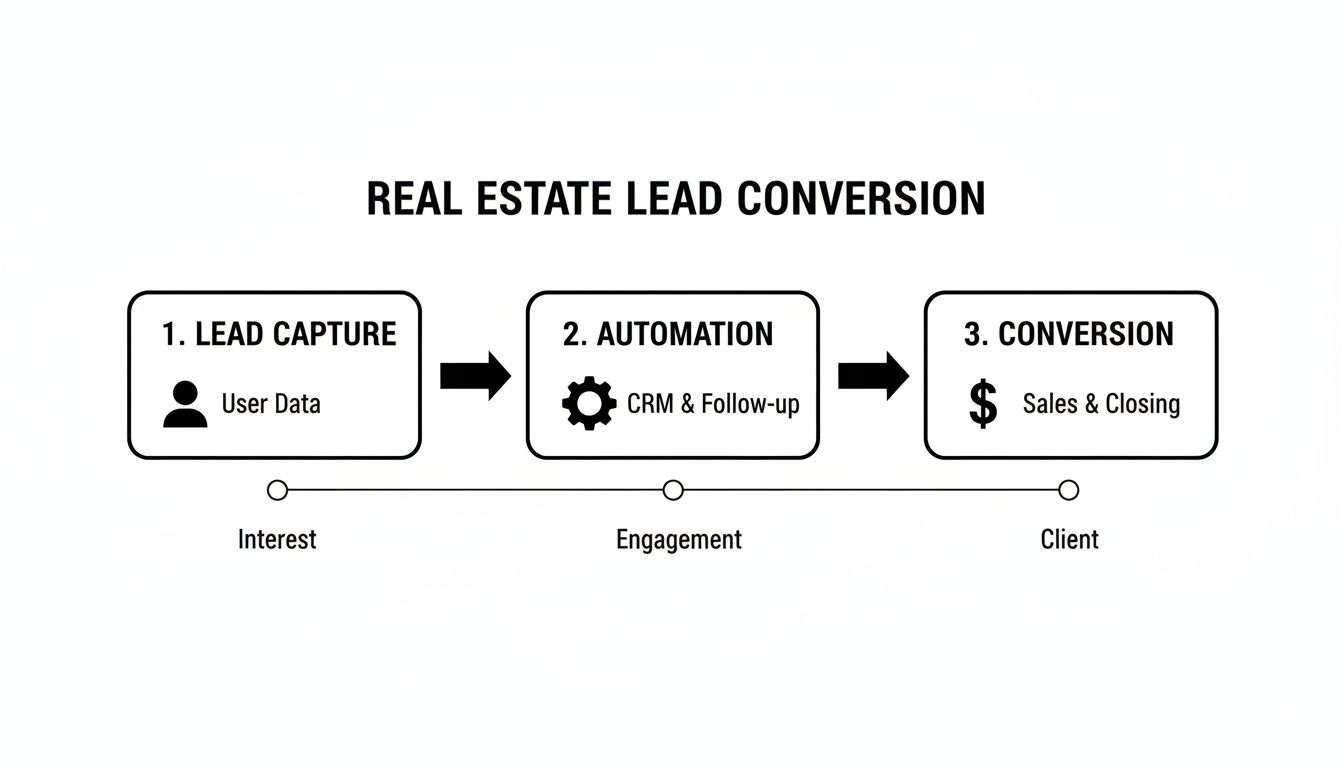
As you can see, automation isn't just a feature; it's the engine that propels a raw lead toward a closed deal, ensuring no opportunity is ever lost to inaction.
The Instant Lead Response Workflow
In markets like Dubai and Riyadh, the first agent to make meaningful contact wins the viewing. If a lead waits even 30 minutes for a reply, you've likely already lost them. This workflow ensures you are always first.
- Trigger: A new lead is captured from Property Finder, Dubizzle, or your website.
- Step 1 (0 seconds): The CRM instantly creates a new contact and deal, auto-assigning it to the correct agent based on property type or community.
- Step 2 (5 seconds): A personalized, bilingual (Arabic/English) WhatsApp message is sent to the lead. It confirms their specific property inquiry and states that an agent will call them shortly.
- Step 3 (10 seconds): The assigned agent receives a push notification on their phone with the lead's details and a one-tap link to their profile in the CRM.
This entire sequence executes before your competitors have even seen the lead email. It provides immediate confirmation to the prospect that their inquiry is being handled, setting a professional tone from the first second. This speed is a powerful competitive weapon that directly increases your lead-to-viewing conversion rate.
The Long-Term Nurture Sequence
Not every lead is ready to transact today. Many are investors conducting preliminary research or future tenants exploring options months in advance. Letting these contacts go cold is like throwing away future commission checks.
This workflow keeps your agency top-of-mind without any manual effort.
- Trigger: An agent tags a lead with a status like "Long-Term Nurture" or "6-Month Horizon."
- Step 1 (Day 1): The lead receives a thank-you message and is automatically added to a long-term nurture list.
- Step 2 (Day 30): The system sends a relevant market update, like a report on rental yield trends in their area of interest.
- Step 3 (Day 90): An automated email shares a helpful guide, such as "A Foreign Investor's Guide to Dubai Real Estate."
- Step 4 (Day 180): A personalized check-in is sent via WhatsApp: "Hi [First Name], it's been a while. Are you still considering a property in the Marina area?"
This patient, value-add follow-up ensures that when these leads are finally ready to act, your agency is the one they trust. It's a low-effort, high-reward strategy for building a robust future pipeline.
The Post-Viewing Follow-Up
The work isn't done after the viewing. The follow-up is where deals are made or lost—gathering feedback, overcoming objections, and guiding the client towards an offer. Automating this ensures consistency and prevents missteps.
- Trigger: An agent moves the deal stage in the CRM to "Viewing Completed."
- Step 1 (2 hours later): An automated, friendly WhatsApp message asks the client for their initial thoughts on the property.
- Step 2 (24 hours later): If the agent hasn't already, the CRM creates a high-priority task reminding them to call the client for detailed feedback.
- Step 3 (48 hours later): If feedback was positive, an automated email can showcase similar available properties. If negative, the client can be placed back on an "Active Search" list for new listings.
These workflows are the operational backbone of a high-performing real estate agency. They turn a passive CRM into an intelligent system that actively drives your business forward. This all begins with effective lead capture, which relies on well-designed websites and sales funnels that feed your system with high-quality inquiries.
Measuring Your CRM Performance and ROI
Implementing a real estate customer relationship management system without a clear framework for measuring its success is like buying a performance car but never looking at the speedometer. It might feel faster, but you have no objective data to prove it.
The purpose of a CRM is not to organize contacts; it's to help your agency make more money. To know if it's working, you must track the right metrics and connect them directly to financial outcomes. This is how you shift from "this feels better" to "we generated X% more revenue."
KPIs That Actually Matter (And Those That Don't)
Forget vanity metrics. In the cut-throat Gulf property market, you need to focus on a handful of KPIs that directly reflect operational efficiency and sales velocity. These are the numbers that prove your technology investment is delivering a return.
Start by mastering these three essentials:
- Lead Response Time: The average time from a lead entering your system to an agent making the first meaningful contact. In Dubai, the goal should be under five minutes. A properly automated CRM makes this the standard, not the exception.
- Lead-to-Viewing Conversion Rate: Of all qualified leads, what percentage result in a property viewing? This KPI is a direct measure of your initial engagement effectiveness. A low number here signals a broken process.
- Sales Cycle Length: The average time from lead creation to a closed deal. A good CRM should demonstrably shorten this cycle by automating follow-ups and putting all necessary information at your agents' fingertips.
Tracking these metrics gives you a data-driven diagnostic of your entire sales operation. It pinpoints exactly where your processes are breaking down or where your team needs support—a level of insight a spreadsheet can never provide.
A No-Nonsense Framework for Calculating CRM ROI
Calculating Return on Investment (ROI) provides the hard numbers to justify your technology spend. It's a simple comparison of what you gain versus what you spend.
ROI is the ultimate proof that your CRM is an investment, not an expense. It translates efficiency gains and faster deal closures into a clear dirham-and-fils value, making the business case for technology undeniable.
Here’s a simple framework:
- Increased Agent Productivity: Estimate time saved per agent per week from automation (e.g., 5 hours/week). Multiply this by the agent's hourly cost to quantify the value of that reclaimed time.
- Increased Deal Closures: If your lead-to-viewing rate improves by 10%, how many extra deals does that generate per month? Multiply that by your average commission per deal.
- Software Subscription: The monthly or annual platform fees.
- Implementation & Training: Any one-time costs for setup and onboarding.
- ROI (%) = [(Total Gains - Total Costs) / Total Costs] x 100
This calculation provides the financial justification for your real estate CRM.
The Bigger Picture Market Shift
This drive for measurable performance is reshaping the regional market. The Middle East and Africa Real Estate Property Software market, including CRMs, hit USD 213.08 million in 2024 and is projected to grow at a 13.0% CAGR.
While legacy on-premise solutions comprised 60% of deployments before 2022, cloud-based CRMs are now the standard, expected to reach 70% market share by 2025. This isn't just a technology trend; it's a performance imperative. UAE firms report an 18% faster deal cycle after migrating to the cloud. You can dive deeper into this shift in the full market report.
Ultimately, measuring CRM performance means looking at the entire customer journey. You must understand how all your marketing channels work together to feed your sales pipeline. We cover this in our guide on how to fix disconnected marketing channels.
Choosing and Implementing the Right CRM for Your Agency
Selecting a real estate customer relationship management system isn't a tech purchase; it's a strategic business decision that will define your agency's growth trajectory. Get it right, and you unlock operational excellence and higher revenues. Get it wrong, and you're saddled with an expensive, unused piece of software. Success starts with a clear plan.
That plan begins with an honest assessment of your current pain points. Before you watch a single demo, define your biggest problems. Are you leaking leads from portals? Is agent follow-up inconsistent? Do you have zero visibility into your sales pipeline? A clearly defined problem is your best filter for cutting through vendor marketing hype.

Evaluating Vendors for the MENA Market
Once you know what you need to fix, you can evaluate potential partners. For agencies in the UAE and KSA, most generic, Western-built CRMs are immediate disqualifications. Your evaluation checklist must reflect how business is actually done here.
These are the non-negotiables:
- Deep, Native WhatsApp Integration: Not a clunky add-on. You need a native, two-way integration where agents can message clients directly from the CRM. In MENA, this is the most critical feature.
- Bilingual (Arabic/English) Natively: The entire platform—UI, support, automated messages—must function flawlessly in both languages. Anything less is a compromise that hurts adoption.
- Local Data Hosting: For compliance with regional data sovereignty laws, confirm the vendor uses data centers physically located within the UAE or Saudi Arabia. This is a critical compliance checkpoint, not a "nice-to-have."
- Automated Portal Lead Parsing: The system must instantly capture and categorize leads from regional giants like Bayut, Property Finder, and Dubizzle without manual intervention.
This local focus is fueling a CRM boom across the GCC. Projections show 65% of KSA real estate firms will adopt these tools by 2025, driven by Vision 2030 initiatives. Data suggests firms that delay risk ceding 15-20% of market share to more tech-savvy competitors—an advantage too significant to ignore.
Planning for a Smooth Launch and Adoption
Choosing the software is only half the battle. The real challenge is getting your team to use it consistently. A successful rollout depends on a seamless transition and demonstrating immediate value to your agents.
The goal of implementation is not to install software. It is to make your agents more successful. If the CRM doesn't directly help them close more deals and earn more commission, they will not use it.
Your launch plan must include a few key steps. First, data migration. Moving contacts from spreadsheets is a delicate process. You need a plan to clean and map data correctly. A rushed migration creates a messy, untrustworthy database from day one.
Next, agent training. This cannot be a one-off technical session. It must be hands-on and focused on the "what's in it for me?" factor. Show them exactly how features like automated WhatsApp follow-ups will save them time and help them engage more leads. When vetting platforms, also check how they connect with your other tools; exploring different CRM integration types is a crucial due diligence step.
Finally, choose a partner, not a vendor. A successful launch requires strong support. Look for providers with dedicated onboarding, local support teams, and a genuine interest in helping you optimize workflows post-launch. Our guide on the best CRM for a small business offers more tips on this. This transforms a software purchase into a business partnership focused on one thing: measurable growth.
Common Questions About Real Estate CRM
Adopting a foundational technology platform like a real estate customer relationship management system always raises critical questions. Getting clear, straight answers is essential before you commit. Here are the most common questions we hear from real estate leaders across the UAE and Saudi Arabia.
How Is a Specialised Real Estate CRM Different From a Generic One?
A generic CRM is like an empty warehouse. It has a foundation and walls, but you have to design the layout, buy the shelving, and build all the workstations from scratch. It's a time-consuming and expensive DIY project that distracts you from your core business.
A specialized real estate CRM is a fully-equipped workshop, engineered for agents from day one.
It comes with the right tools pre-installed:
- Relevant Fields: Fields for property types, budgets, bedroom counts, and specific communities are built-in.
- Tailored Pipelines: Sales and leasing pipelines that mirror how you actually work are pre-configured.
- Native Integrations: Direct, reliable connections to MENA portals like Bayut and Property Finder are core features, not afterthoughts.
This specialization means you get operational faster, with lower setup costs, and every feature is designed to solve a real-world problem your agents face daily.
How Do I Get Agents to Actually Use the New CRM?
This is the most critical question. A CRM has zero value if the team doesn't use it. The key to driving adoption is simple: the CRM must make an agent's job easier and help them earn more money. If it feels like an administrative burden, they will resist it.
The secret to adoption is to position the CRM not as a management oversight tool, but as a personal sales assistant for every agent. Frame all training around how it helps them close more deals and increase their commission.
Success hinges on a system that:
- Eliminates Manual Work: It must automate tedious tasks like logging WhatsApp chats or setting follow-up reminders.
- Is Mobile-First: Agents live on their phones. The CRM must have a fast, intuitive mobile app.
- Centralizes Communication: Native WhatsApp integration prevents agents from constantly switching between apps to communicate with clients and update records.
When agents see the tool directly contributing to their success—enabling faster responses, better organization, and reviving cold leads—adoption ceases to be a challenge.
Can One CRM Manage Both Property Sales and Leasing?
Yes, absolutely. Any competent real estate CRM must allow you to create and manage separate, distinct pipelines for different business units. The process of selling a villa is entirely different from leasing an apartment, and your software must reflect this reality.
For example, you can configure a custom sales pipeline with stages like Lead > Viewing Scheduled > Offer Received > MOU Signed > Transfer Complete.
Simultaneously, you can run a separate leasing pipeline: Inquiry > Viewing > Application Submitted > Security Deposit Paid > Contract Signed.
This provides a unified view of your entire business without the cost and complexity of running two separate systems. You can accurately forecast revenue from both sales and rentals from a single, centralized dashboard.
Can a Cloud CRM Comply with Local Data Storage Laws?
This is a non-negotiable for any agency operating in the UAE or Saudi Arabia. Data sovereignty is not a "nice-to-have"; it's a legal requirement. The good news is that you don't have to sacrifice the benefits of the cloud to remain compliant.
While many large, international CRM providers host data in Europe or the US, a growing number of modern platforms and MENA-focused specialists now utilize local data centers.
When evaluating vendors, ask this direct question: "Is my client data stored on servers physically located within the UAE or KSA?" A trustworthy provider will give you a clear, unambiguous "yes." This ensures your agency is fully compliant with regional data protection laws, giving you and your clients complete peace of mind.
Ready to stop juggling spreadsheets and start closing more deals with a system built for the MENA market? SMOrchestra designs and implements unified sales and marketing systems that turn your random activities into a predictable growth engine. Our SalesMfast solution provides the localised CRM and automation workflows you need to thrive.
Discover how SMOrchestra can build your high-conversion real estate engine

Read Our latest
Lorem ipsum dolor sit amet, consectetur adipiscing elit.