When it comes to ecommerce website design in Dubai, slapping an Arabic language pack on a generic Shopify template is a recipe for failure. To actually capture this sophisticated market, you must move beyond superficial translation and embrace deep cultural localisation, a flawless mobile-first architecture, and seamless integration with the region's unique payment and logistics ecosystem. True success here isn't about having a pretty website; it's about building a technical backbone engineered to convert local buyers and scale with your ambition.
Why Your Dubai Ecommerce Strategy Needs a Local-First Approach (Not a Western Clone)
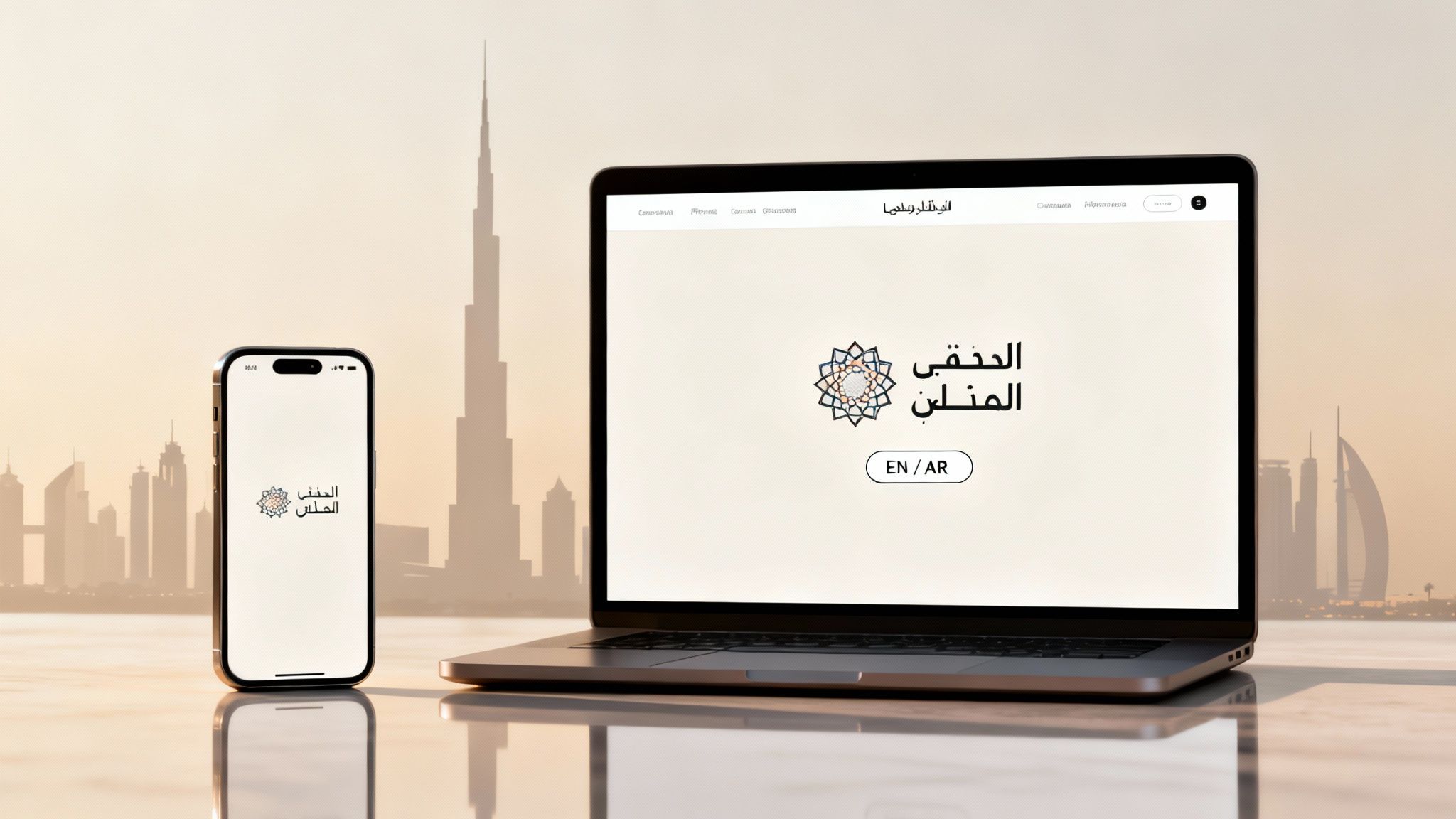
Trying to penetrate the Dubai market with a one-size-fits-all ecommerce platform is a guaranteed way to burn cash. The digital shoppers in the UAE are among the most connected and savvy in the world. Their expectations have been shaped by global giants like Amazon and hyper-local innovators who anticipate their every need. A simple translated version of your Western site won't just underperform; it will actively alienate customers. You need a strategy built from the ground up that respects the region's distinct digital behaviors.
This isn't just theory; the numbers tell a clear story. The UAE ecommerce market is projected to hit AED 63–74 billion by 2025 and is expected to grow at a compound rate of about 11.5% annually from 2025 to 2030. This explosive growth forces retailers to build websites that aren't just aesthetically pleasing, but are precision-engineered to handle massive traffic and convert discerning visitors.
The Pillars of a MENA-Centric Ecommerce Framework
To build a site that genuinely connects with local customers, your design philosophy must stand on three non-negotiable pillars. Neglecting even one of these undermines your entire investment and caps your potential before you start.
- Deep Cultural Localisation: This is more than translating product descriptions. It’s understanding the subtleties in imagery, aligning your marketing calendar with local events like Ramadan, and offering a perfect Right-to-Left (RTL) layout for Arabic users. It must feel native, not adapted.
- Uncompromising Mobile Performance: With the majority of traffic coming from smartphones, a mobile-first mindset isn't a choice—it's a baseline requirement. This means designing for the small screen first and obsessing over load times. Anything over two seconds is a direct hit to your revenue.
- Seamless Regional Integrations: Your beautiful website is useless if a customer reaches checkout and can't find their preferred payment method, like Mada, or the still-dominant Cash on Delivery (COD). Integrating with local logistics providers like Aramex for live tracking is no longer a bonus; it’s a fundamental expectation.
A common pitfall is treating the MENA region as a single entity. An effective ecommerce website design in Dubai understands that a shopper in the UAE has different habits, payment preferences, and expectations from one in Saudi Arabia or Egypt.
Ultimately, a successful ecommerce store in Dubai is more than a sales channel; it's a cornerstone of your brand’s reputation. Your website must work flawlessly, build trust instantly, and feel like it was crafted specifically for the local shopper. The only path to turning browsers into loyal customers is a strategic blend of thoughtful user experience and a rock-solid technical foundation. You can see how this thinking extends to the bigger picture in our guide to choosing a digital marketing agency in Dubai.
Designing a Seamless User Experience for MENA Shoppers
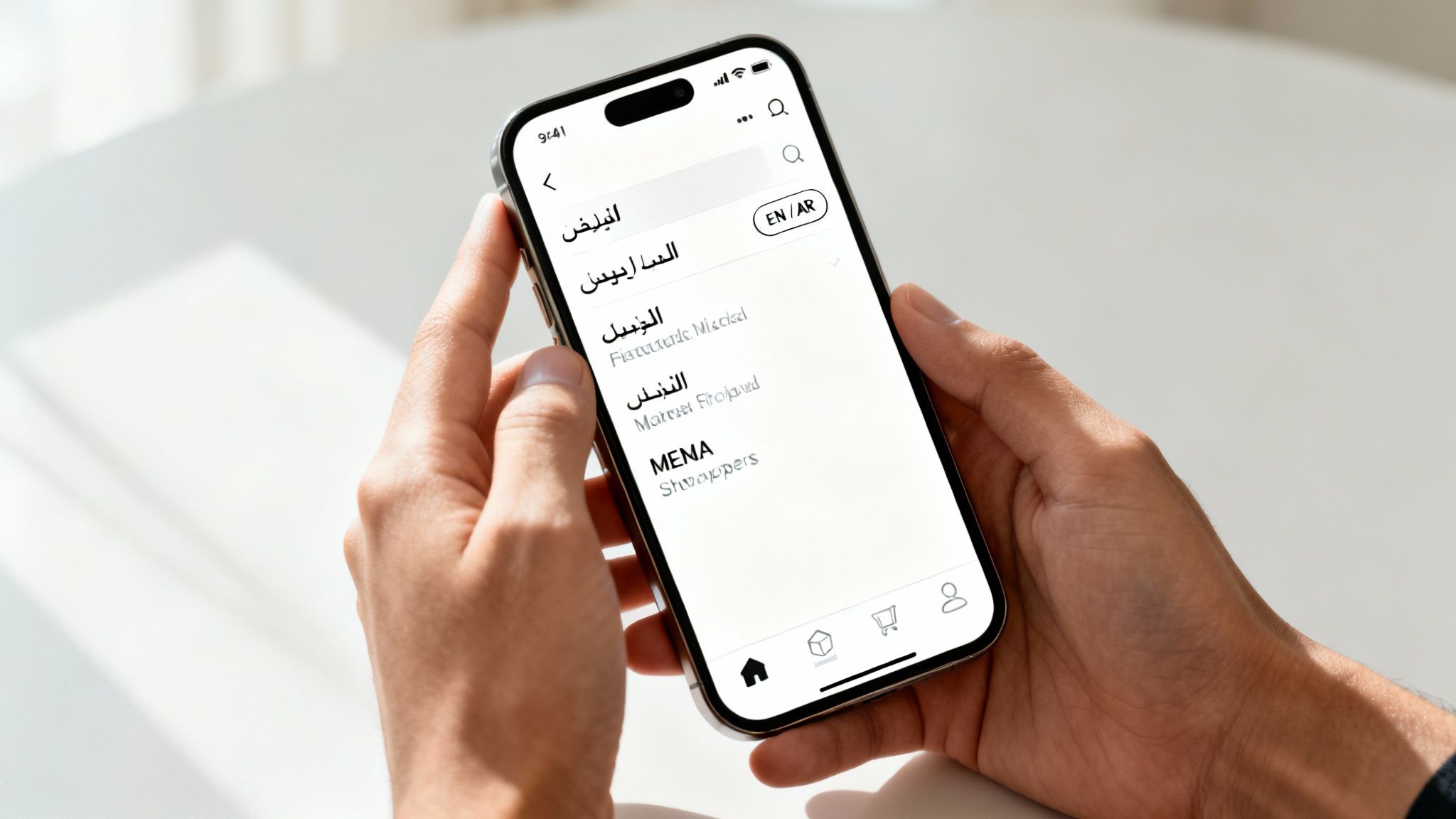
Thinking your website just needs to be "responsive" is a decade-old mindset. For ecommerce website design in Dubai, the real mantra is mobile-first. This isn't a buzzword; it’s a strategic imperative dictated by regional consumer behavior.
By 2025, it's expected that a staggering 72% of all internet traffic in the UAE will originate from mobile devices. This fact sets a brutal performance standard: your pages must load in two seconds or less. For every additional second a customer waits, you could be losing up to 20% of your conversions.
This forces a reversal of the traditional design process. We start with the smallest screen, crafting an experience that doesn't just work on a phone but feels entirely natural and frictionless, from the first tap to the final purchase.
Navigating Bilingual UX and Flawless RTL Implementation
One of the biggest make-or-break challenges for e-commerce in the MENA region is executing the bilingual experience correctly. You must support both English (Left-to-Right, LTR) and Arabic (Right-to-Left, RTL) without a single glitch. Many off-the-shelf themes claim RTL support, but the reality is they often fail in small but critical ways that erode user trust.
Proper RTL design isn't just flipping text alignment. It's a fundamental re-engineering of the entire user interface.
- Navigation Menus: Must be mirrored, with the logo and primary links anchored to the right.
- Icons and Buttons: Directional cues, like arrows in sliders or "next" buttons, must be reversed to point correctly.
- Form Fields: Labels and input boxes need to align right-to-left for natural data entry.
- Image Sliders: Carousels and banners must swipe from left to right, the intuitive direction for an RTL user.
Getting these details wrong creates a jarring, unprofessional experience for your Arabic-speaking customers. It immediately signals that the Arabic version of your site was an afterthought, instantly damaging credibility.
Building Trust Through Localised Design Choices
Beyond the technicalities of RTL, the user experience is massively influenced by cultural and visual cues. Your design must resonate with a local audience to give them the confidence to complete a purchase.
The most effective e-commerce designs in Dubai don't just translate content; they translate trust. This is achieved by demonstrating a deep understanding of local aesthetic preferences, cultural norms, and security expectations.
To achieve this, you need to master three key areas of visual communication:
1. Typography That Works in Both Scripts
Choosing the right fonts is a careful balancing act. You need a font pairing that is legible and aesthetically pleasing in both Arabic and English. More importantly, it must render flawlessly on every device and browser. Modern, clean fonts like Noto Sans Arabic and Cairo are excellent choices that provide superior clarity.
2. Culturally Resonant Imagery
Generic stock photos featuring Western models in non-descript settings will make your brand feel distant and irrelevant. Invest in imagery that reflects the lifestyle and diversity of Dubai and the wider MENA region. Using photos of local landmarks, diverse models, and culturally appropriate scenes makes your brand feel authentic and relatable.
3. Clear and Simple Navigation
A confused shopper is a lost sale. Your site’s navigation has to be incredibly intuitive, especially when switching between languages. This means:
- A language switcher that’s prominent and easy to locate.
- A smart search bar that understands different Arabic dialects (e.g., Gulf vs. Levantine) and common misspellings (Arabizi).
- Product categories that use terminology people in the region actually use.
Ultimately, a great user experience is about eliminating friction. Every single element, from the moment someone lands on your site to the final confirmation page, must be optimised for speed, clarity, and cultural relevance. This obsessive attention to detail is what separates a basic online shop from a true sales machine. Our work on high-converting websites and sales funnels is built on this very principle.
Mastering Payments and Logistics for the Dubai Market
You can have the most beautiful, persuasive storefront in the world, but if the checkout is a headache and delivery is a guessing game, you’ve lost the sale. When it comes to ecommerce website design in Dubai, nailing the final moments of the customer journey—payment and logistics—is everything. This is the moment of truth where you either build lasting trust or break it completely.
Simply plugging in a familiar global payment processor isn't going to cut it here. While options like Stripe are great, they don't fully appreciate the ingrained payment habits of shoppers in the region. Your customers need to see names they recognise and feel secure with.
Choosing the Right Payment Gateway
This is where local champions like Telr and PayTabs really shine. They've built their entire platforms around the needs of the MENA market, offering critical features that many global giants simply overlook.
- Local Payment Methods: They come ready with support for must-haves like Mada (Saudi Arabia’s debit card network) and Knet (in Kuwait). If you plan to sell across the GCC, these are non-negotiable.
- Flexible Instalment Plans: "Buy Now, Pay Later" (BNPL) is huge here. Local gateways have seamless, built-in connections to services like Tabby and Tamara, which can do wonders for your conversion rates, especially on bigger-ticket items.
- Easier Onboarding: These companies get the local business landscape. They understand the registration and banking norms, which often makes the setup process far less painful for UAE-based companies.
Now, let's talk about the elephant in the room: Cash on Delivery (COD). It might feel a bit old-school, but ignoring it means you could be turning away 30-40% of your potential customers. The trick is to manage it intelligently. Set clear order limits, use WhatsApp to confirm orders before they go out the door, and maybe even add a small fee to cover the extra work involved.
Don’t just write off COD as a hassle. Think of it as a powerful trust-builder. For a first-time buyer who’s a bit nervous about online fraud, offering COD tells them you understand their concerns and stand behind your product.
To give you a clearer picture, here’s a quick look at how the main players stack up.
Payment Gateway Comparison for UAE Ecommerce
Choosing the right payment gateway is a crucial decision for any ecommerce business targeting the UAE. This table compares some of the most popular options to help you see which one best fits your needs, from local payment acceptance to ease of integration.
Each gateway has its strengths, but for businesses focused squarely on the MENA region, the local knowledge and feature sets of Telr and PayTabs often provide a significant advantage.
Seamless Logistics and Delivery Integration
The second the payment goes through, your customer’s mind pivots to one thing: "When will my package arrive?" Expectations in Dubai are sky-high. People want it fast, they want to track it in real-time, and they want returns to be painless. This isn’t the place to cut corners.
Your ecommerce platform needs to talk directly to established regional couriers. This is what separates a professional operation from an amateur one.
- Aramex: A true regional heavyweight. Aramex has an unbeatable network across the GCC for both last-mile delivery and international shipping.
- Fetchr: This is the tech-savvy option. Fetchr brilliantly solved the region's "vague address" problem by using a customer's phone location for pinpoint delivery.
- Other Local Couriers: Don't overlook other strong players like Naqel Express or SMSA Express, especially if you have your sights set on the massive Saudi Arabian market.
Finally, make your shipping policy crystal clear on your website. Show estimated delivery times, costs, and return instructions right where people can see them. A dedicated order tracking page that pulls data directly from your courier isn't a "nice-to-have" anymore—it's an essential part of the modern customer experience.
Understanding these market-specific details is absolutely vital. You can dive deeper into this topic by learning how to properly strategise when breaking into the Middle East market. When you get both payments and logistics right, you complete the journey in a way that turns a one-time buyer into a lifelong fan.
Using AI and Automation to Elevate the Customer Journey
Your e-commerce website should be more than just a digital catalogue with a checkout button. A standard site is purely transactional; a winning one is conversational and intelligent. It’s time to move beyond the simple shopping cart and transform your website into a customer experience hub that actively builds loyalty.
This is where practical AI and automation, particularly tools designed for the MENA market, create a competitive moat. Instead of a generic chatbot, imagine an Arabic-native WhatsApp bot powered by a platform like SalesMfast AI. It doesn't just answer basic FAQs; it proactively handles order updates in the customer's dialect, recovers abandoned carts with tailored offers, and provides instant support on the channel they use most.
Here, you can build a serious competitive advantage. While your competitors are stuck relying on basic email follow-ups that get ignored, you can be having personalized, automated conversations on the one platform where your customers spend most of their time: WhatsApp.
The checkout process is the perfect place to start weaving in this kind of intelligent automation.
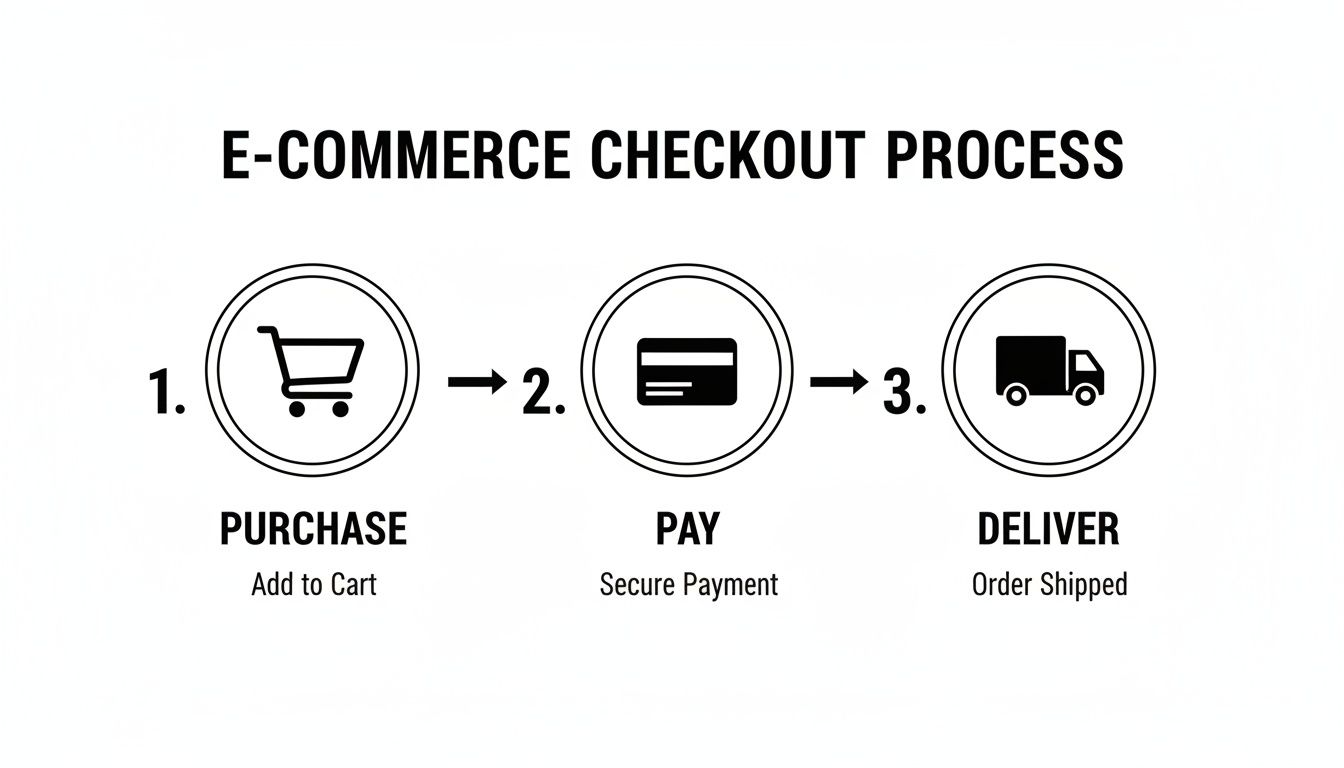
This straightforward flow from purchase to delivery is packed with opportunities where AI-driven communication can remove friction and make the entire experience smoother for the customer.
From Transactional to Relational Commerce
The real magic happens when you connect your automation tools to a localised Customer Relationship Management (CRM) system. This integration is what lets you shift from broadcasting generic offers to delivering hyper-personalised experiences, even when you're dealing with thousands of customers.
A smart, integrated system doesn't just see a sale; it sees a customer with a history, preferences, and a unique journey. This insight allows you to orchestrate the entire relationship.
- Segmented Post-Purchase Follow-Ups: Instead of a single "thank you" email for everyone, your system can trigger tailored WhatsApp messages. A first-time buyer might get a welcome discount for their next purchase, while a VIP customer gets early access to a new collection.
- Proactive Support and Order Tracking: Don't make customers chase you for their order status. Automated messages can update them at each key stage—shipped, out for delivery, and successfully delivered—right on WhatsApp. This builds trust and massively cuts down on "where is my order?" support tickets.
- Intelligent Abandoned Cart Recovery: Most platforms send a generic reminder email. A system optimised for the MENA region can send a WhatsApp message asking if the customer had trouble with payment options or needed help, tackling common local checkout barriers head-on.
The goal isn't just to make a sale; it's to start a relationship. Automation gives you the tools to manage thousands of these relationships personally and instantly, creating a level of service that smaller teams could never dream of achieving manually.
Building an Omnichannel Communication Engine
A great customer experience feels consistent, no matter where it happens. When your ads, website, and support channels all operate in their own silos, the customer's journey feels disjointed and frankly, frustrating. Integrating these systems is the only way to create a seamless flow. We've actually written more on this topic; you can learn why your ads, emails, and website aren't working together and how to fix it at https://www.smorchestra.com/post/why-your-ads-emails-and-website-arent-working-together-and-how-to-fix-it.
Ultimately, the aim is to create an intelligent, omnichannel experience with your Dubai e-commerce website at its core. You can even explore how AI content optimization for e-commerce can sharpen your messaging and boost conversion rates. By automating smartly, you build a responsive, helpful, and genuinely personal shopping experience that your competitors, stuck with their off-the-shelf templates, simply can't replicate. That's how you win in the long run.
Winning the Technical SEO Battle in the GCC
Let's be blunt: a beautiful website for your ecommerce website design in Dubai is useless if no one can find it. If Google.ae can't crawl, understand, and rank your pages, your entire investment will fall flat. Getting seen in the GCC isn't about luck; it's earned through meticulous, technical Search Engine Optimisation (SEO).
This isn't just about sprinkling keywords around. We're talking about the deep, structural work that signals quality and relevance to search engines, ensuring your site performs brilliantly for users from Dubai to Riyadh. Too many businesses pour their budget into aesthetics, completely ignoring the invisible architecture that actually drives organic traffic and sales.
Forget generic tips. This is your practical checklist for the technical optimisations that are absolutely non-negotiable in this market.
Mastering Hreflang for Bilingual Websites
One of the most frequent—and damaging—technical SEO mistakes I see in the MENA region is the mishandling of bilingual content. When you have both Arabic and English versions of the same page, you have to explicitly tell Google they are equivalents, not just copies.
This is where hreflang tags come in. These are small snippets of code placed in your page's header that clarify the specific language and regional target for each version. Without them, Google might see your content as duplicated, which can lead to penalties and force your two language sites to cannibalise each other's rankings.
A correctly implemented hreflang tag is the difference between Google seeing a sophisticated, multilingual platform and a sloppy, duplicated one. It’s a small detail with massive consequences for your search rankings.
Think of a product page. With proper hreflang, you’d have one tag telling Google this URL is for English speakers in the UAE (en-ae) and another pointing to the URL for Arabic speakers in the UAE (ar-ae). This simple signal is absolutely critical for ranking correctly in both languages.
The Non-Negotiable Need for Regional Hosting and CDNs
Latency is the silent killer of conversions. Mobile users in the UAE are not patient; they expect pages to load in under two seconds. The physical distance your site's data has to travel is a huge part of that equation. Hosting your website on a server in North America or Europe adds precious milliseconds of delay for every single visitor in Dubai.
That's why choosing a hosting provider with servers located right here in the UAE or a nearby GCC data centre is a foundational requirement. It drastically cuts down latency, which improves not only the user experience but also your Core Web Vitals score—a key SEO metric.
On top of that, a Content Delivery Network (CDN) is essential. A CDN works by storing copies of your site's assets (like images and code) on a global network of servers. So, when a user from Riyadh visits your site, the CDN delivers the content from the nearest server—perhaps in Dubai—instead of making the request travel all the way to your primary server in another country. This guarantees a fast experience for everyone, everywhere in the region.
The Page Speed Optimisation Checklist
In the world of SEO, speed is king, especially on mobile. Here are the core tasks to get your site moving at top speed:
- Aggressive Image Compression: Large product photos are the #1 cause of slow ecommerce sites. Use modern formats like WebP and powerful tools to shrink image file sizes without making them look blurry or pixelated.
- Code Minification: This process strips out all the unnecessary characters from your site's code (HTML, CSS, and JavaScript), like extra spaces and developers' comments. The result is smaller files that download much faster.
- Leverage Browser Caching: You can configure your server to tell a visitor's browser to save static files locally. The next time they visit, their browser loads these files from its own memory instead of re-downloading everything, making return visits feel instantaneous.
Nailing these technical SEO tasks is part of building a high-performance ecommerce machine. To get ahead of the curve, you can explore powerful AI SEO Strategies to Dominate Search Rankings. And if you need an expert team to build this foundation for you, see how we operate as a fully integrated digital marketing agency.
Your Questions About Ecommerce in Dubai, Answered
Jumping into the world of ecommerce website design in Dubai brings up a lot of questions. It's a unique market with its own set of rules and customer expectations. To help you get a clearer picture, we’ve put together answers to some of the most common questions we hear from businesses looking to succeed online here.
How Much Does an Ecommerce Website Cost in Dubai?
This is the big one, and the honest answer is: it varies wildly. The cost depends entirely on what you want to build, the features you need, and the team you partner with. You could get a simple, template-based site on a platform like Shopify starting from around AED 15,000, but this approach often just scratches the surface and won't have the deep localisation needed to really make an impact.
For a custom-built site on a more robust platform like Magento or a modern headless setup, you're looking at a range from AED 50,000 to over AED 200,000.
Why the big jump in price? That investment covers the things that actually drive sales in this market:
- True Bilingual Design: Not just a translated theme, but a ground-up user experience crafted for both English and Arabic speakers, with flawless right-to-left (RTL) functionality.
- Local Integrations: Seamlessly connecting your store with regional payment gateways like Telr or PayTabs, local logistics pros like Aramex or Fetchr, and any CRM or ERP systems you already use.
- Speed, Speed, Speed: Building a site that loads in under 2 seconds. This comes from smart regional hosting, a content delivery network (CDN), and clean, optimised code.
- A Future-Proof Foundation: Creating a scalable architecture that grows with you, so you're not forced into an expensive and painful rebuild in a couple of years.
Think of it less as a cost and more as an investment in your digital storefront. A cheap build today often leads to a cascade of bigger costs later on—lost sales from a slow site, frustrated customers, and eventually, a full-scale redevelopment.
Which Ecommerce Platform is Best for the UAE Market?
There's no single "best" platform for everyone. The right choice comes down to your business model, your budget, and how much technical heavy lifting you're willing to do. What matters most is whether the platform can handle the must-haves for the Dubai market.
Here’s a practical look at the main contenders:
The real question isn't "What's popular?" but "Which platform gives my customers in the UAE the fast, localised, and mobile-friendly experience they expect?" The technology should always serve your strategy, not the other way around.
For many, a well-tuned WooCommerce or Shopify site is a fantastic place to start. But for brands aiming to lead the pack, Magento or a headless architecture often provides the long-term power and flexibility you need to win.
Do I Really Need to Offer Cash on Delivery?
In a word: yes. For most businesses selling directly to consumers, offering Cash on Delivery (COD) is still non-negotiable in the UAE and across the GCC. While digital payments are on the rise, a huge chunk of shoppers either prefer paying with cash or see the COD option as a sign of trust, especially when they're buying from a new brand.
Choosing not to offer it could mean you're waving goodbye to as much as 40% of your potential customers. The solution isn’t to avoid COD, but to manage it smartly.
Here’s how you can minimise the risks that come with COD:
- Confirm Every Order: A simple, automated WhatsApp message to confirm the order details and address before you ship can work wonders in reducing fake or accidental orders.
- Set a Price Cap: You can choose to limit COD to orders below a certain value to protect yourself from major losses.
- Add a Small Fee: A nominal COD fee is common practice and helps cover the extra logistics and administrative work involved.
- Have a Clear Policy: Make sure your return policy for COD orders is crystal clear on your website to manage everyone's expectations.
Ultimately, offering COD shows you understand the local culture and are willing to meet your customers where they are. It’s a powerful way to build that crucial initial trust and capture sales you’d otherwise miss out on.
Ready to move beyond a generic template and build an ecommerce machine that truly converts in the Dubai market? SMOrchestra designs and builds unified sales, marketing, and customer care systems that drive predictable, scalable revenue. We integrate the right platforms with MENA-specific automation to turn your website into your most powerful growth engine.
Discover our integrated ecommerce and automation solutions
Article created using Outrank

Read Our latest
Lorem ipsum dolor sit amet, consectetur adipiscing elit.