If your sales team is relying on manual follow-ups in the MENA region, you’re losing revenue. Low response rates and missed opportunities aren't a slump; they're a symptom of an outdated process. In today's instant-response market, mastering automated WhatsApp follow-up messages for MENA sales teams isn't just an advantage—it's the only way to turn inquiries into booked appointments at scale.
This guide moves beyond generic templates. We'll focus on the automation logic, CRM integration, and AI-driven systems that enable you to respond instantly, qualify leads 24/7, and convert more conversations into customers.
Why Manual Follow-Ups Fail in the MENA Market
Are your carefully crafted follow-up emails sitting unread? Do calls go to voicemail more often than not? This happens because there's a major gap between your strategy and how customers in the MENA region actually communicate. The standard, high-latency sales process doesn't work here.

In the MENA region, business is built on relationships and trust, but driven by speed and immediacy. Generic email templates and delayed calls feel impersonal and are easily ignored. WhatsApp, however, is the primary channel for direct, real-time conversation, making it the default platform for everything from inquiries to closing deals.
The Undeniable Dominance of WhatsApp
This isn't just a trend; it's a fundamental shift in communication. For sales teams, this is a massive opportunity—but only if you have the automation infrastructure to capitalize on it.
In the UAE, for example, WhatsApp usage is nearly universal. This translates into follow-up messages seeing open rates of up to 98%, completely eclipsing email’s typical 20-30%. This pattern holds across the region, where research shows that a staggering 75% of nationals in key MENA countries use WhatsApp daily.
Let's look at the data side-by-side.
Manual Email vs. Automated WhatsApp Follow-Up Performance
The table below breaks down the stark contrast between a slow, manual channel and an instant, automated one.
The takeaway is clear: if you aren't engaging leads on WhatsApp within minutes, you are invisible to a majority of your potential customers.
The core problem is simple: you're trying to connect with high-intent leads on channels they no longer prioritize. A modern sales strategy in MENA must be built on automated, "WhatsApp-first" systems that mirror customer expectations for speed and convenience.
This means more than just sending texts. It requires a system that can handle the entire initial conversation, from instant response to qualification and appointment booking, right inside the app. If you're building out your messaging strategy, our safe outbound campaign launch checklist is a great place to start.
The High Cost of Slow Response Times
In a market that moves at the speed of a tap, every minute counts. A lead who has to wait hours for a response has likely already been engaged by a competitor with a faster, automated system.
Relying on human agents for initial follow-ups is a recipe for delay and lost revenue. One salesperson can only handle so many conversations at once, and leads inevitably fall through the cracks. This is where manual models crumble. The only way to win is by deploying technology that delivers instant, 24/7 engagement.
Building Automated WhatsApp Sequences That Convert
A single message rarely closes a deal. Real conversions happen through consistent, well-timed automated communication. A solid follow-up sequence is your playbook for guiding a prospect from initial inquiry to a booked appointment without human intervention.
We're moving beyond basic templates. These are strategic, multi-step sequences designed for the most common sales scenarios. The goal is to deploy an intelligent system that nurtures leads automatically, handing them off to your sales team only when they are qualified and ready to talk.
Each sequence maps out the timing, message logic, and specific goal for every touchpoint. The system maintains a helpful, professional presence without ever being pushy.
At the heart of every effective automated message is a simple, three-part structure. This ensures every touchpoint lands with purpose.
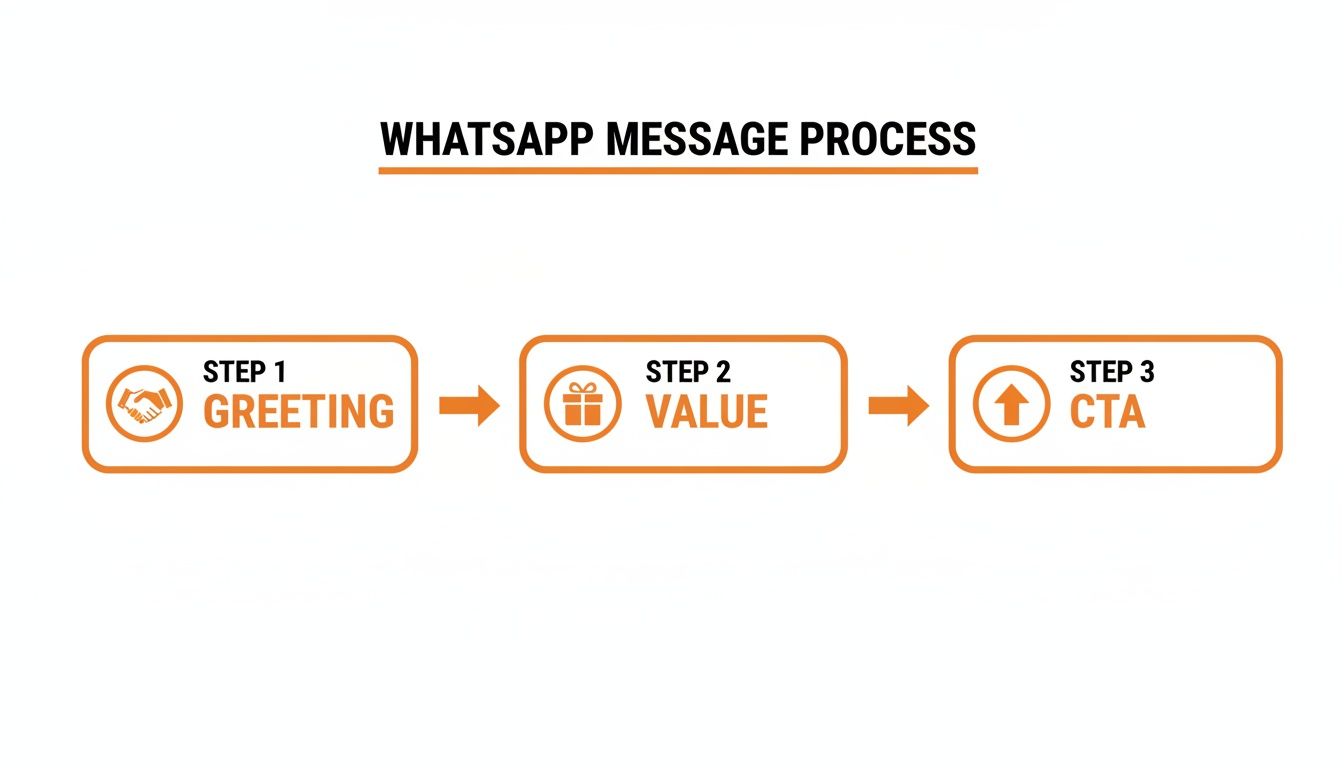
This flow is critical: a personalized Greeting, a clear offer of Value (a resource, an answer, a next step), and a simple Call-to-Action.
Sequence 1: Post-Demo or Sales Call Nurturing
The time immediately following a demo is crucial. The lead's interest is at its peak, and your automation should keep the momentum going. This sequence is designed to be helpful, not salesy.
Step 1 (Trigger: Immediately After Call): The Recap & Asset Delivery
- Goal: Cement value points and deliver on promises.
- English: "Hi [Name], thanks for your time today. As promised, here is the case study we discussed. Let me know if you have any initial questions after reviewing it."
- Arabic: "مرحباً [Name]، شكراً لوقتك اليوم. كما وعدت، هذا هو دراسة الحالة التي ناقشناها. أعلمني إذا كان لديك أي أسئلة أولية بعد مراجعتها."
Step 2 (Trigger: 3 Days Later): The Gentle Nudge
- Goal: Check in and offer further assistance to gauge their progress.
- English: "Hi [Name], just checking in to see if you had a chance to look over the materials. Is there anything else I can provide to help with your evaluation?"
- Arabic: "مرحباً [Name]، أتواصل معك لمعرفة ما إذا أتيحت لك الفرصة للاطلاع على المواد. هل هناك أي شيء آخر يمكنني تقديمه للمساعدة في تقييمك؟"
Step 3 (Trigger: 7 Days Later): The Value-Add
- Goal: Provide new, relevant information to keep the conversation warm.
- English: "Hi [Name], thought you might find this article on improving [their specific goal] interesting. It relates to what we discussed. Happy to chat more when you're ready."
- Arabic: "مرحباً [Name]، أعتقد أن هذا المقال حول تحسين [هدفهم المحدد] قد يثير اهتمامك. إنه يتعلق بما ناقشناه. يسعدني التحدث أكثر عندما تكون جاهزاً."
Sequence 2: New Inbound Lead Qualification & Booking
When a new lead fills out a form, speed and relevance are everything. This sequence is designed to instantly engage, qualify, and book an appointment with a sales rep, fast.
This is especially critical in markets like Saudi Arabia, where 76% of users prefer buying from brands they can chat with on WhatsApp. With daily usage at 75%, a rapid automated follow-up is not just preferred; it's expected. We've seen businesses achieve 53% automation in their customer journeys by implementing smart, multi-channel campaigns to connect with these leads instantly.
Below is a sample automated cadence. The aim is to convert initial interest into a booked meeting.
Sample 5-Day Automated Cadence for a New Lead
This automated structure gives you multiple attempts to engage the lead without being intrusive, offering value at each step.
Sequence 3: Re-Engaging a Cold Lead
When a promising conversation goes dark, this automated sequence can restart the dialogue without being awkward. It focuses on re-establishing context and value.
Pro-Tip: Your automation system should pull data from your CRM. Personalizing the re-engagement message with a detail from a past conversation (e.g., "we spoke about your goal of X") dramatically increases reply rates.
Step 1 (Day 1): The Contextual Check-In
- Goal: Remind them of the previous conversation with a low-pressure next step.
- English: "Hi [Name], we spoke a while back about [topic]. Just wanted to check in and see if this is still a priority. Any updates on your end?"
- Arabic: "مرحباً [Name]، تحدثنا قبل فترة عن [الموضوع]. أردت فقط المتابعة ومعرفة ما إذا كان هذا لا يزال أولوية بالنسبة لك. هل هناك أي مستجدات من جانبك؟"
Step 2 (Day 5): The Trigger Event
- Goal: Use new information as a reason to reconnect.
- English: "Hi [Name], saw your company was mentioned in [publication/event]. Congratulations! It reminded me of our chat. Would it make sense to reconnect briefly next week?"
- Arabic: "مرحباً [Name]، رأيت أن شركتك ذُكرت في [المنشور/الحدث]. تهانينا! هذا ذكرني بحديثنا. هل من المنطقي أن نتواصل مجدداً لفترة وجيزة الأسبوع المقبل؟"
Step 3 (Day 12): The "Break-Up" Message
- Goal: Politely close the loop, which often prompts a response.
- English: "Hi [Name], I haven't heard back, so I'll assume your priorities have shifted. I'm closing your file for now, but please don't hesitate to reach out if anything changes."
- Arabic: "مرحباً [Name]، لم أتلق رداً، لذا سأفترض أن أولوياتك قد تغيرت. سأغلق ملفك في الوقت الحالي، ولكن لا تتردد في التواصل إذا تغير أي شيء."
By deploying these structured, automated sequences, your team can build a predictable and highly effective follow-up process. These frameworks ensure no lead is missed and every interaction has a clear purpose. To build more sophisticated workflows, our guide on multi-channel outbound campaigns for MENA SMEs is a great next step.
Automating Your WhatsApp Follow-Up Machine
Manual messaging doesn't scale. It creates bottlenecks, leads to slow response times, and results in lost deals. The solution is automation, which transforms WhatsApp from a simple chat app into a dedicated, 24/7 sales engine that converts missed calls and inquiries into booked appointments.
The goal isn’t just sending messages faster. It’s about building an intelligent system that responds instantly, uses AI to qualify leads, and only hands off high-intent opportunities to your sales team. This frees up your reps to focus on what they do best: building relationships and closing.
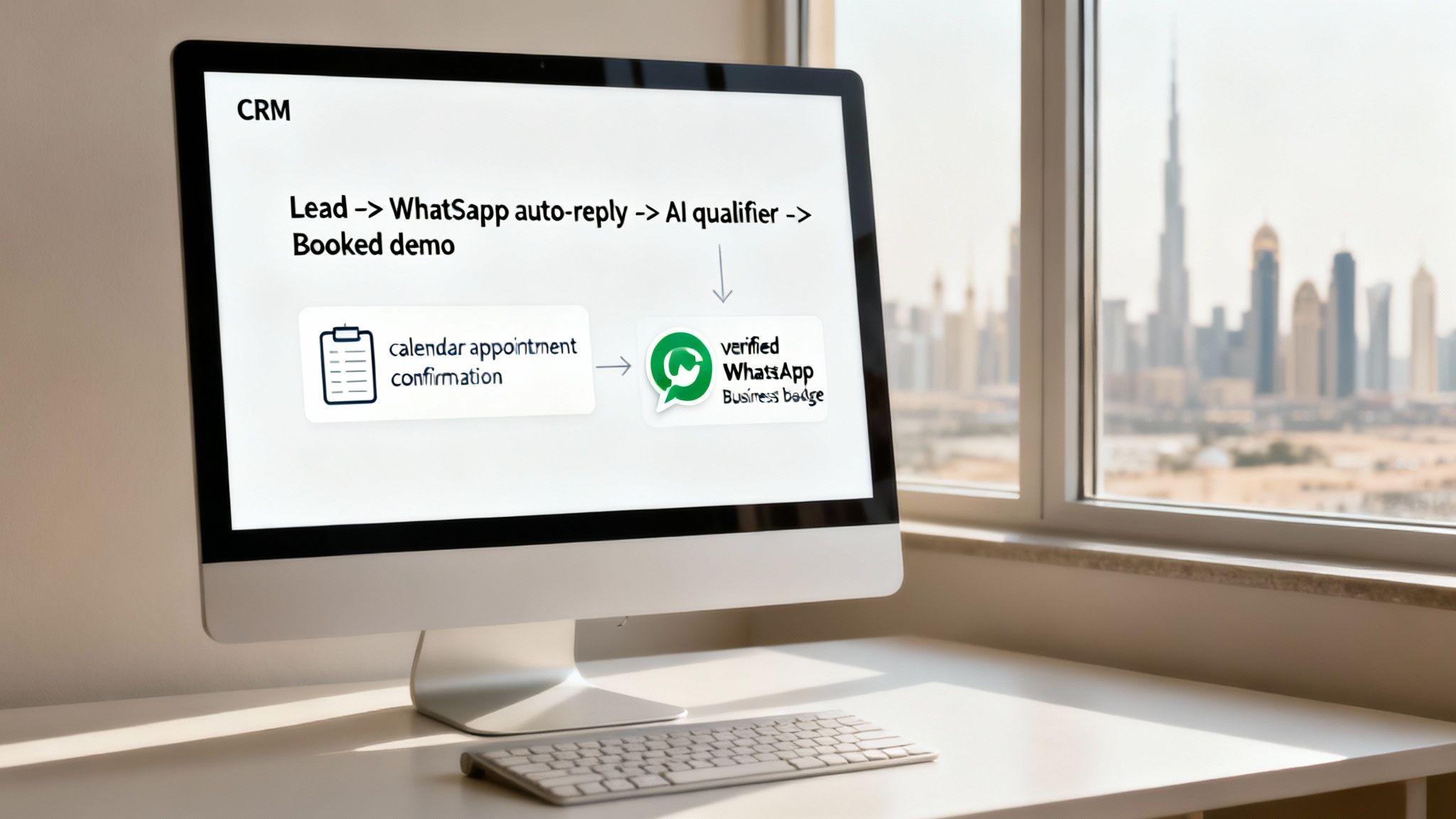
Connecting WhatsApp to your CRM via an automation platform creates a sales machine that never sleeps.
Setting Up Triggers for Instant Automated Responses
In sales, speed is non-negotiable. When a prospect fills out a form or you miss a call, the clock starts ticking. An automated system can reply in seconds.
You can configure "triggers" that initiate a conversation the moment a lead enters your system.
- New Lead from Website/Missed Call: A form is submitted or a call is missed. Instantly, an automated WhatsApp message is sent, confirming receipt and asking a qualifying question.
- Downloaded Resource: Someone downloads a brochure. A trigger delivers the document via WhatsApp and asks if they want to book a call to discuss it.
- Abandoned Cart: For e-commerce, a trigger can send a helpful reminder with a direct link to complete the purchase.
This immediate contact capitalizes on peak interest and demonstrates professionalism.
Using AI Agents to Qualify and Book Appointments 24/7
This is where automation becomes truly powerful. Instead of sending templated messages, you can deploy AI agents to handle the initial sales conversation, day or night.
Modern AI agents understand conversational context. They ask intelligent qualifying questions and guide leads to the next logical step.
An AI agent can handle hundreds of inquiries simultaneously. It can ask key questions like, "What's your budget?" or "What's your timeline?" It uses this data to qualify the lead and can then book a meeting directly on your sales team's calendar based on their real-time availability.
This process ensures your sales reps only spend time on pre-qualified, high-intent prospects who are ready for a serious conversation. It eliminates time wasted on unqualified leads and the manual back-and-forth of scheduling.
Integrating WhatsApp with Your CRM for a Single Source of Truth
Without a deep CRM integration, your WhatsApp conversations are isolated data points, disconnected from your sales pipeline. This leads to lost information and missed follow-ups.
A true automation machine ensures every message, reply, and interaction is logged automatically within your CRM contact record.
This native connection provides several key advantages:
- One Central Record: The entire team has a complete history of every chat with a lead, directly in the CRM. No more "Did anyone talk to this person?"
- Smarter Follow-Up: Sales reps see the full context from the AI agent's conversation before they make a call, allowing them to enter the conversation fully prepared.
- Accurate Revenue Attribution: You can finally track which WhatsApp conversations are converting into appointments and closed-won deals.
For seamless pipeline management, you need solutions that can forward WhatsApp messages directly to your CRM. This integration is the final piece, turning scattered chats into structured, actionable data that powers your sales process.
Navigating Cultural Norms and Compliance in MENA
Using WhatsApp for sales in the MENA region requires more than just clever automation; it requires an understanding of culture and compliance. Trust is paramount. How you communicate is as important as what you sell, and a misstep can damage your brand and lead to your number being blocked.

It all begins with explicit consent. Before sending any promotional message, you must have a clear "opt-in" from every contact. This is a strict requirement of both WhatsApp's Business Policy and local data privacy laws in markets like the UAE and Saudi Arabia.
Respecting Time and Boundaries
Timing is deeply linked to cultural respect. A message sent during prayer times or late at night is considered intrusive.
Your automation platform must be configured to account for these nuances.
- Avoid Late Nights: Do not send messages after 9 PM local time.
- Know the Weekend: In most of the MENA region, the weekend is Friday and Saturday. Adjust your send schedules accordingly.
- Respect Prayer Times: Automated sequences should be paused during the five daily prayer times. These times shift throughout the year, so your system must be able to adapt.
This consideration shows you respect the local culture, which is fundamental to building trust.
Compliance and the WhatsApp Business API
To scale your sales efforts, you must use the official WhatsApp Business API. The API is built for automation, CRM integration, and team collaboration, but it comes with strict rules.
Meta assigns a quality rating to your business phone number. If too many users block or report your messages, your rating will drop, which can lead to messaging limits or even suspension of your account.
To maintain a healthy account status, follow these fundamentals:
- Get Verified: Complete the Meta Business Verification process to get the green checkmark next to your business name, which serves as a powerful symbol of trust.
- Use Pre-Approved Templates: For initiating conversations, you must use message templates pre-approved by WhatsApp. You can personalize these with variables like names, appointment times, or product details. We cover similar concepts in our guide on CRM email personalization best practices.
- Provide a Clear Opt-Out: Every message must include a simple way for users to unsubscribe (e.g., "Reply STOP to opt out"). This request must be honored instantly and automatically.
By building these cultural and compliance rules into your WhatsApp follow-up messages for MENA sales teams, you create a strategy that is not just effective but also sustainable and respectful.
Measuring What Matters in Your Campaigns
How do you know if your WhatsApp automation is driving revenue or just creating noise? It's easy to send messages, but understanding their direct impact on the bottom line is what separates high-performing teams from the rest. You must focus on metrics that directly correlate with sales outcomes.
A 98% open rate is a vanity metric. The true test of your WhatsApp follow-up messages for MENA sales teams is the actions they drive. Track the KPIs that prove you are moving prospects through your sales pipeline.
Core Metrics That Drive Revenue
To get a clear picture of your campaign's ROI, focus on these three core metrics.
Reply Rate: This is your fastest feedback loop. A low reply rate indicates a problem with your opening message's value proposition or timing. A high rate shows your content is relevant.
Lead-to-Appointment Conversion: This is the critical bridge between conversation and opportunity. It measures how many automated chats result in a booked demo or sales call. This KPI proves your CTAs and qualification logic are effective.
Revenue Attribution: This is the ultimate proof of ROI. How much closed-won revenue can be directly traced back to a conversation initiated or nurtured by your WhatsApp automation? This requires tight CRM integration to track a lead from the first touchpoint to the final sale.
The most valuable insight isn't knowing how many people opened your message. It's understanding how many of those conversations led to a real business outcome. Every other metric you track should feed into this one goal.
A Simple Framework for A/B Testing
Continuous optimization is key. Systematically test one variable at a time to learn what your audience responds to. This data-driven approach removes guesswork from your strategy.
Create two versions of a single message, change only one element, and send Version A to one group of leads and Version B to another.
Elements to Test:
- The Call-to-Action (CTA): Test a direct CTA ("Book a call now") against a softer one ("Would a quick 10-minute chat be helpful?").
- Message Timing: Does sending a follow-up at 10 AM perform better than 2 PM? Test different time slots within business hours.
- Use of Media: Does including a short video or PDF in the initial message improve the lead-to-appointment rate?
By running these small experiments, you'll identify patterns that allow you to refine your automated sequences for maximum performance.
Your Questions Answered
We receive many questions from sales teams looking to implement automated WhatsApp follow-ups in the MENA region. Here are the most common ones.
How Should We Handle Arabic and English in Conversations?
The best practice is to initiate contact with a bilingual message (English followed by Arabic). This approach caters to both local and expat professionals. From there, your automation system should mirror the language the prospect uses. If they reply in Arabic, the system continues in Arabic. AI-powered platforms can detect language and route conversations or trigger automated replies accordingly, ensuring a seamless experience.
Can We Send Bulk WhatsApp Messages to a Purchased List?
Absolutely not. Sending unsolicited messages to a purchased list is a violation of WhatsApp's terms of service and the fastest way to get your number blocked by users and banned by Meta. Build your contact list organically through explicit opt-ins on your website, QR codes, or social media CTAs where users request to be contacted on WhatsApp.
What Is the Best Time to Send Follow-Up Messages?
Respecting local culture is key. Avoid sending messages during prayer times, late evenings (after 9 PM), or on weekends (typically Friday and Saturday). The highest engagement occurs during standard business hours: Sunday to Thursday, between 10 AM and 4 PM. Configure your automation system with these "quiet hours" to show respect for your prospects' personal time.
How Can We Integrate WhatsApp with Our Existing CRM?
Integration requires the official WhatsApp Business API and a third-party automation platform to act as the bridge to your CRM. Solutions like SMOrchestra are purpose-built for this. They enable you to automatically log all WhatsApp chats in your CRM, create new leads from conversations, and trigger CRM workflows based on message content or user actions.
What Happens If Our Number Gets a Low-Quality Rating?
A low-quality rating from Meta, typically caused by a high number of blocks or reports from users, can lead to severe restrictions on your messaging capabilities. To maintain a high rating, ensure every message is valuable and sent only to users who have opted in. Always provide a clear and easy way to opt out, and ensure your system honors these requests instantly.
Ready to turn missed calls and inquiries into booked appointments? SMOrchestra builds an AI sales machine that automates your lead follow-ups across WhatsApp, Instagram, email, and SMS, so your team can focus on closing deals. Book a call to see how it works.

Read Our latest
Lorem ipsum dolor sit amet, consectetur adipiscing elit.