For SMEs in the MENA region, the constant cycle of paid ad spending is unsustainable. The path to predictable growth is a smart, multi-channel outbound strategy. This approach combines email, WhatsApp, and SMS into a single, automated sequence managed from your CRM. It’s about building a scalable sales pipeline that you own and control, moving away from a total reliance on paid ads.
Why Outbound is the New Growth Engine for MENA SMEs
Relying solely on paid ads is like renting your customer relationships. The moment you stop spending, the leads disappear. This dependency on fluctuating ad costs and changing platform algorithms is a significant risk for any growing business.
This is why many MENA businesses are shifting to multi-channel outbound. This isn't about sending random, unsolicited messages. It's about creating an intelligent communication system that directly connects with prospects through a coordinated workflow of email, WhatsApp, and SMS.
The Power of an Owned System
Building your own outbound system creates stability. You are no longer vulnerable to sudden ad platform policy changes or budget-breaking keyword costs. Instead, you build a valuable database of contacts—a business asset that grows over time and makes every future marketing effort more efficient.
The benefits are tangible:
- Direct Control: You decide who to contact, when, and with what message, free from algorithm constraints.
- Predictable Pipeline: Automated sequences ensure no lead is missed, creating a steady stream of qualified opportunities for your sales team.
- Cost Efficiency: While there's an initial setup, your cost per acquisition (CPA) decreases over time compared to the endless cycle of paid advertising.
- Regional Resonance: This approach is built for how business is done in the MENA region, prioritizing direct channels like WhatsApp and SMS where they are most effective.
The objective is a seamless customer journey. A prospect receives a professional introductory email. If there’s no reply, a friendly WhatsApp message follows a day later. Still no response? An SMS with a time-sensitive offer might be next. The entire sequence is orchestrated automatically from your CRM based on the contact's actions.
Comparing Paid Ads vs. Multi-Channel Outbound
Putting the two models side-by-side clarifies the difference. One is a short-term rental; the other is a long-term asset you build.
The table makes it clear: while paid ads can provide a quick boost, an outbound system builds a sustainable business.
Adapting to Regional Communication Styles
In the MENA region, business is personal. A formal email is a great way to initiate a conversation, but a follow-up on WhatsApp often builds rapport and elicits a response. A multi-channel system allows you to manage these interactions at scale, automatically switching between English and Arabic based on the contact’s profile in your CRM.
This strategic approach is already delivering significant results. Projections show that by the end of 2025, over 70% of marketing budgets in the region will be allocated to digital channels, with a heavy emphasis on automation.
The data supports this shift. Multi-channel content marketing generates 3x more leads at a 62% lower cost. When outbound strategies are integrated with good SEO, the results are even more dramatic—a 14.6% close rate versus just 1.7% for traditional outbound methods alone.
Building this engine requires a different mindset than simply buying clicks. If you're weighing your options, our guide on choosing a digital marketing agency can offer helpful perspective. The goal isn't just to get leads for next week; it's to build a long-term asset that powers sustainable growth.
Mapping Your Bilingual Campaign Sequence
Now, let's move to practical application. A smart multi-channel sequence isn't just sending messages on different platforms; it’s orchestrating a conversation. The goal is to create a logical flow that earns your prospect's attention respectfully.
Instead of relying on paid ads, your CRM will execute a deliberate sequence. It starts with a professional introduction, adapts based on the prospect's response, and uses the right channel for the right message—all while respecting communication preferences across the MENA market.
This diagram illustrates a core three-step process, combining email, WhatsApp, and SMS into a single, cohesive campaign managed from your CRM.
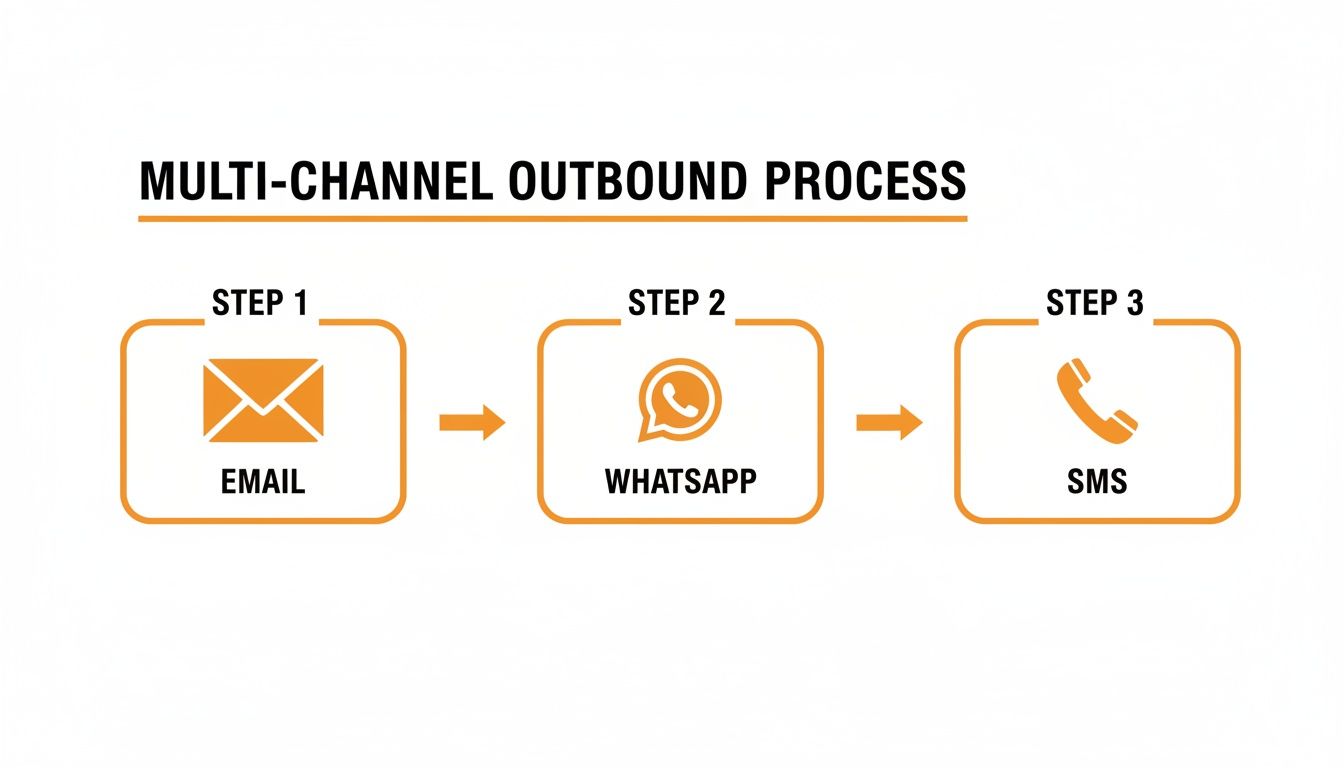
The flow typically moves from more formal channels to more direct ones, guided by automation rules within your CRM.
Designing the Core Workflow
The heart of an effective sequence is a simple, repeatable workflow. The objective is to engage, not to annoy.
For B2B or high-value B2C sales in the GCC, a three-touchpoint sequence managed through a CRM automation builder is a highly effective starting point.
- Day 1 - The Email Opener: Start with a highly personalized email. This channel is ideal for professional detail. The content should be concise, focus on a specific pain point, and offer clear value. Use CRM data like company name, industry, and job title to personalize it.
- Day 3 - The WhatsApp Nudge: If there is no reply or open within 48 hours, your CRM should automatically send a WhatsApp message. This is a brief, low-pressure follow-up, simply referencing the email you sent.
- Day 5 - The SMS Reminder/Offer: If there is still no engagement, a final SMS can serve as a direct call to action. It is perfect for a time-sensitive offer or a quick question. The high open rate of SMS makes it effective for a final, concise message.
This layered approach ensures persistence without being intrusive. For a detailed framework, our guide on crafting CRM email sequences for outbound sales provides an adaptable structure.
Mastering the Bilingual Switch
In the MENA region, language is key to building connection. Your CRM must manage bilingual communication. A simple "Arabic" or "English" tag on a contact record should trigger the entire language-specific workflow.
This requires two complete versions of every message template in your sequence. When a workflow starts, the CRM checks the contact's language preference and sends the correct version. If a contact replies in Arabic to an English message, your team must be prepared to continue the conversation in Arabic and update the language preference in the CRM immediately.
Your system must be able to run two parallel sequences from a single trigger. An English-speaking lead receives the English email, WhatsApp, and SMS. An Arabic-speaking lead receives the fully localized Arabic versions of the same sequence, automatically.
Crafting Messages That Actually Work
Message content and tone must be tailored to the channel. What works in a formal email will not work on WhatsApp.
Email Template (B2B Example)
- Subject: An idea for [Prospect's Company Name]
- Body: Hi [First Name], I saw your recent work in the [Industry] space and had a thought about how you might be able to improve [Specific Business Area]. We recently helped [Similar Company] achieve [Result] by implementing a system for [Solution]. Would a quick 15-minute chat next week be worthwhile?
WhatsApp Template (B2B Follow-up)
- Hi [First Name], just following up on the email I sent about [Topic]. Did you get a chance to see it?
The email provides context and value. The WhatsApp message is short, personal, and refers back to the email. To ensure your Arabic content is accurate, consider using specialized Arabic document translation services for cultural and linguistic precision.
SMS Template (B2C Offer)
- Hi [First Name]! Our exclusive Eid sale ends in 24 hours. Use code EID25 for an extra 25% off your next order. Don't miss out! [Link]
This SMS is direct, creates urgency, and has a clear call to action, playing to the channel's strengths. By mapping out these logical, bilingual sequences, you build a powerful engagement machine that connects with prospects on their terms.
Getting Your Tech Stack Right for True Automation
Your automated campaign is only as effective as the technology behind it. For MENA SMEs, the goal is a lean, integrated tech stack where all components work together seamlessly.
The key to multi-channel outbound is integration. You are creating a single customer journey managed from one central platform. Without this, you are sending disconnected messages, not running a coordinated campaign.
This diagram shows how your CRM should act as the central hub, connecting all communication channels.
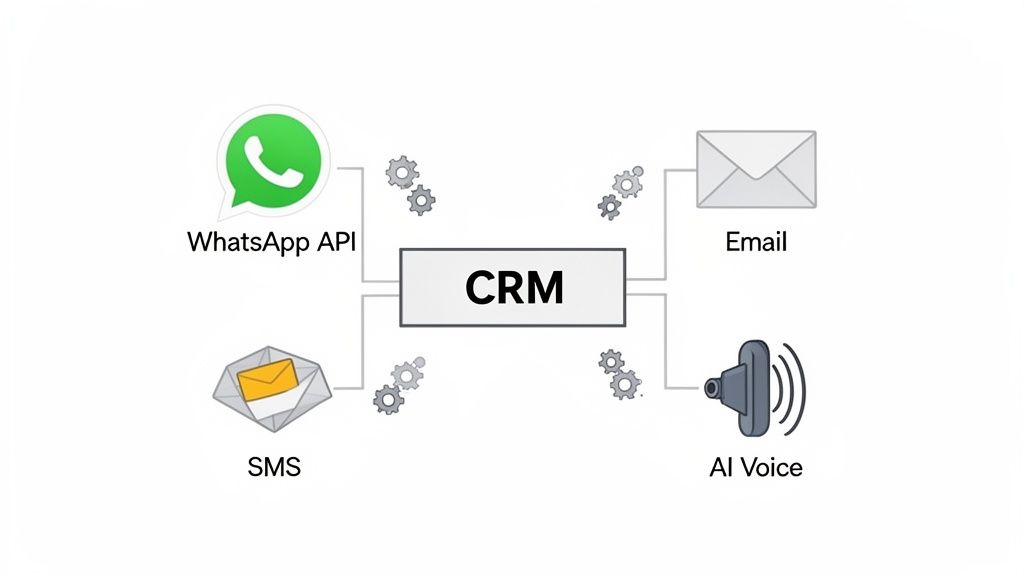
The CRM is not just a database; it orchestrates the conversation across every channel.
The Four Pillars of Your Tech Stack
An effective multi-channel outbound campaign requires four key technologies working together.
- A Central CRM: This is the core of your operation, the single source of truth for all customer data and where you build automation rules. Platforms like HubSpot or Zoho are excellent choices for most SMEs.
- A WhatsApp Business API Provider: This is not the standard WhatsApp Business app. An official API provider is required for automation, sending approved message templates, and integrating with your CRM.
- An Email Platform: This may be part of your CRM (like HubSpot's Marketing Hub) or a separate tool that integrates smoothly. It must be able to send emails based on triggers from your CRM.
- An SMS Gateway: Similar to the WhatsApp API, an SMS gateway allows you to send text messages automatically from your CRM, perfect for time-sensitive reminders.
Choosing the right foundation is critical. Our guide on the best CRM for small business can help you decide which platform fits your growth plans.
Bringing Your Automation Rules to Life
With a properly integrated stack, you can create powerful "if this, then that" rules that guide the customer journey automatically. You'll primarily use your CRM's workflow builder.
Here are a few practical examples of automation:
- Rule 1: If a new contact is tagged 'New Lead' and their preferred language is 'Arabic', then automatically enroll them in the 'Arabic Welcome Sequence'.
- Rule 2: If a prospect opens 'Email #1' but doesn't click the demo link within 48 hours, then trigger 'WhatsApp Follow-Up #1'.
- Rule 3: If a prospect replies to any message in the sequence, then immediately pause all automation for that contact and create a task for a sales rep to take over personally.
The system should handle repetitive tasks. The moment a lead shows interest by replying, automation should stop, allowing a human to build a real connection.
This level of automation is driving significant growth. SMEs across the UAE are adopting multi-channel strategies, contributing to a Middle East & Africa market projected to grow from USD 425.7 million in 2024 to over USD 1 billion by 2030. While email remains important, the real growth is in analytics that provide cross-channel insights.
Weaving in AI Voice for Practical Tasks
AI voice is a practical tool for specific, high-volume tasks. Instead of your team making hundreds of simple confirmation calls, an integrated AI voice system can do it for you.
Here's how to use AI voice:
- Appointment Confirmations: An automated call a day before a scheduled demo to confirm attendance.
- Basic Lead Qualification: A quick, automated call to ask one or two simple questions to qualify a lead for a salesperson's time.
The workflow is simple. When a contact reaches a specific stage in your CRM (e.g., 'Demo Booked'), it triggers the AI voice provider to make the call. The outcome (confirmed, rescheduled, no answer) is logged back into the CRM, providing a complete interaction history.
Navigating Compliance and Customer Opt-Ins in the GCC
Building an effective outbound campaign is one thing; ensuring it doesn't damage your reputation is another. In the GCC, where business is built on relationships, handling customer data and communication with respect is critical.
The core principle is simple: only message people who have given clear consent. This is especially true for personal channels like WhatsApp, where an unsolicited message is an invasion of privacy and leads to being blocked.
The Golden Rule: Opt-In First, Always
Before any automated message is sent, you need proof of consent. This is mandatory under data protection laws in the UAE and Saudi Arabia. You must be able to show that a contact gave you explicit permission to reach out.
Integrate consent collection into your daily processes:
- Website Lead Forms: Add a clear, separate checkbox to your forms stating, "I'd like to receive offers and updates on WhatsApp and email."
- Event QR Codes: At trade shows, use a QR code that directs people to a sign-up page that specifies which channels you will use.
- E-commerce Checkouts: Add a consent checkbox before the customer finalizes their purchase.
- In-Store Sign-ups: Use a tablet to collect details, allowing customers to read the terms and agree.
Consent must be an active choice. Hiding it in lengthy terms and conditions is not sufficient.
Managing Opt-Outs: Instant and Automatic
Respecting a customer's decision to opt out is as important as getting their consent. Your system must process opt-out requests immediately. If someone replies "STOP" to an SMS or clicks an unsubscribe link, your CRM workflow must automatically flag their contact record and remove them from all future campaigns.
This is a critical compliance function. Relying on manual removal is unreliable. Your tech stack should handle this seamlessly, tagging the contact as "Opted-Out" and blocking further automated messages. Our article on how to prevent outbound email mistakes with approval workflows offers valuable insights applicable across all channels.
A seamless opt-out process builds trust. When customers see that you respect their choice immediately, it leaves a positive impression and keeps the door open for future engagement on their terms.
Documentation Is Your Defence
Maintain a clear digital paper trail for every contact. Your CRM should log precisely when and how you obtained their consent—for example, "Opt-in via 'Website Demo Form' on [Date] at [Time]."
This detailed record-keeping ensures you are always prepared to demonstrate compliance and gives your team the confidence to run their multi-channel outbound campaigns for MENA SMEs, knowing every interaction is built on ethical ground.
Measuring What Actually Matters: Your Campaign KPIs
You cannot improve what you do not measure. For a multi-channel campaign in the MENA region to succeed, you must focus on Key Performance Indicators (KPIs) that directly link to revenue.
Setting up a simple, powerful dashboard in your CRM is mandatory. It is the only way to stop guessing and start making data-backed decisions. You will know instantly which channel to invest in or which message is underperforming.

Go Beyond Opens and Clicks
Open rates and click-throughs are surface-level metrics. The KPIs you should focus on are those that track genuine engagement and movement through your sales pipeline.
Start with these core engagement KPIs:
- Channel-Specific Reply Rates: This is the best indicator of message resonance. Track reply rates for email, WhatsApp, and SMS separately. A 5% email reply rate versus a 25% WhatsApp rate tells you where your audience is most active.
- Positive Reply Rate: Differentiate between "Yes, tell me more" and "Unsubscribe." This metric reveals the true quality of your leads.
- Conversion Rate by Sequence Stage: Track how many people move from one step to the next. What percentage of prospects who received the first email booked a meeting after the WhatsApp follow-up? This identifies strengths and weaknesses in your funnel.
Tying Campaign Activity to Business Results
The next layer of your dashboard must connect campaign activity to sales results to prove the value of your outbound engine.
You need a clear view of:
- Lead-to-Opportunity Velocity: How long does it take for a new lead to become a qualified sales opportunity? A shorter cycle means a more efficient process.
- Cost Per Acquisition (CPA): Calculate the total cost of your campaign (tools, team time) and divide it by the number of new customers acquired.
- Return on Investment (ROI): Compare the total revenue generated from the campaign against its total cost. This is the final verdict on profitability.
Effective dashboards tell a story. They should clearly show how a high WhatsApp reply rate directly lowers your Cost Per Acquisition, giving you the confidence to invest in proven channels and messages.
Building Your Essential KPI Dashboard
Your CRM is the ideal home for this dashboard. Our guide on choosing a performance marketing company provides insights into data-driven strategies.
Here is a breakdown of critical metrics to track for each channel.
Essential KPIs for Your Multi-Channel Dashboard
This structured approach is driving growth for SMEs across the UAE.
With nearly 70% of 2025 marketing budgets in the region allocated to digital, hybrid strategies combining SEO and outbound are achieving conversion rates of 14.6%, far surpassing the 1.7% from traditional outbound. For MENA business owners, this data indicates that systemized pipelines with precise, local tracking are the future. By measuring the right KPIs, you transform your outbound efforts into a predictable, data-driven revenue engine.
Common Questions on MENA Outbound Campaigns
As you implement your strategy, practical questions will arise. Here are answers to some of the most common questions from business leaders in the MENA region.
How Do We Legally Get Phone Numbers for WhatsApp Campaigns?
The only legal and sustainable method is to collect numbers through explicit, provable opt-ins. Never buy a list. It is the fastest way to get your WhatsApp Business Account banned and damage your brand.
Build consent collection into your customer interactions:
- On Your Website: Use a clear, unticked checkbox on your forms asking for permission to send marketing messages on WhatsApp.
- At Checkout: Add a simple consent checkbox to your e-commerce flow.
- In Person: Use QR codes at events or in-store that link to a simple sign-up page.
Every opt-in must be tagged in your CRM with a timestamp to create a permanent, compliant record of consent.
Should We Start an Outbound Sequence with Email or WhatsApp?
For most B2B sales or high-value consumer products in the GCC, start with a professional, personalized email. It is less intrusive and sets a professional tone.
Use WhatsApp for follow-up. A quick, friendly message 24-48 hours after the email can be very effective. A simple, "Hi [Name], I sent you an email about [Topic] and just wanted to make sure you saw it," feels helpful, not aggressive.
For time-sensitive offers or B2C promotions, leading with WhatsApp or SMS is often better due to their immediacy and high open rates.
Can Our Current Sales Team Actually Run These Automated Campaigns?
Yes, they should. Automation is meant to empower your team, not replace them. The system handles the repetitive work of initial outreach and follow-ups. The moment a lead replies or shows significant interest, the automation should stop.
Your CRM should be configured to instantly notify the assigned salesperson and create a task for them to take over the conversation personally. This shifts their role from cold caller to consultant, allowing them to engage with warm, interested leads.
The system handles the work of getting a 'hello'. Your sales team focuses on turning that 'hello' into a contract.
Is AI Voice Effective in the MENA Region Given Different Dialects?
Modern AI voice platforms are effective for specific, well-defined tasks and can handle both English and various Arabic dialects with high accuracy. Use it for simple, repetitive jobs, not complex sales negotiations.
Practical uses for AI voice in your campaigns:
- Appointment Confirmations: An AI agent calls a lead 24 hours before a demo to confirm their attendance.
- Simple Qualification: An automated call can ask, "Are you still interested in learning more about our services?" A 'yes' response can trigger a task for a human agent to call back.
As you integrate these channels, understanding industry standards for outbound call KPIs will help you set realistic benchmarks and identify opportunities for improvement.
At SMOrchestra, we build these systems. If you're ready to implement an AI-powered, multi-channel outbound engine that generates predictable leads, let's connect.

Read Our latest
Lorem ipsum dolor sit amet, consectetur adipiscing elit.