We’ve all felt that pit-of-your-stomach feeling when a major email campaign launches with a glaring error—like the wrong price. For businesses in the MENA region, an unchecked outbound email isn't just an embarrassing slip-up; it's a direct hit to your revenue and reputation. The best way to prevent outbound email mistakes is to put a solid approval workflow in place inside your CRM, creating a structured review process before a single message lands in a customer's inbox.
The Hidden Costs of Unchecked Outbound Emails
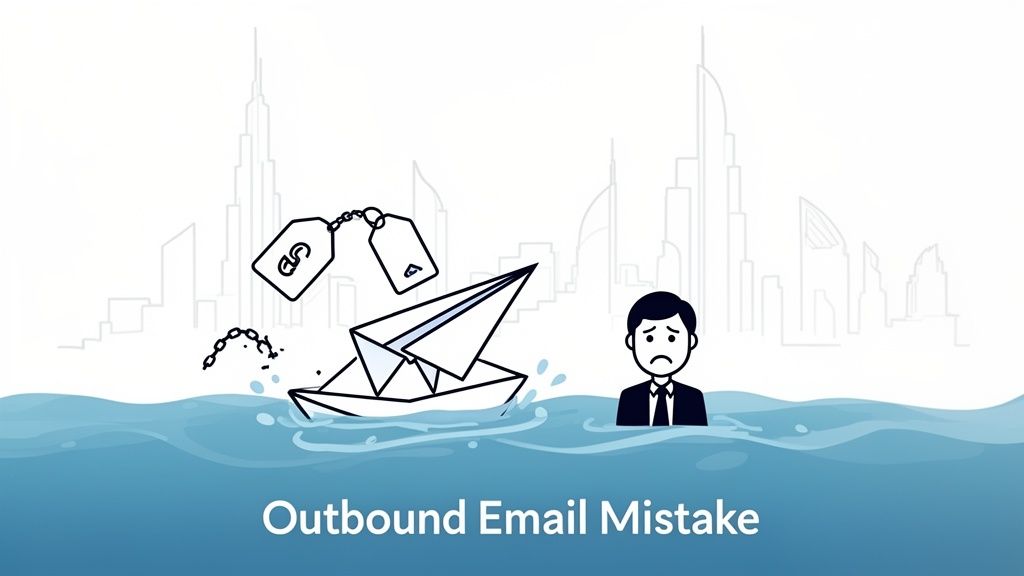
When your sales and marketing teams are moving fast, it's easy to operate without a safety net. But that exposure leads to tangible, expensive problems that create ripples far beyond a simple typo. These aren't just hypothetical risks; they're the kinds of daily operational issues that slowly erode customer trust and eat away at your bottom line.
Real-World Scenarios in the MENA Market
Let’s look at a common example. A Dubai-based retailer is launching a special promotion for Saudi National Day. In the rush, the marketing team sends the Saudi-specific offer to its entire GCC customer list without a final segmentation check in the CRM. This one mistake immediately creates operational chaos.
The fallout is swift and predictable:
- A spike in customer service calls: Your contact center is suddenly overwhelmed with calls from confused customers in Kuwait, Oman, and the UAE trying to use a promo code that won't work for them.
- Brand erosion: Customers outside of Saudi Arabia now feel spammed with irrelevant content, which damages the brand's reputation for smart, personalized communication.
- Lost sales opportunities: The exclusive feel of the offer for the Saudi audience is gone, reducing its impact and urgency.
Another classic pitfall is the botched translation. Imagine a financial services firm in Riyadh sending an English email about a new investment product. The automated Arabic translation completely misses the cultural nuances, making the tone feel clunky, unprofessional, or even untrustworthy. This instantly undermines the firm's credibility with a massive, key demographic.
For any business operating in a multilingual region like MENA, a human review for both Arabic and English communications is non-negotiable. It’s the final line of defense against cultural missteps that automation can't catch.
Beyond Embarrassment to Business Risk
These mistakes are more than just cringeworthy—they introduce serious business risks. A misconfigured promotion or a broken link has a direct, negative impact on revenue. Inconsistent messaging can completely sabotage all the hard work your team has invested in generating high-quality digital marketing leads.
The security implications are even more severe. Phishing attacks via deceptive emails have surged across the MENA region, targeting people everywhere from the UAE to Egypt. Without an approval workflow, a single compromised or poorly vetted campaign could inadvertently expose customer data or internal systems, turning a marketing effort into a major security incident.
Ultimately, an approval workflow isn't about adding bureaucracy or slowing things down. It’s a system designed to catch costly errors before they happen, protecting your revenue, reputation, and customer relationships in a fiercely competitive market.
Making Your CRM's Approval Workflow a Reality
Let's move from theory to practical application. A solid approval workflow isn't just a good idea—it's a process you can build right inside your CRM. The whole point is to create a smart, role-based quality check that helps you prevent outbound email mistakes with approval workflows that actually work, without bogging everyone down in red tape.
This isn't about adding more layers of management. It's about giving specific people clear responsibilities at the right moments in a campaign's journey.
Designing Stages Based on Roles
Picture this common scene at a Dubai e-commerce company. A junior marketer drafts a new promo email for a big sale. Instead of being able to blast it out to thousands of customers on the spot, the CRM automatically kicks off the approval process.
First, the draft zips over to a senior copywriter. Their one job? A bilingual review. They'll check the Arabic for cultural relevance and make sure the English hits the right brand tone. Once they give it the thumbs-up, the workflow automatically pushes it to the next person in line.
Now, the campaign lands in the marketing manager's queue. They aren't worried about typos; they're focused on the bigger picture—strategy and data. They’re checking two critical things:
- Offer Details: Is that discount code correct and live? Does the sale's end date match what's on the website?
- Segmentation Logic: Is this email really going to the right people? For instance, is it correctly targeting "customers in KSA who haven't bought anything in the last 90 days"?
The "send" button only becomes clickable after that final sign-off. This kind of multi-stage process separates content checks from technical checks, which drastically cuts down the risk of an embarrassing (and costly) mistake. Choosing the right platform is often the first hurdle, and our guide on the best CRM can help you navigate that decision.
Different Strokes for Different Folks
A single, rigid approval process just won't cut it. The workflow for a massive, high-stakes marketing campaign needs to be way more thorough than a simple follow-up email from a sales rep. To build these kinds of tailored workflows into your current setup, you could look into solutions like integrating an app for Salesforce or similar tools that make customization easier.
Let's look at how different teams might set up their approval stages.
Role-Based Approval Stages for Outbound Campaigns
In a typical MENA business, different teams have unique needs. This table shows how approval stages can be adapted to ensure every campaign is accurate, compliant, and culturally on-point before it goes out the door.
As you can see, the complexity of the workflow matches the risk and scale of the communication. Marketing's multi-step process protects the brand's reputation, while the sales team's leaner approach prioritizes speed.
The key is to design a workflow that provides oversight without creating a bottleneck. Automation is crucial here—the CRM should handle the notifications and task routing, so the process flows smoothly from one approver to the next without manual intervention.
The Essential Checklist for Your Approval Process
An approval workflow is only as good as the checks it enforces. It’s one thing to have the stages mapped out, but knowing exactly what to look for at each step is what really prevents costly mistakes. When teams are moving fast, it’s the small details that get missed—and those often cause the biggest headaches.
A structured checklist inside your CRM transforms a simple sign-off into a genuine quality assurance gate. It’s about protecting your brand, your budget, and your relationship with your customers.
This simple diagram shows the basic journey from creation to launch.
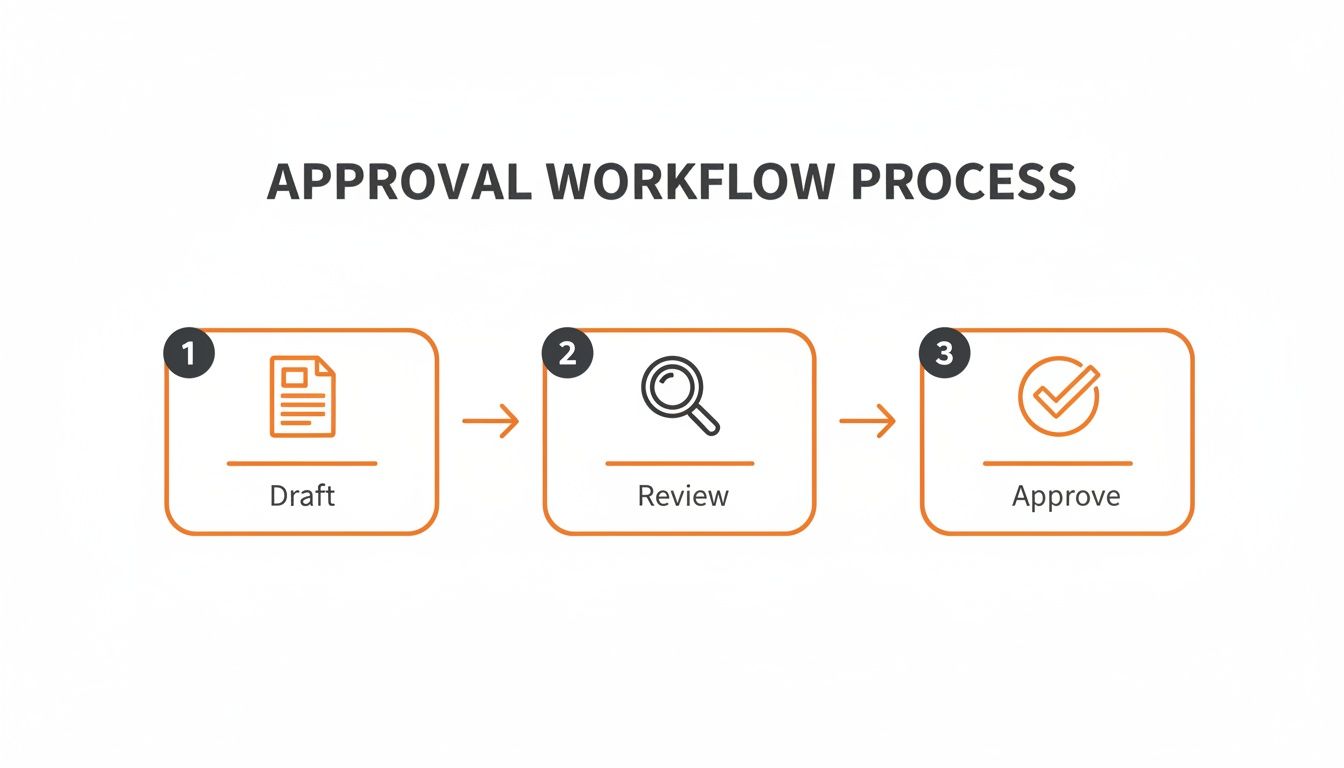
Each checkpoint—Draft, Review, and Approve—is an opportunity to catch an error before it ever reaches a customer.
Segmentation and Audience Sanity Checks
The very first thing to validate inside the CRM is the audience. You could have the most amazing offer in the world, but if it goes to the wrong people, it’s a waste of effort and can annoy your customers. Before anyone gives the green light, the reviewer must confirm the segmentation logic.
Ask these practical questions:
- Is this Abu Dhabi promotion only going to contacts located in Abu Dhabi?
- Have we properly excluded customers who just made a purchase from this "win-back" campaign?
- Does this list correctly filter for contacts who have actually consented to this kind of email?
This single step prevents one of the most common and damaging mistakes: blasting an irrelevant offer across different cities or countries. You don't want to be sending a promotion for your Cairo branch to customers living in Riyadh.
Bilingual Content and Cultural Nuances
For any business operating in the MENA region, relying on a simple machine translation for your Arabic content is a recipe for disaster. Your approval checklist absolutely must include a manual review by a native speaker of both Arabic and English.
This human review isn't just about catching grammar mistakes; it’s for checking tone, cultural context, and even formatting. An automated tool will never catch that a certain phrase is inappropriate for a specific GCC market or that the right-to-left (RTL) layout is broken on mobile devices.
This check ensures your messaging feels authentic and professional in every language, which builds trust. To make sure your entire process consistently delivers high-quality outcomes, it's worth understanding the broader principles of Mastering E-commerce Customer Service Quality Assurance.
Technical and Compliance Verification
Finally, you have to get the technical details perfect. This is the testing phase that prevents the dreaded "Hello {{FirstName}}" error and ensures you're meeting legal standards.
Here's what your workflow should enforce:
- Test Personalization: Always send a test email to an internal address. This confirms all your merge tags (like name, company, or last purchase) are pulling the right data from your CRM.
- Verify Links: Click every single link in the email. That includes the social media icons, the fine print, and especially the main call-to-action. Make sure they all work and point to the right place.
- Confirm Compliance: Check for a clear, working unsubscribe link and double-check that the content adheres to regional data laws like PDPL.
With new data protection laws emerging and mandating breach alerts within 72 hours, a sloppy process is a serious business risk. Building these compliance and accuracy checkpoints directly into your workflow is non-negotiable. For a deeper dive into building such robust systems, check out our guide on standard operating procedures formats and templates.
Extending Your Approval Workflow Beyond Email to WhatsApp and SMS
If you’ve gone to the trouble of building a solid approval process for your outbound emails, you’re on the right track. But what about WhatsApp and SMS? In the MENA region, these channels aren't just secondary—they’re often the primary way customers want to engage with you.
Leaving these channels unchecked creates a huge blind spot. It's like locking the front door but leaving the back door wide open. A mistake in a WhatsApp blast—a wrong price, a broken link, a poorly translated offer—can damage your brand just as fast as a bad email. The goal is to create one cohesive approval system, ideally right inside your CRM, that governs all your outbound messages.
The Unique Approval Needs for WhatsApp
WhatsApp is a different beast altogether, largely because you have to play by Meta's rules. Your first hurdle is getting your WhatsApp Business templates approved by them. Think of this as the first checkpoint.
But Meta's approval is just about compliance, not quality or accuracy. They aren't checking if your offer makes sense or if your personalization is working. That’s on you. Your internal approval workflow needs to pick up where Meta leaves off.
Here’s what your team should be verifying:
- Interactive Elements: Do the quick reply and call-to-action buttons actually work? More importantly, do they trigger the correct automated follow-up in your system? A broken button is a dead end for a customer.
- Bilingual Nuances: How does the Arabic version look on a phone? Is it formatted correctly for right-to-left (RTL) display? Even small formatting errors can make your message look unprofessional and hard to read.
- Placeholder Accuracy: You absolutely have to test that variables like
{{customer_name}}or{{order_number}}are pulling the right data from your CRM. There's nothing worse than a message that says "Hello,{{customer_name}}!"
A common mistake is treating Meta's approval as the final green light. It isn't. Meta is checking for policy violations, not business sense. Your team is the only one who can catch a flawed offer or a segmentation error before it goes out.
Don't Forget to Secure Your SMS Campaigns
SMS might feel more straightforward, but its simplicity can be deceiving. The potential for technical glitches is high, and a pre-send check is non-negotiable. An approval workflow for SMS should really zero in on technical delivery and the specific regulations across the MENA region.
Your SMS approval checklist should confirm things like:
- Character Limits: A message that gets awkwardly cut off looks sloppy. Your workflow needs to ensure the final message, after all the personalized fields are populated, still fits within the character count.
- Sender ID Regulations: Rules for sender IDs can vary significantly between countries in the GCC. The approver must confirm you’re using a registered, compliant ID for the target country. Using the wrong one can get your messages blocked.
- Link Shortener Functionality: Always test your shortened links. Make sure they not only work but also point to the correct Arabic or English landing page based on the segment you're targeting.
By building these channel-specific checks into a single, unified workflow within your CRM, you create consistency. This approach ensures every message, whether it’s an email, a WhatsApp template, or an SMS blast, has been properly vetted, protecting your brand's reputation at every turn. Crafting these campaigns is a detailed process, and you can dive deeper with our guide to CRM email sequences for outbound sales.
Creating a Bulletproof Audit Trail for Compliance
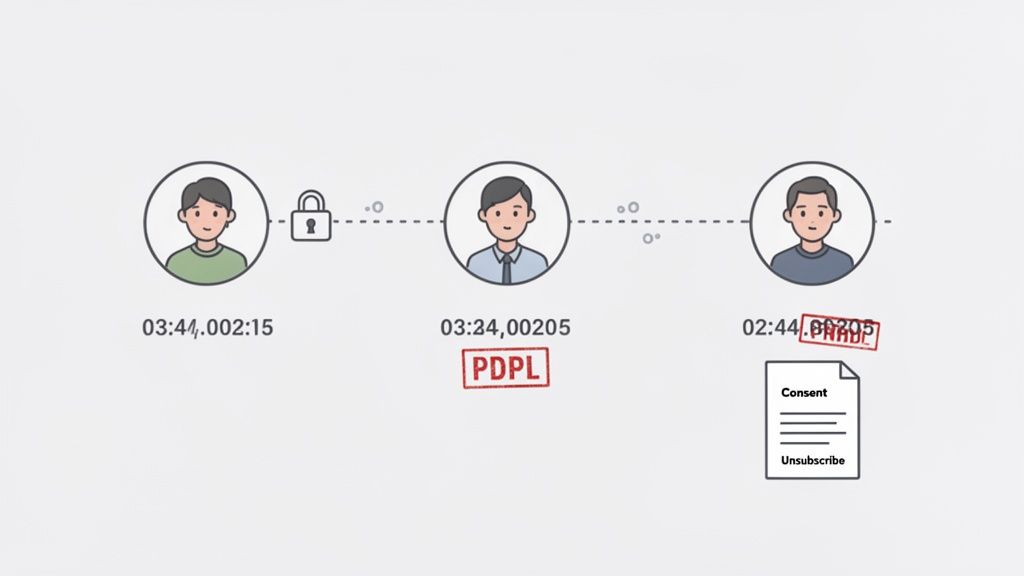
If you're an operations manager in the GCC, you know that compliance isn't just a box to tick—it's a critical part of doing business. A formal approval workflow does more than just stop errors; it naturally builds a digital paper trail for every single outbound campaign. Think of it as your company's built-in compliance record.
This system automatically logs every key action, giving you a clear, timestamped history. When regulators come knocking, this audit trail is your first and best line of defense. It’s the definitive proof that answers the tough questions before they’re even asked.
What Your Audit Trail Must Document
A solid audit trail, whether it's built into your CRM or another system, needs to capture a few non-negotiable data points for every single message, no matter if it’s an email, a WhatsApp blast, or an SMS campaign.
- Who created the campaign: The exact team member who drafted the initial message.
- Who approved each stage: The names and user IDs of every manager who gave the green light.
- When each approval happened: The specific date and time of every sign-off, which creates an unbreakable timeline.
- What was actually sent: A perfect snapshot of the final, approved content, including the offer and the specific audience segment.
This isn't about finger-pointing. It's about moving away from "he said, she said" and into a world of documented, factual processes. This is the concrete evidence you'll need to demonstrate due diligence if a customer ever raises a data privacy concern.
Keeping Up With Regional Data Privacy Laws
This kind of meticulous documentation is absolutely essential for navigating the complex data protection laws across the MENA region, like the UAE's Personal Data Protection Law (PDPL). If a complaint ever comes in, you can immediately pull up the record showing the campaign went through a rigorous, multi-stage review.
The reality is, data privacy enforcement across the region is getting more serious. The Dubai International Financial Centre (DIFC) alone has handed out dozens of fines since late 2020, many of which stemmed from failures in outbound communication compliance. With new data privacy laws constantly emerging across MENA, the pressure is on to prove you’re accountable.
An approval workflow turns compliance from a reactive scramble into a proactive, systemized part of your daily operations. It’s proof that you systematically check for consent, verify audience lists, and provide clear unsubscribe options.
At the end of the day, an audit trail is far more than just a defensive tool. It turns a simple internal process into a powerful business asset. By systematically recording your commitment to responsible communication, you build customer trust—a major competitive edge in the MENA market. This kind of meticulous record-keeping is just as crucial as maintaining accurate financial documents, a principle you can see in action in our guide to creating a sample pro forma invoice.
Common Questions About Email Approval Workflows
When you start building or tweaking your outbound approval process, a few key questions always pop up. Here are some straight answers to the things we hear most often from business owners and ops managers across the MENA region.
How Can We Add Approvals Without Slowing Everything Down?
This is the big one. The secret is to think lean and role-based, not bureaucratic. You don't need everyone to approve everything.
Instead, create specific, focused checkpoints inside your CRM. Maybe the content specialist clears the copy and translation, while the marketing manager only validates the audience segment and the offer itself. Using your CRM's automation is non-negotiable here. The system should ping the next person in line the second a task is ready for them. This keeps the message moving forward, adding that critical layer of oversight without becoming a frustrating bottleneck.
What Is the Biggest Mistake Companies Make with Email Approvals?
Hands down, it's over-engineering the process. I’ve seen five-stage approval workflows for a simple weekly newsletter, and it’s just not productive. That kind of complexity trains your team to mindlessly click "approve" to clear their queue, which completely defeats the purpose.
Start simple. A two-step flow like Creator -> Manager is often all you need. Save the more complex, multi-stage workflows for the high-stakes campaigns—think major product launches or a massive promotional blast hitting your entire GCC database. The goal is smart risk reduction, not creating red tape for the sake of it.
Can We Use Different Workflows for Different Communications?
Not only can you, but you absolutely should. A transactional email like a password reset probably needs zero manual approval; it should just go out. On the other hand, a marketing campaign to your entire database better have a few rigorous sign-offs.
A sales sequence for high-value leads might just need a quick once-over from a sales director. Smart teams tailor their workflows based on the campaign type, audience size, and even the channel—whether it's Email, WhatsApp, or SMS. This is how you prevent outbound email mistakes with approval workflows that are both effective and efficient.
How Do We Manage Approvals for Bilingual Campaigns?
For any business in the MENA region, this is a must-have step. Your workflow needs a dedicated checkpoint where a native speaker of both Arabic and English reviews the final version.
This person is looking for the things automated tools and non-native speakers almost always miss: subtle cultural nuances, correct local dialects, and especially those tricky right-to-left (RTL) formatting glitches that can make a message look broken on different devices. Relying on machine translation for that final check is a recipe for brand-damaging mistakes.
At SMOrchestra, we design and operate the precise outbound, CRM, and automation workflows that systemize your growth. We build the bilingual customer journeys that help MENA businesses generate leads and close sales predictably. Learn more about our systems at smorchestra.com.

Read Our latest
Lorem ipsum dolor sit amet, consectetur adipiscing elit.