For a business in the MENA region using a CRM, a digital marketing lead isn't just a contact detail. It's the trigger for an automated sales workflow—a clear signal from a potential customer through a digital channel, giving your systems the green light to start a structured engagement.
From Raw Clicks to Automated Sales Workflows
Let's skip the textbook definitions. For a business in the MENA market, especially one using automation, a lead is the first input into a revenue-generating machine.
Picture your marketing as an operational workflow. Raw clicks, website visits, and social media interactions are the initial inputs—plentiful, but not useful on their own. The real value is created during the process. Your CRM, email marketing, and WhatsApp automation systems are the machinery, taking that raw interest and systematically processing it into a qualified opportunity ready for your sales team.
This is how you turn marketing activities into predictable sales outcomes. To execute this, a solid understanding of customer profiling techniques is essential to ensure you're feeding the right inputs into your system from the start.
Connecting Marketing Actions to Sales Outcomes
As a business owner or sales leader, you need to see a clear, automated path from a marketing click to a closed deal. A lead is that connection made visible. It’s the exact moment a website visitor becomes a named prospect in your CRM, ready for a pre-defined follow-up sequence.
This is where integrated sales and marketing systems are critical. Here’s how that transition plays out in a practical workflow:
- Initial Interaction: A prospect sees your ad on Instagram and hits the "Chat on WhatsApp" button.
- Automated Capture: Instead of a sales rep manually replying, your system instantly captures their number, creates a contact in your CRM, and tags them based on the specific ad campaign.
- Immediate Engagement: An automated, bilingual (Arabic/English) welcome message is sent via WhatsApp, perhaps asking a simple qualifying question to segment their interest.
- Systemized Nurturing: Based on their answer, another automated action is triggered. This could be an email with a relevant case study or a notification to a sales rep to initiate a call.
This seamless flow is the modern digital marketing lead in action. It’s not about just collecting contact info; it’s about initiating a structured, automated journey that moves a person through your sales funnel. To better understand that journey, see our guide on what a sales funnel means and how to map it.
A lead isn't a task for your marketing team. It's the starting point for a systematic sales process. The objective is to create an integrated engine where every marketing touchpoint triggers a predictable, measurable, and automated sales action.
Adopting this operational mindset is crucial for scaling in the competitive MENA market. It’s the difference between running disconnected campaigns and building a single, powerful system that generates revenue efficiently.
Building Your MENA Lead Lifecycle Automation Map
Acquiring a digital marketing lead isn't the end goal—it's the start of an automated process. For any business serious about growth in the MENA region, you must map the entire customer journey. This isn't a theoretical flowchart; it's your operational blueprint for turning initial interest into predictable revenue.
Think of it as transforming scattered, manual efforts into a well-oiled, automated system. Each stage is a step in a workflow inside your CRM, methodically moving a contact from a stranger to a customer.
Stage 1: Attract
First, you need to pull in the right prospects. This isn’t about casting the widest net. It’s about using a targeted magnet. In the MENA market, that magnet is high-value, bilingual content that addresses the specific operational challenges and goals of your ideal customer.
- Bilingual Content is Non-Negotiable: Develop practical guides, case studies, and social media content in both Arabic and English. An e-commerce brand could create a guide on "The Best Eid Gifts for Family," while a B2B tech firm might publish a whitepaper on "AI-Driven Logistics in the GCC."
- Smart Outreach: Don't just post and wait. Use your outbound systems to deliver this content to carefully segmented contact lists. The goal is to become a trusted resource long before you ask for their business.
Stage 2: Capture
Once you have their attention, you must capture their information—and it needs to be fast and frictionless. This is where your CRM and communication channels must work in perfect sync. In this region, slow, clunky forms are conversion killers.
In the MENA market, the transition from a social media ad to a conversation must be instant. The best capture methods remove all friction, like a one-click WhatsApp chat that triggers a CRM workflow.
A prime example is running "Click-to-WhatsApp" ads on Instagram or Facebook. When someone clicks, it shouldn't just open a chat. A smart automation workflow should instantly create a new contact in your CRM, tag them with the specific ad campaign, and log the interaction. This eliminates manual data entry and ensures no lead is lost.
Stage 3: Nurture
You have their contact details. But a lead is not a sale. The nurture stage is where you build trust and demonstrate value with automated follow-ups. This is critical in the relationship-driven MENA market. At the heart of building this effective automation map lies the power of a robust Marketing Automation API, which enables the seamless integration needed for these personalised campaigns.
This is also where your bilingual workflows are essential. Your CRM should be configured to trigger a pre-built sequence of messages based on the lead's language preference, determined at the first touchpoint.
- Email Drip Campaigns: Send a series of automated emails in their preferred language—Arabic or English—that provide case studies, testimonials, or helpful tips.
- WhatsApp Follow-ups: Use automated WhatsApp messages for a more direct touch. Send appointment reminders, share quick updates, or re-engage contacts who have gone quiet.
Stage 4: Convert
After a lead has been nurtured—they’ve opened your emails, clicked on links, or replied to your messages—they become a Marketing Qualified Lead (MQL). At this point, your CRM should automatically flag them as a high-potential prospect and assign them to your sales team.
This automation prevents your sales team from wasting time on cold leads. They can focus their energy on engaged prospects, armed with a complete history of every interaction. The conversation shifts from a cold call to a warm, informed discussion.
Stage 5: Grow
The journey doesn't end when a deal is closed. Retaining a customer and turning them into a repeat buyer is far more profitable than constantly acquiring new ones. Post-sale automation is key to building loyalty and generating more revenue from your existing customer base. For deeper insights into leveraging AI for this purpose, consider exploring how an AI automation agency can build systems that enhance customer retention.
A few simple automated workflows can make a significant difference:
- Automated Onboarding: Trigger a welcome series via email or WhatsApp that helps new customers get the most value from their purchase.
- Satisfaction Surveys: Automatically send a quick SMS or email asking for feedback a week after purchase.
- Upsell Campaigns: Based on their purchase history, enroll customers into automated campaigns that introduce relevant products or services.
Let's summarize. The table below breaks down each lifecycle stage with practical automation examples for the MENA market, showing how your email, WhatsApp, and CRM systems can work together.
Lead Lifecycle Stages and Corresponding MENA Automation Workflows
By mapping out and automating these critical touchpoints, you build a powerful, scalable engine for growth that is perfectly tuned for the expectations and behaviors of the MENA customer.
Putting Your Lead Generation Channels to Work
You've mapped your automation strategy; now it's time to activate the channels. This is where your plan meets execution. Forget generic advice—we’re focused on practical, channel-specific tactics built for the MENA market. The goal is to funnel high-quality digital marketing leads straight into your CRM and sales pipeline.
We'll focus on four key channels: Paid Ads, Social Media, Conversational Marketing, and Outbound. Each strategy is designed to integrate directly with your automation systems, ensuring every dirham spent delivers a measurable result and turns each channel into a predictable source of revenue.
Using Paid Ads to Feed Your CRM Directly
In the MENA region, paid advertising is a primary tool for capturing leads now. The key is to design campaigns that do more than generate clicks—they must deliver sales-ready contacts directly into your CRM.
This approach is highly effective given the regional ad spend. Digital ad spend in the MENA region is exploding, fueling a surge in quality leads for e-commerce and B2B tech. The market is on track to hit $2.8 billion by 2025, with a solid 20.6% annual growth rate. You can find more data on the MENA digital ad market at Astute Analytica.
To capitalize on this trend, build your campaigns for conversion:
- Use Native Lead Forms: Instead of sending traffic to a generic homepage, use the lead generation forms built into platforms like LinkedIn, Facebook, and Instagram. They pre-fill user information, reducing friction and increasing submission rates.
- Connect Directly to Your CRM: Integrate your ad accounts with your CRM. When a lead form is submitted, a new contact should be automatically created, tagged with the campaign source, and assigned to a sales rep or an automated follow-up sequence.
- Run Click-to-WhatsApp Ads: For instant engagement, run ads that open a WhatsApp chat. This is highly effective in the GCC, where immediate response is expected. The first message can trigger a bot to qualify the lead instantly.
For any business, getting the mechanics right is critical. A fantastic starting point is our guide on pay-per-click advertising in Dubai, which takes a deeper dive into building effective local campaigns.
This diagram shows the workflow, from attracting attention to nurturing a contact into a qualified lead. This is the core of turning ad traffic into business.

The key takeaway? Capturing the lead is just the first step. The real value is created in the systematic, automated nurturing that follows.
Turning Social Media Chatter into Sales Leads
Across the GCC, social media platforms like Instagram, TikTok, and LinkedIn are lead generation goldmines. However, many businesses let likes and comments go to waste instead of converting them into sales opportunities. The solution is automation.
Don't let valuable interactions die in your comment section. Use automation to immediately move interested prospects from a public forum into a private, trackable sales conversation within your CRM.
Here’s how to set this up:
- Keyword Triggers: Configure an automation tool to monitor your comments and DMs for specific keywords like "price," "how," "details," or "كم السعر".
- Automated DM Response: When a keyword is detected, the system instantly sends a direct message: "Thanks for your interest! To get you the right details, could you share the best WhatsApp number to reach you on?"
- WhatsApp Integration: Once they reply with their number, another automation sends a welcome message on WhatsApp, starting the qualification process and logging the new lead in your CRM.
This system transforms passive social media engagement into a proactive stream of digital marketing leads, ensuring you never miss an opportunity.
Rolling Out Bilingual Conversational Marketing
Conversational marketing, especially via WhatsApp, is essential for lead generation in the MENA region. It's about meeting customers where they are and providing the instant, personal interaction they expect. A smart, bilingual bot can handle initial screening, freeing up your sales team to engage with qualified prospects.
Consider a real estate developer in Dubai. A potential buyer messages their WhatsApp number about a new property.
- Initial Triage (Bilingual): The bot instantly responds: "Welcome! For English, reply 1. للعربية, رد بـ 2."
- Qualification Questions: Depending on the language chosen, the bot asks qualifying questions: "Are you looking for a 1, 2, or 3-bedroom apartment?" and "Are you an investor or an end-user?"
- CRM Update & Handoff: The answers are automatically sent to the lead's profile in the CRM. If the lead is flagged as high-value (e.g., an investor), the bot immediately notifies a human agent to take over the conversation.
This process provides a smooth customer experience while efficiently segmenting new leads for your team.
Systemizing Your Outbound Sales Efforts
Outbound remains a powerful channel for B2B lead generation when executed with precision and automation. The old "spray and pray" email blast is ineffective. Success today requires building hyper-targeted prospect lists and using automation for the initial outreach.
Start by defining your Ideal Customer Profile (ICP). Then, use tools to build a clean list of contacts who fit that profile.
With your list ready, use an outbound automation platform to launch a multi-channel outreach sequence. Modern systems can coordinate emails, social media touchpoints, and even automated AI voice calls to follow up with warm leads who have engaged with your content. This integrated system ensures every touchpoint is part of a deliberate, measurable strategy to generate high-quality digital marketing leads.
Mastering Bilingual Lead Nurturing with Automation
In the MENA region, communicating with customers in both Arabic and English is a fundamental requirement for building trust and closing deals. When using automation, a bilingual approach allows you to scale the personal, rapport-building touch that is crucial for success.
The process begins the moment a new digital marketing lead enters your system. The goal is to create automated sequences that instantly detect a lead’s language preference and guide them down a path that feels natural.
Building the Initial Language-Tagging Workflow
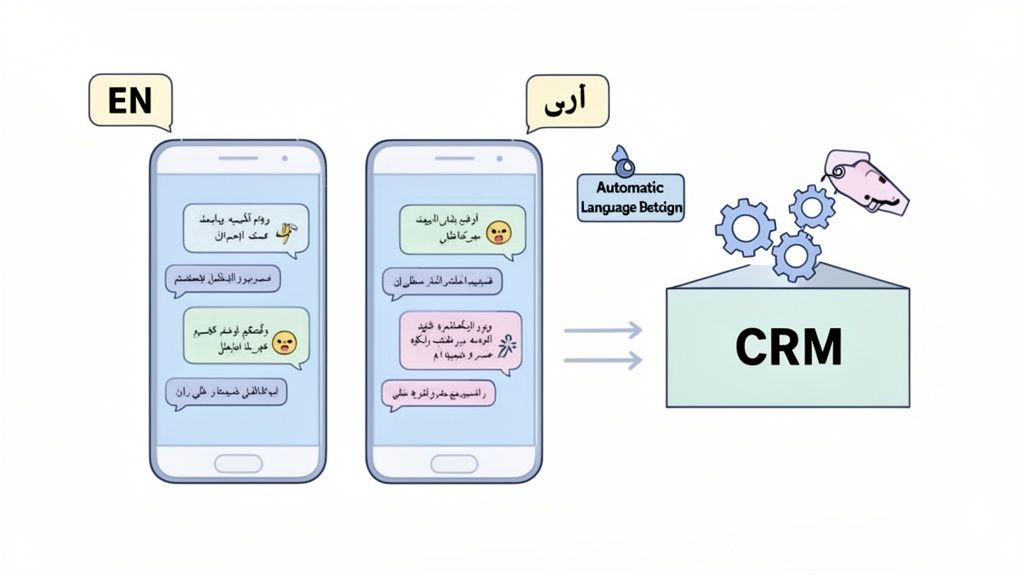
Effective nurturing systems identify a lead's language from their first interaction. This should not be a manual task; it's a simple but powerful automation configured once within your CRM.
Here’s how a standard workflow operates:
- Interaction Source: A lead clicks an Arabic-language Facebook ad or fills out a form on your English landing page.
- Automated Tagging: Based on that initial touchpoint, your CRM automatically tags the new contact with their likely language ("Arabic" or "English").
- Journey Trigger: That tag immediately initiates the correct nurturing sequence, ensuring every subsequent email, WhatsApp message, or SMS is in their preferred language.
This simple setup prevents the awkwardness of sending an English follow-up to an Arabic-speaking lead—a small mistake that can break trust and lose a sale. The right CRM is key; you need one that supports custom tags and automation triggers. We break down what to look for in our guide to the best CRM options for small businesses.
Practical Bilingual Nurturing Examples
Let's look at practical scenarios that can run automatically in the background.
For a SaaS Company: A user signs up for a free trial on your English website. They are tagged "English" and instantly receive an onboarding email sequence in English. A week later, an automated WhatsApp message is sent: "Hi [Name], how are you finding the trial? Any questions so far?"
For a Real Estate Developer: A prospect messages your WhatsApp from an ad targeting Arabic speakers in Riyadh. Your bot’s first message is bilingual, asking them to choose a language. They select Arabic, are tagged accordingly, and begin receiving project updates and virtual tour links in a familiar Khaleeji dialect.
The goal is to make your automated outreach feel as personal as a one-on-one chat. Respecting a lead's language from the start demonstrates cultural awareness and builds a foundation of trust.
The Impact of Mobile and Social on Bilingual Leads
This strategy is particularly effective in the mobile-first MENA market. Social media and smartphone usage are driving a high volume of digital leads. Research shows that by 2029, MENA's streaming viewership is expected to hit 365 million. YouTube penetration is already at 94% in the UAE and 89% in Saudi Arabia. For businesses in healthcare, e-commerce, or service industries, using bilingual WhatsApp and voice bots is essential for converting this engagement. You can dive deeper into MENA marketing trends from Think with Google.
Ultimately, building these automated, bilingual workflows is a one-time investment that delivers continuous returns. It allows your sales and operations managers to scale relationship-building, ensuring every lead feels understood and valued, regardless of their language.
How to Measure Your Lead Generation Performance
To understand the effectiveness of your lead generation, you must look beyond surface-level metrics like clicks and impressions. For business owners and sales leaders in the MENA region, the real story is in your CRM. That’s where you find the numbers that impact your bottom line.
When you track the right metrics, your CRM becomes a predictive tool. It helps you forecast sales, allocate budget effectively, and fine-tune your operations for sustainable growth. This isn't just about running campaigns; it's about building a data-driven business.
Key Metrics for Your CRM Dashboard
Your CRM dashboard should be the command center for your lead generation machine, providing a clear, real-time snapshot of performance. Focus on a few crucial Key Performance Indicators (KPIs) that connect marketing activities to sales outcomes.
Here are three essential metrics to track:
- Cost Per Qualified Lead (CPQL): This is the ultimate measure of channel efficiency. It tells you exactly how much you're spending to acquire a single lead that your sales team deems a valid prospect. A high CPQL on one channel is a clear signal to reallocate that budget to a more effective one, like an automated WhatsApp campaign.
- Lead Velocity Rate (LVR): This metric tracks the month-over-month growth of your qualified leads. A healthy, rising LVR is a strong predictor of future revenue because it shows your pipeline is consistently expanding. It's a forward-looking indicator that helps you anticipate sales rather than just react to past results.
- Lead-to-Close Ratio by Channel: Not all leads are equal. This ratio reveals which channels—Google Ads, LinkedIn outreach, or your WhatsApp bot—are delivering leads that convert into paying customers. A channel might generate a high volume of leads, but if they don't close, it's attracting the wrong audience.
Building and Interpreting Your Dashboard
Setting up these KPIs in your CRM is typically straightforward using custom reports or widgets. The real value comes from interpreting the data and acting on it.
For example, if your CPQL from paid search is high but the Lead-to-Close Ratio for those leads is excellent, you know the leads are valuable. The challenge then becomes optimizing the campaign to lower the cost without sacrificing quality. Conversely, if your WhatsApp channel has a low CPQL but those leads rarely close, you need to refine your bot’s qualification questions to filter out unsuitable prospects earlier.
This level of analysis is increasingly important. The digital marketing analytics market in the Middle East, valued at $90.36 million in 2024, is projected to reach $322.425 million by 2025—an 18.068% annual growth rate. This trend makes it easier to track lead sources. You can explore insights from Cognitive Market Research to learn more.
Think of your CRM dashboard as the cockpit of your sales operation. Each metric is an instrument indicating your engine's performance, allowing you to make real-time adjustments to achieve predictable revenue growth.
By monitoring these core metrics, you move from guesswork to operational clarity. It’s the difference between hoping for growth and engineering it. For any business serious about scaling, mastering these numbers is not optional. If you need help implementing these measurement strategies, consider what a results-focused digital marketing agency can put in place. This data-first approach ensures every riyal or dirham invested in generating digital marketing leads delivers a measurable, optimized return.
Answering Your Top Questions About MENA Lead Generation
Diving into automated lead generation raises practical questions, especially for businesses in the MENA region. Here are the most common questions from sales, marketing, and operations managers building out these systems, with straightforward, practical advice.
"I Only Have a Contact List. Where Do I Even Begin?"
If you're starting with a spreadsheet of contacts, your first step is to get them into a proper system. Managing leads from a spreadsheet is unsustainable.
First, implement a CRM. This is your foundation. Import your list and begin segmenting contacts based on known data—source, location, or past interactions. This simple organization is the first step toward predictable growth.
Next, master one channel. Don't try to do everything at once. For the MENA market, WhatsApp is an excellent starting point. Your initial goal should be to create a simple, automated welcome message for any new lead from that channel.
The point isn't to build your entire lead generation engine overnight. It's to perfect a single, solid workflow—from initial contact to the first automated follow-up.
Once that one channel reliably feeds new digital marketing leads into your CRM, you can layer on more complexity, like an email nurture sequence. This methodical approach ensures each part of your system is robust before you expand.
"What’s the Biggest Mistake People Make with WhatsApp Leads in the GCC?"
The single biggest mistake is relying on manual human follow-up. In a market that operates at the speed of a chat message, any delay is a deal-breaker.
When a potential customer clicks your WhatsApp ad, they expect an immediate response. A delay of even a few minutes can cause them to lose interest. Manual replies cannot meet this expectation of instant gratification.
The second critical error is failing to log the conversation in a CRM. If a chat only exists on a salesperson's phone, it's an invisible asset. The lead is untraceable, there is no accountability for follow-up, and the business has zero visibility.
The solution is straightforward:
- Use the WhatsApp Business API: This is non-negotiable. Connect it directly to your CRM.
- Automate the First Reply: Ensure an instant, relevant message is sent the moment a lead contacts you.
- Track Everything: Automatically log every conversation in the contact's CRM record for a complete history.
"Should My First Automated Message Be in Arabic or English?"
The smartest and most respectful approach is to let the user choose. Never assume a preferred language.
An effective tactic is to send the first automated message bilingually, asking the user to select their language.
- For example: "Welcome! For English, please reply with '1'. للعربية، يرجى الرد بـ '2'."
Their reply triggers an automation that tags them in your CRM with their language preference ("Arabic" or "English"). This simple step ensures all future communication—email, SMS, or WhatsApp—is in their preferred language, improving engagement and rapport from the start.
"Can I Really Use AI Voice for Outbound Leads in MENA?"
Yes, but it must be used strategically. Blasting unsolicited, cold AI voice pitches is ineffective and will damage your brand.
AI voice excels in high-volume tasks for warm leads, such as qualification and reminders. For example, you can use an AI agent to call a list of webinar registrants to confirm their attendance or follow up with leads who have submitted a demo request form.
If you deploy AI voice, ensure you do it correctly:
- The AI must have a high-quality, natural-sounding Arabic or English accent appropriate for your target audience.
- You must provide a clear and easy option for users to transfer to a human agent at any point during the call.
This way, AI voice serves as an efficient assistant, not an intrusive robot.
Ready to build an automated system that generates, nurtures, and closes leads predictably? SMOrchestra designs and operates the AI-powered sales and marketing workflows that drive growth for MENA businesses. Explore our systems at smorchestra.com.

Read Our latest
Lorem ipsum dolor sit amet, consectetur adipiscing elit.