Let's be honest, staring at a generic standard operating procedures formats and template can feel like an absolute waste of time, especially when you're working in the MENA region. Most of these off-the-shelf documents just miss the point entirely because they’re clueless about the operational realities of places like Dubai, Riyadh, or Cairo.
A truly effective SOP isn't just a dusty document you file away. Think of it as a living blueprint for a scalable, automated business machine—one that’s built for how your customers and your teams actually behave on the ground.
Why Standard SOP Templates Fail In The MENA Market
The heart of the problem is that most standard SOP templates are built around a Western business model. This creates instant friction the moment you try to apply them to the business culture in the Gulf and the wider MENA region. They simply don't have the right structure or fields to capture the nuances that make or break your success here.
Trying to force a rigid, one-size-fits-all approach on your team doesn't just fall flat; it can actively get in their way. You end up boxing them into workflows that don’t align with local customer expectations, which leads straight to frustrated staff, inconsistent service, and a lot of missed opportunities.
The WhatsApp Reality
One of the biggest disconnects is communication. In markets like the UAE and Saudi Arabia, customer conversations are happening on WhatsApp, not buried in email inboxes. So, that generic sales SOP outlining a five-step email follow-up sequence? It’s pretty much useless when your leads are sending you voice notes in Arabic.
Your procedures have to live in the real world. That means they need to explicitly cover things like:
- Response Time SLAs: What’s the absolute maximum time a customer should wait for a reply on WhatsApp?
- Language Protocol: Who jumps on Arabic inquiries versus English ones? How do you handle "Arabizi" (that mix of Arabic and English text)?
- Escalation Paths: When a question gets tricky, how does it get from a junior team member to a senior specialist right inside the WhatsApp chat?
Any template that doesn’t put WhatsApp front and center for sales and support is fundamentally broken for this market.
Multilingual Team Dynamics
Another huge piece of the puzzle is the multilingual nature of our teams. It’s completely normal for a customer service agent in Dubai to flip between formal Arabic, a local dialect like Egyptian or Khaleeji, and English—all within the same conversation.
An SOP has to provide crystal-clear guidance on which language to use in specific situations. It should also have standardized responses ready to go in both English and Arabic. Without this, your brand's voice gets choppy and inconsistent, and the customer experience pays the price.
This is a challenge that generic, off-the-shelf templates are utterly unprepared to handle. Your procedures need to be a playbook for this linguistic dance, not a rigid script that pretends it doesn't exist.
For a deeper dive into building these kinds of operational systems, our guide on creating a high-performing digital marketing agency offers some great frameworks you can adapt for any team. It helps shift your thinking from just documenting tasks to truly building a system. The goal here is to get away from static documents and create an operational blueprint you can automate, scale, and fine-tune for the way business actually gets done here.
Choosing The Right SOP Format For Your Operations
Not all processes are built the same, so your SOPs shouldn't be either. Picking the right format is the difference between a living document your team actually uses and one that just collects dust. The structure has to fit the task at hand, otherwise, you're just creating confusion.
For teams in the GCC, this decision gets even more interesting. A procedure for handling a customer complaint on WhatsApp needs a totally different layout than a multi-stage B2B sales sequence that switches between Arabic and English. Let's dig into the three most effective formats and figure out exactly when to pull each one out of your toolbox.
Here’s a quick breakdown to help you compare the three main formats at a glance.
SOP Format Comparison For Key Business Functions
Choosing the right format from the get-go saves a ton of headaches down the line and makes sure your team can actually execute the plan.
The Simple Checklist Format
Let's start with the basics: the checklist. It’s just a straightforward list of tasks that need to be ticked off. Think of it as a simple memory aid, perfect for routine jobs where the steps are always the same and don't require much explanation.
You'll want to use a checklist for repetitive tasks with a low risk of error, where the main goal is just to make sure nothing gets forgotten. It's all about accountability, not deep instruction.
- Best For: Daily opening and closing duties, basic equipment safety checks, or the pre-flight steps for scheduling a social media post.
- MENA Example: A daily checklist for a clinic’s front desk staff in Jeddah. This would cover prepping patient files, sending out appointment reminders via WhatsApp, and making sure the reception area is good to go.
The Hierarchical or Step-by-Step Format
When you need more detail than a checklist can offer, the step-by-step (or hierarchical) format is your go-to. This approach breaks a major process into a series of clear steps, and each of those steps can have its own set of detailed sub-steps. It gives your team both the big picture and the nitty-gritty details.
This format really shines when you need to explain the "how" and "why" behind each action. It's perfect for training new hires or documenting complex procedures that need to be followed to the letter. If you're managing intricate operational tasks, you can learn more from our deep dive into logistics in a warehouse.
Getting this right has a real, measurable impact. In the UAE and Saudi Arabia, well-structured SOPs have slashed customs processing delays by up to 40% in key industries. For marketing agencies in Dubai, breaking down their process into modular SOPs for attracting, capturing, and nurturing leads has boosted lead-to-sale conversions by 30-50%. Why? Because it ensures every single step gets done right, every time.
The Flowchart Format
For any process that involves decision-making and multiple possible outcomes, nothing beats a flowchart. It’s a visual map of the entire workflow, using different shapes and arrows to show steps, decisions, and what happens next. That visual element makes it incredibly easy to understand complex logic in a single glance.
A flowchart is the only format that can cleanly map out "if-then" scenarios, making it essential for customer-facing roles where interactions are unpredictable.
Picture a customer support agent in Riyadh handling an inquiry on WhatsApp. The customer could be happy, angry, or just have a technical question. A flowchart can guide that agent through every possible path, ensuring they deliver a consistent, high-quality response no matter how the conversation twists and turns.
This decision tree gives you a visual guide on when to pick a specific format, especially when dealing with common MENA business realities like heavy WhatsApp use and multilingual customer bases.
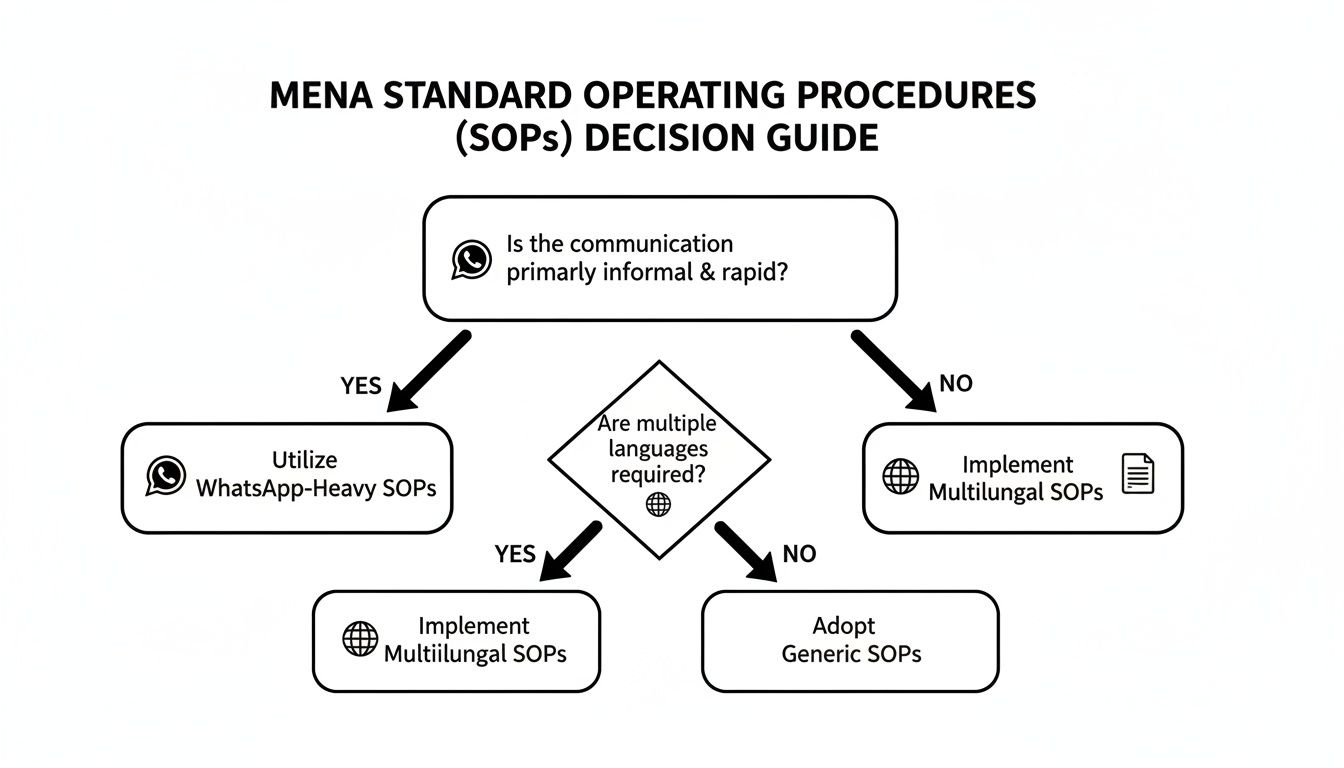
The big takeaway here is that your main communication channels and your customers' languages should directly shape which SOP format you choose. That's how you make them truly effective.
Building Your Master SOP Template
Alright, let's get our hands dirty. It's time to move from theory to practice and build the one template to rule them all: your master SOP. Forget those generic downloads you find online. We're going to create a foundational, reusable template with all the essential components you need, especially for a team operating in the MENA region.
Think of this master template as your blueprint. It's the starting point for every single process you document, whether it's for sales, marketing, or customer care. By standardizing this core structure, you're creating a sense of familiarity. Your team will know exactly where to find the information they need, no matter what task is at hand.
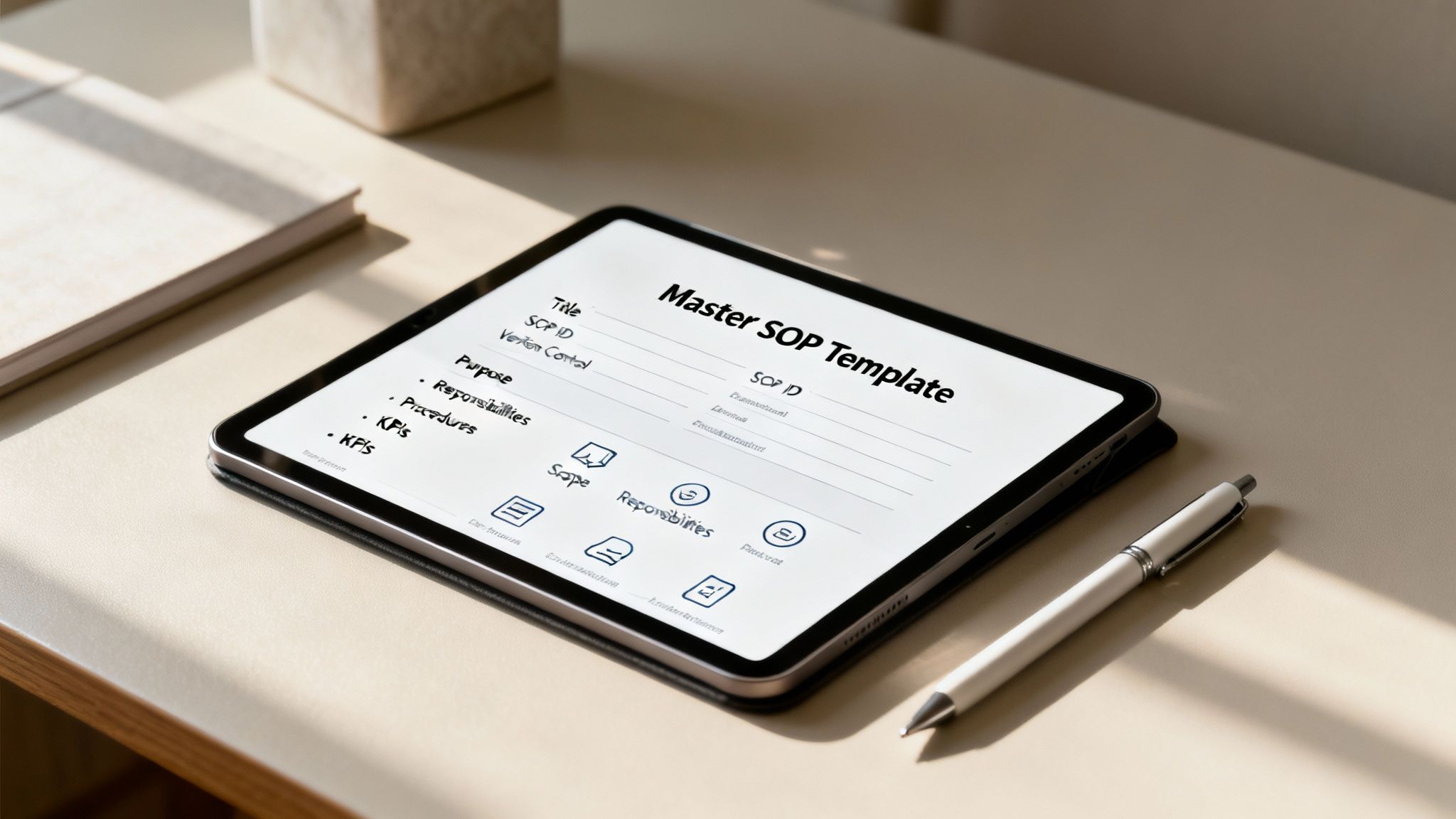
Core Administrative Components
First things first. Every single SOP, no matter how simple, needs a clear administrative header. This isn't just bureaucracy for the sake of it; it's about control and clarity. It’s what stops someone from using an outdated process and causing a mess.
- SOP Title: Be brutally specific here. "Lead Follow-Up Process" is way too vague. Something like "B2B Lead Qualification via WhatsApp - UAE Market" leaves no room for guessing.
- SOP ID: A simple, unique code (like SALES-001 or SUPPORT-003) is a lifesaver. It makes it foolproof to reference the exact document in a meeting or a training session.
- Version Number: I stick to a simple system like v1.0, v1.1, v2.0. This little number is your front-line defense against chaos caused by someone following an old, retired procedure.
- Effective Date: This is the date the SOP officially goes live.
- Owner: Who is the single point of contact responsible for keeping this document fresh? Assigning a name or role here makes accountability crystal clear.
These simple fields might seem trivial, but they instantly answer the most critical questions: "What is this for?" and "Is this the latest version?"
Defining Purpose, Scope, and Roles
Once the admin info is in place, you need to set the scene. This part of the template defines the why, the what, and the who. Getting this right is critical for team alignment and making sure nothing falls through the cracks. It's a good idea to perform a structured review to understand what your process looks like now versus what you want it to be. Our gap analysis template can give you a solid framework for spotting these differences.
Here's what this section must include:
- Purpose: Keep it short and sweet. A sentence or two explaining why this SOP even exists. What problem is it solving? What's the goal?
- Scope: You have to draw clear lines in the sand. When does this process begin and end? Which teams, tools, or customer types does it cover? For instance, you could specify that a procedure is only for leads coming from Saudi Arabia or for support tickets submitted in Arabic.
- Responsibilities: List the roles involved and what they're on the hook for. Crucially, use titles, not names (e.g., BDR, Account Executive, Arabic Support Specialist). This is where you can detail that the Arabic Support Specialist handles all incoming WhatsApp inquiries in Arabic, while the BDR takes the English-language web form submissions.
The Heart of the SOP: Procedures and Metrics
Now we get to the main event—the actual step-by-step instructions. Your goal here is to be so clear that a brand-new hire could follow the steps and get the same result every time. I always use a numbered list for this; it’s just easier to follow. Keep the language direct and simple.
If you're starting from scratch and need more guidance, this step-by-step guide on creating Standard Operating Procedures is an excellent resource.
MENA Example: Procedure for a UAE Landing Page Lead
- Lead submits a form on the "Dubai Real Estate" landing page.
- An automated email is sent instantly in English confirming receipt.
- Within 15 minutes, the assigned BDR sends the approved WhatsApp template (Template ID: WHATSAPP-LEAD-ENG-01).
- If no reply within 4 hours, BDR follows up with a second WhatsApp message (Template ID: WHATSAPP-LEAD-ENG-02).
- BDR updates the lead status in the CRM to "Contacted."
Finally, a process that isn't measured can't be improved. The last part of your master template has to define what success actually looks like.
- KPIs & Metrics: How do you know if you're winning? List 2-3 key performance indicators. This could be something like "Lead response time under 15 minutes" or "80% of support tickets resolved on first contact."
- Tools & Resources: Make it easy for your team. List any software, templates, or links they'll need to do the job (e.g., CRM login, a link to the WhatsApp templates document, or specific email signatures).
By putting in the effort to build this master template now, you’re creating a powerful, adaptable framework. It drives consistency across the board and lays the groundwork for the scalable, automated systems that lead to real, predictable growth.
How To Localize SOPs For Multilingual Teams
When you're operating in the MENA region, localization isn't just about translation. It's about completely re-engineering your processes for a bilingual world. A workflow that’s seamless in English can quickly break down when your team and customers are bouncing between Gulf Arabic, Egyptian dialect, and English in a single interaction.
Adapting your standard operating procedures formats and template for this reality is absolutely critical for delivering consistent, top-tier service. It's about building parallel workflows that respect cultural nuances and linguistic diversity right from the start.
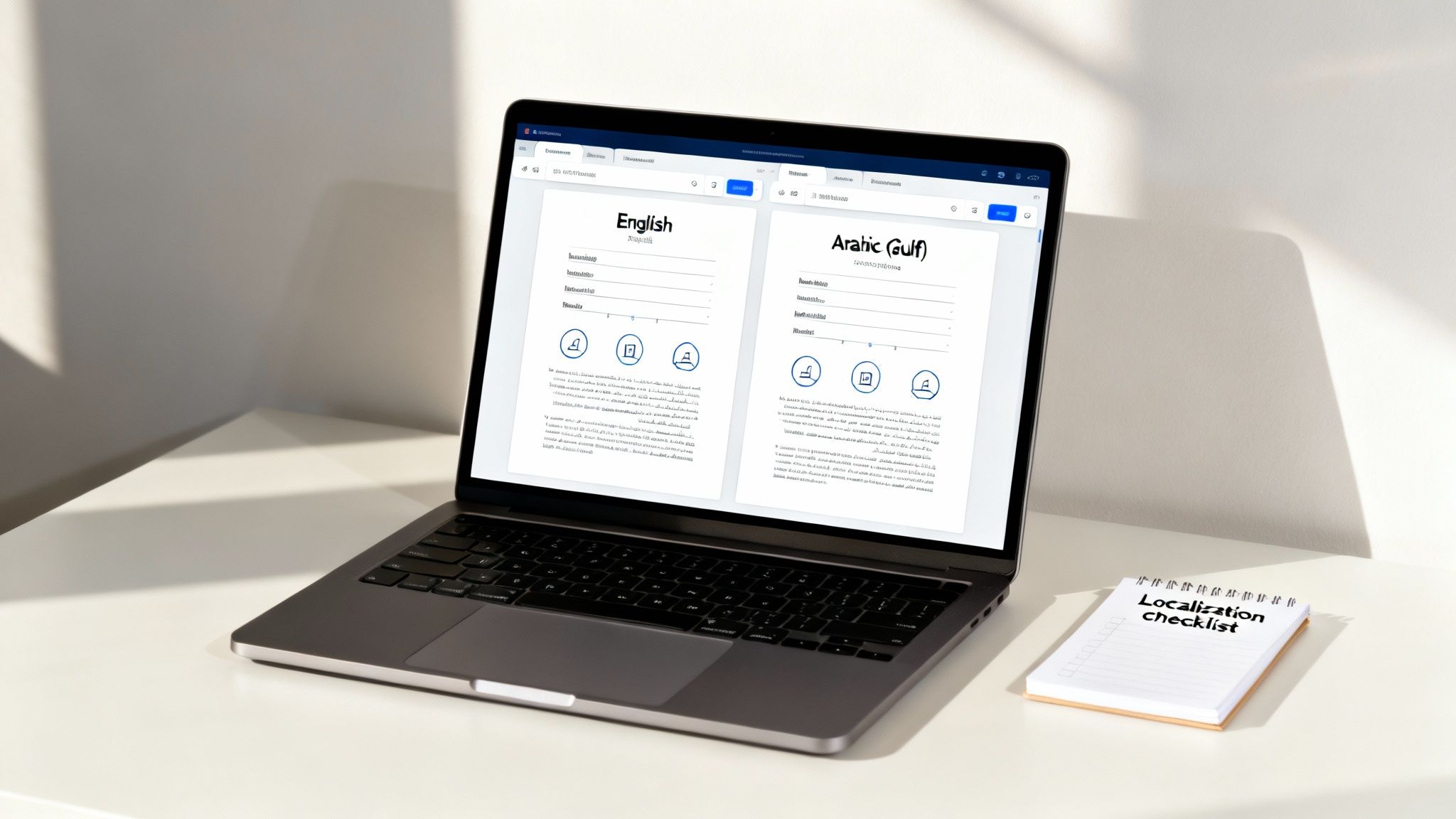
Go Beyond Translation to Operational Adaptation
The classic mistake I see businesses make is taking their English SOPs and just handing them over for a direct Arabic translation. This approach misses the mark because it completely ignores crucial operational differences. Real localization means adapting the entire process, not just swapping out the words.
Think about it this way: a sales follow-up SOP might call for a formal email in English. But for the Arabic version, the most effective step is probably a friendly, pre-approved WhatsApp message. That's how relationships are often built in the region.
The goal is to achieve the same outcome—a qualified lead or a resolved issue—through a process that feels natural and intuitive to both your team and your customers, regardless of the language they're using.
This requires creating distinct, yet perfectly aligned, procedures. The core objective doesn't change, but the steps, tools, and even the conversational tone might be completely different.
Standardizing for Different Dialects
Arabic isn't one single language. A canned response that works for a customer in Riyadh might feel awkward or unnatural to someone in Cairo. Now, you can't create a unique SOP for every single dialect, but you absolutely can—and should—standardize key responses for the major regional variations you encounter.
Your localization efforts should zero in on a few key areas:
- Customer-Facing Language: Standardize greetings, common problem-solving phrases, and closing lines for both Gulf and Egyptian dialects.
- Internal Lingo: Make sure everyone on your team uses the same Arabic terms for your products, services, and internal processes. This cuts down on confusion immensely.
- Visuals are Universal: Lean on icons and simple flowcharts. A well-designed diagram rarely needs translation.
Getting these details right prevents the kind of miscommunications that kill customer trust and create friction within your team. And while you're documenting these processes, it's the perfect time to look at the systems they run on. Our guide on choosing the best CRM for a small business digs into how the right software can be a game-changer for supporting localized workflows.
A Practical Localization Checklist
To make sure your SOPs are not just linguistically correct but also culturally and operationally sound, run them through this checklist.
- Pinpoint High-Impact Processes: Which SOPs have the most customer contact or involve handoffs between multilingual team members? Start with those.
- Map Out Parallel Workflows: For each process, actually document the different steps for an English interaction versus an Arabic one.
- Build Your Bilingual Toolkit: Create approved email and WhatsApp templates in both English and your key Arabic dialects. Give them clear IDs (e.g., CUST-GULF-01) so they're easy to find and use.
- Assign Language Ownership: Be crystal clear about who handles inquiries in which language.
- Sanity-Check Your Visuals: Go through all diagrams and screenshots. Are they cluttered with English-only text that could confuse an Arabic-speaking team member?
- Get Your Team's Feedback: This is the most important step. Ask your bilingual staff: Are the instructions clear? Does this reflect how conversations actually go?
The payoff for this level of detail is huge. World Bank data reveals that GCC firms using SOP templates demonstrate 30% better resilience during economic turbulence, largely because solid procedures eliminate operational chaos. You can dive deeper into how process improvements drive economic strength by reading the full World Bank MENA Economic Update. When you truly operationalize for a bilingual reality, you’re not just translating—you’re building a stronger, more scalable business.
Turning SOPs Into Automated Business Systems
An SOP gathering dust in a shared drive is a wasted asset. Let's be honest, the real power of a well-defined standard operating procedures formats and template isn't unlocked until you stop seeing it as a document and start treating it as the source code for your business systems. This is the leap from just writing instructions to building actions that run parts of your business on autopilot.
It’s all about mapping your documented procedures directly into the logic of your software. A static document becomes a living, breathing workflow that executes flawlessly every time, freeing your team from tedious manual work. This shift from documentation to automation is what separates businesses that scale from those that get stuck.
From Document To Dynamic Workflow
Let's get practical. Think about your "Lead Follow-Up SOP." It's not just a PDF; it's the exact blueprint for an automated sequence. You can take the steps you’ve already laid out and build them directly into a localized CRM that understands how business really gets done in the MENA region. Platforms like SalesMfast AI are a prime example. It's a localized CRM alternative built for SMEs, B2B, clinics, and eCommerce that includes Arabic templates and pre-built automation workflows, meaning your documented SOPs can become active systems without complex configuration.
The same goes for your "Customer Support Triage SOP." That process can be embedded straight into the decision-making logic of a chatbot or the routing system in your contact center. This ensures every single inquiry is handled consistently and sent to the right person immediately, whether it comes in Arabic or English. To really get this right, you need the right tools in your corner. It’s worth exploring the best document automation software platforms to see how they can kickstart this process.
This SOP-first approach isn't just theory; it gets results. A great parallel is the MENA Anticipatory Action (AA) Advocacy Strategy, which showed how standardized formats boosted disaster response efficiency by 50% in their pilots. We see a similar impact when applying this thinking to business systems in Dubai. Implementations that start with a clear SOP have automated up to 60% of routine inquiries and consistently generate between 5-20 booked calls every month. If you’re curious about the details, you can reading the full advocacy report here.
The Power of Templated Systems
For service businesses and agencies, this idea goes a step further. Every time you solve a complex problem for a client, you're essentially creating a brand-new, highly valuable SOP. The biggest mistake I see is leaving that hard-won knowledge locked away in a single project file instead of turning it into a product.
This is the whole philosophy behind SMOrchestra's BOT Model (Build Once, Template). It’s a framework we developed specifically for turning bespoke client work into repeatable, scalable systems.
The BOT Model is about shifting your mindset from selling hours to deploying proven solutions. You take the custom workflow you built—all validated by your SOP—and turn it into a templated system you can roll out for the next client in a fraction of the time.
For any agency trying to break free from the "time for money" trap, this is a genuine game-changer.
Here's how it works in practice:
- Define the Process: First, you document the custom solution you built for a client as a clear, detailed SOP.
- Systemize in Software: Next, you rebuild that exact SOP as an automated workflow inside a core platform, like your CRM or marketing automation tool.
- Template and Deploy: Finally, you save that entire system configuration as a "snapshot" or template that can be quickly deployed for new clients with only minor tweaks.
This approach has been shown to cut delivery time dramatically—often by 60-80%—while ensuring every client gets the same high-quality, battle-tested system. To see how this plays out in the real world, check out our deeper insights on building a scalable AI automation agency. By turning your documented expertise into automated assets, you're not just being more efficient; you're building a foundation for predictable, profitable growth.
Answering Your Top SOP Questions
Even with the best templates in hand, questions always pop up when it's time to put theory into practice. Getting your SOPs off the page and woven into your team's daily rhythm is where the real challenge—and reward—lies. Here are some of the most common questions we get from teams across the MENA region, along with straight-to-the-point answers.
How Often Should We Actually Review and Update Our SOPs?
Think of your SOPs as living documents, not dusty binders on a shelf. For most procedures, a formal review once a year is a solid baseline. It’s a dedicated time to make sure they haven't become stale or irrelevant.
However, some areas of the business move much faster. For anything in sales or digital marketing, especially in a dynamic market like the UAE, you should be looking at your SOPs every quarter. Customer habits, platform algorithms, and marketing tactics can change in a heartbeat, and an annual review just won't cut it.
Beyond your scheduled check-ins, certain events should trigger an immediate update:
- New Tech on Deck: Bringing in a new CRM or a customer support platform? You'll almost certainly need to overhaul the related SOPs from the ground up.
- A Team Shake-Up: When roles and responsibilities shift, your procedures need to reflect the new reality of who does what.
- When Things Keep Breaking: If a process is consistently failing, causing errors, or getting ignored, that's a massive red flag. The SOP is broken, not your team. It's time to rework it with input from the people who live that process every day.
A simple but powerful habit is to use strict version control (e.g., v1.0, v1.1, v2.0) and assign a clear "owner" to every single SOP. This creates accountability and ensures your operational playbook stays sharp.
What's the Best Software for Managing SOPs?
For just writing and storing documents, simple tools like Google Docs or Notion work just fine. They’re accessible, collaborative, and perfect for getting your initial thoughts down. But let's be honest, that's the low-hanging fruit.
The real game-changer is embedding your SOPs directly into the software your team already uses. The procedure shouldn't be something they have to go find; it should guide their actions right inside the tool.
Your SOP shouldn't be a separate document your team has to hunt down and read. It should be the very logic that drives the software they use. This is the difference between a static library and a living, automated system.
For example, when you're mapping out sales and marketing processes, you want a system where you can turn your documented steps—like a specific Arabic WhatsApp follow-up sequence—into a pre-built automation workflow.
The same goes for customer service. A modern contact center solution lets you build your SOPs directly into call routing, IVR menus, and chatbot conversations. The system itself enforces the procedure, guaranteeing a consistent, high-quality experience for every customer, every single time.
How Do We Get Our Team to Actually Follow the SOPs?
This is the million-dollar question, isn't it? You can design the most brilliant, perfectly localized SOP on the planet, but it’s worthless if no one uses it. Adoption is everything.
First and foremost, involve your team in creating them. When people have a hand in building the process, they feel a sense of ownership, and that ownership is the most powerful driver of compliance you'll ever find.
Next, make them ridiculously easy to find. Don't bury your SOPs three folders deep on a shared drive. Link them directly from your CRM, your project management tool, or your team's chat channels. The less friction there is between needing help and getting it, the better.
Finally, you have to prove their value. Connect the dots for your team. Show them how following a specific SOP led to a 20% drop in customer complaints, saves them 30 minutes every day, or directly boosted lead conversion rates. When people see the "why"—and how it makes their own work better—following the process becomes a smart choice, not a chore.
And if a process is still being ignored? Don't just assume it's a discipline problem. Nine times out of ten, it’s a sign that the SOP is out of touch with reality. Treat it as feedback, sit down with your team, and figure out how to make it work.
At SMOrchestra, we don't just write procedures; we build them into automated systems that run your business. We design, build, and operate unified sales, marketing, and customer care engines that deliver predictable, scalable growth for MENA businesses. Find out how we can turn your processes into performance at https://smorchestra.com.

Read Our latest
Lorem ipsum dolor sit amet, consectetur adipiscing elit.