When we talk about logistics inside a warehouse, we're really talking about the complete system that governs how goods move and are stored once they're through the door. It’s the entire strategic playbook, from the moment a shipment arrives at the receiving dock until an order is picked, packed, and sent on its way to a customer. Getting these internal movements right is the key to happy customers and a healthy bottom line.
The Hidden Engine of Commerce in the MENA Region

It’s best to think of a warehouse not as a static box for storing things, but as the powerful, hidden engine driving modern commerce. The discipline of logistics in the warehouse is the art and science of keeping this engine tuned and running at peak performance. It's an intricate choreography ensuring the right product is in the right place, at the right time, and in perfect condition.
This goes far beyond just moving boxes from A to B; it's about strategic, moment-to-moment coordination. In the hyper-competitive markets of the UAE and Saudi Arabia, customer expectations for speed and accuracy are sky-high. Here, operational excellence isn't just a nice-to-have—it’s a basic requirement for survival. A messy, inefficient warehouse triggers a domino effect of problems: delayed shipments, wrong orders, and bleeding revenue.
Why Warehouse Logistics Matters More Than Ever
The stakes are massive. The UAE’s critical role as a global re-export hub, combined with the explosion of regional e-commerce, has transformed warehousing into a colossal economic driver. In fact, the UAE logistics and warehousing market is a multi-billion-dollar industry, projected to hit USD 54.65 billion by 2025. This growth is fueled by massive infrastructure projects and the relentless demand from online shoppers.
This boom creates both incredible opportunities and intense pressure. A company's ability to compete is now directly tethered to the efficiency of its warehouse. For any business in this environment, the warehouse has become a primary battleground where the competitive edge is either won or lost.
A solid logistics strategy directly impacts your entire business:
- Customer Satisfaction: Nothing builds loyalty like fast, accurate order fulfillment.
- Profitability: Smooth processes cut labor costs, slash expensive errors, and make the most of your storage space.
- Scalability: A well-oiled system can absorb growth without buckling under the pressure.
Mastering the fundamentals—receiving, storing, managing, and shipping—is non-negotiable. This is especially true for online businesses, where the customer's final, lasting impression is shaped almost entirely by the delivery experience. Having a great e-commerce website design in Dubai is only half the battle; the other half is flawlessly fulfilling the promises you make on it.
Mastering The Four Pillars Of Warehouse Logistics
Think of a warehouse as a living, breathing organism. For it to run efficiently, every part has to work in perfect harmony. In warehouse logistics, this harmony is built on four distinct pillars that guide a product's entire journey from the moment it arrives until it leaves.
These pillars aren't separate functions; they're a continuous loop. A snag in one area instantly creates a domino effect, causing bottlenecks that ripple through the entire operation. This is especially true in the fast-paced e-commerce markets of the MENA region, where customers expect speed and precision above all else. Let's break down each pillar.
Pillar 1: Inbound Logistics
This is your warehouse's front door. Inbound logistics is all about how you receive goods from suppliers, and it's your first—and best—chance to get things right. It’s far more than just unloading a truck.
A sloppy receiving process is a recipe for disaster. If you don't check deliveries properly, you'll end up with misplaced products, damaged goods entering your stock, and inventory counts that are wrong from day one. A solid inbound process has three key steps:
- Receiving: This is the initial check. Your team verifies the incoming delivery against the purchase order, making sure the right products and quantities have arrived.
- Inspection: Next comes quality control. Here, you're looking for any damaged or incorrect items before they officially become part of your inventory.
- Put-away: Once goods are cleared, they need to be moved from the receiving dock to their assigned storage location. Speed and accuracy here are critical to making those items available for sale as quickly as possible.
Smart put-away, often called "slotting," is about more than just finding an empty shelf. It means strategically placing items—like putting your fastest-selling products in the most accessible spots—to make the picking process much faster later on.
Pillar 2: Storage and Inventory Management
Once your products are inside, they need a home. This pillar covers not just how you store your products, but more importantly, how you keep track of every single one of them. The end goal is simple: use your space wisely and have a crystal-clear picture of your inventory at all times.
Storage isn't a one-size-fits-all deal. It’s a strategic choice. You might use pallet racking for bulky goods and simple shelving for smaller, individual items. The system you choose directly impacts how much you can store and how easily you can get to it.
But the real heart of this pillar is inventory management. You can't run a great warehouse without mastering the fundamentals, which means implementing solid inventory management best practices. This involves using proven methods like:
- FIFO (First-In, First-Out): Absolutely essential for anything with an expiration date, like food or cosmetics. It ensures you sell your oldest stock first.
- LIFO (Last-In, First-Out): This is less common in e-commerce, but it's sometimes used for non-perishable goods where the last items to arrive are sold first.
Maintaining accurate inventory data, usually with the help of a Warehouse Management System (WMS), is what prevents the two biggest profit killers: stockouts (lost sales) and overstocking (tied-up cash).
Pillar 3: Order Fulfilment
Welcome to the engine room of your warehouse. Order fulfilment—the process of picking items and packing them for customers—is easily the most labor-intensive and expensive part of the entire operation. This is where your promises of fast, accurate delivery are either kept or broken.
Believe it or not, the act of picking items from shelves can account for over 50% of all warehouse labor costs. That means any improvements you make here will have a massive impact on your bottom line.
Comparison Of Order Picking Methods
Choosing the right picking strategy depends entirely on your business model—the size of your warehouse, the number of orders you get, and the types of products you sell. Here's a look at the most common methods we see in the GCC.
As you can see, there's a trade-off between simplicity and efficiency. After items are picked, they head to a packing station. Here, they're double-checked for accuracy, packaged securely, and labeled for their final journey.
Pillar 4: Outbound Logistics
This is the final handoff. The outbound logistics pillar covers all the steps needed to get a packed order from your warehouse floor into the hands of a courier.
This stage involves generating the correct shipping labels, creating manifests for the day's shipments, and sorting packages by carrier—whether that’s Aramex, Fetchr, or another regional partner. A smooth outbound process is non-negotiable for avoiding shipping delays.
Everything you've done up to this point—careful receiving, smart storage, and efficient picking—can be undone by a simple mistake here. A wrong address or an incorrect shipping service can erase all your hard work. When outbound runs like a well-oiled machine, you ensure on-time dispatch and, ultimately, a happy customer.
Driving Efficiency With Technology and Automation
In modern warehouse logistics, manual processes are the biggest roadblock to growth. When you're still relying on paper, spreadsheets, and memory, you're not just moving slowly—you're opening the door to costly human errors that can sink customer trust. To get ahead, especially in demanding markets like the UAE, warehouses need to stop being manual cost centers and start acting like strategic, tech-powered assets.
The first step in this shift is adopting a Warehouse Management System (WMS). Think of it as the central brain of your entire operation. It directs, tracks, and measures everything from the moment a shipment hits your dock until the final package goes out the door. A good WMS gives you a real-time, bird's-eye view of your inventory, telling you exactly where every item is, how many you have, and where it needs to go next.
This kind of technology isn't a luxury anymore; it's a fundamental requirement. The push toward automation is happening fast here in the region. The UAE's warehouse automation market was valued at around USD 212 million in 2024 and is expected to more than double by 2030, all thanks to the relentless pressure of e-commerce. This shows a massive investment and a critical move toward robotics and smarter systems.
Core Technologies for the Modern Warehouse
Beyond a WMS, a few key technologies can deliver immediate wins by tackling specific bottlenecks in your workflow. Each tool has a clear purpose, whether it's cutting out manual data entry or physically moving goods with almost no human touch.
Here are the essentials:
- Barcode and RFID Scanners: This is your first and most crucial step to digitizing inventory. Scanners get rid of manual keying, which dramatically cuts down on receiving mistakes and makes counting stock a much faster, more accurate job.
- Conveyor Systems: For any high-volume operation, conveyors are a game-changer. They automatically move products between different zones—like from picking aisles to packing stations—slashing the time your team spends just walking back and forth.
- Pick-to-Light/Voice Systems: These systems are brilliant for accuracy and speed. They guide workers directly to the right bin using either a simple light or voice commands, taking the guesswork out of picking.
This infographic breaks down the typical flow of goods through a well-managed warehouse, from receiving all the way to shipping.
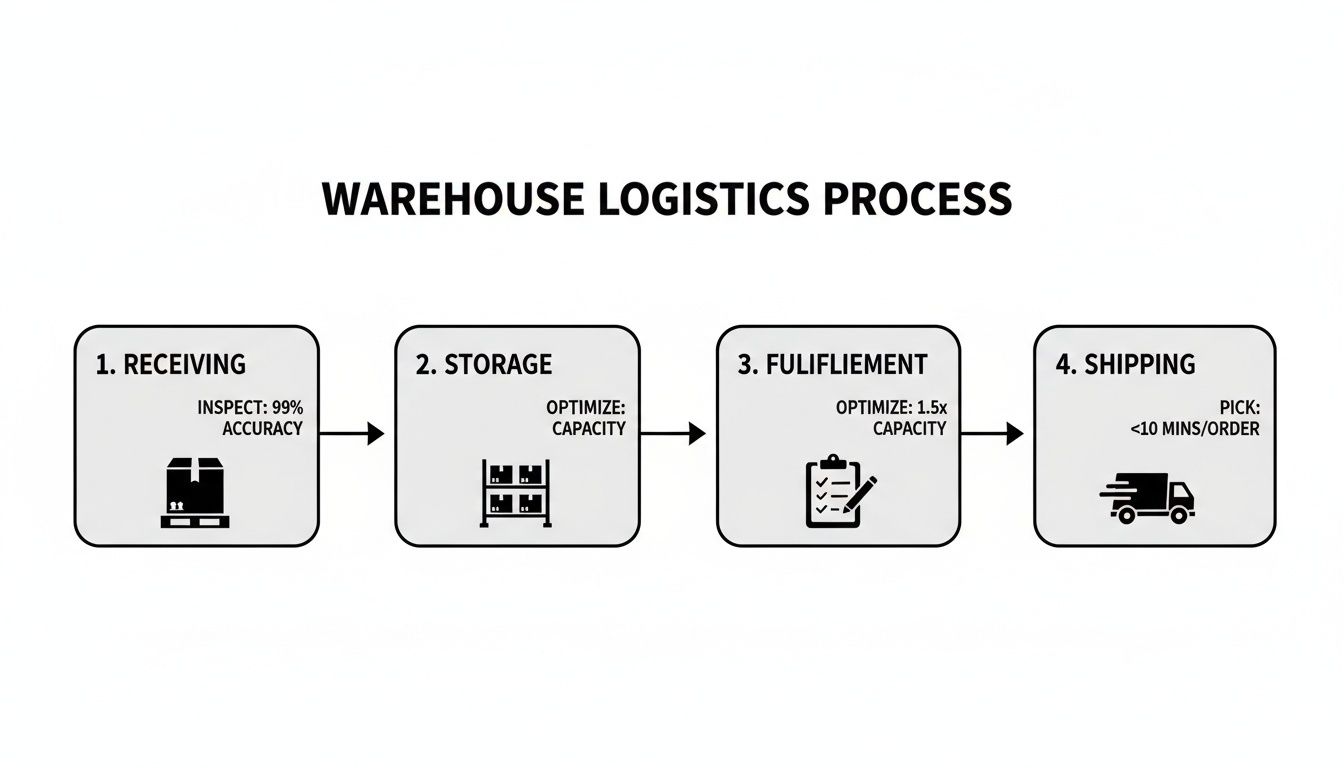
As you can see, technology connects each stage, turning what used to be separate, clunky tasks into a smooth, data-driven process.
The Rise of Robotics and Intelligent Automation
The next big step in warehouse logistics is robotics. These systems are no longer sci-fi; they're becoming more accessible and are designed to work right alongside your team to boost productivity. They directly tackle huge challenges like labor shortages and the physical wear-and-tear of repetitive tasks.
"The goal of automation isn't really to replace people. It's to augment their capabilities. Robots handle the monotonous, back-breaking work, which frees up your team to focus on more complex, valuable tasks like quality control and problem-solving."
Two types of robotic systems are making a huge difference right now:
- Autonomous Mobile Robots (AMRs): Picture these as smart, self-driving carts that navigate the warehouse on their own. They can bring an entire shelf of products directly to a picker's station, which practically eliminates travel time and can boost order fulfillment rates by two or three times.
- Automated Storage and Retrieval Systems (AS/RS): These are more sophisticated setups that use cranes and shuttles to automatically put away and retrieve items from high-density racks. The implementation of Automated Storage and Retrieval Systems (ASRS) is key to maximizing efficiency, as they can dramatically increase your storage capacity and retrieval speed.
Putting these systems in place requires careful planning and real expertise. For businesses trying to figure all this out, working with an experienced partner is a must. You can get a better sense of how to approach these projects in our guide explaining what an AI automation agency does. By integrating the right mix of technology, warehouses in the MENA region can finally meet today's demands for speed and accuracy, turning logistics into a serious competitive advantage.
How To Measure Success With The Right KPIs
In warehouse logistics, if you can't measure it, you can't improve it. It’s easy to mistake being busy for being efficient, but the real story is always in the numbers. Key Performance Indicators (KPIs) are what separate guesswork from a smart, data-backed strategy. Think of them as a regular health check for your warehouse, pinpointing hidden problems and celebrating what you’re doing right.
By keeping a close eye on the right metrics, you stop just putting out fires and start preventing them altogether. This shift is crucial for any business trying to stay ahead in the competitive GCC market, where customers expect speed and precision. Let's break down the most important KPIs by function to give you a clear picture of what to track.
Receiving And Put-Away KPIs
How smoothly your goods come in the door sets the stage for everything else. A snag or delay here creates a ripple effect, disrupting the entire workflow from storage to shipping.
Dock-to-Stock Time: This is the total time it takes for a new shipment to be unloaded, checked in, and placed in its proper storage spot. The faster this happens, the sooner those products are ready to be sold. For most warehouses, getting this done in under 8 hours is a solid goal.
Receiving Accuracy: This KPI tells you what percentage of your incoming orders are processed perfectly—no wrong quantities, no damaged items. You calculate it with:
(Number of Accurate Orders Received / Total Orders Received) x 100. The industry standard here is incredibly high, aiming for 99.5% or better.
Inventory KPIs
Your inventory is your biggest asset, and managing it well is the bedrock of a healthy warehouse. These metrics reveal just how well you're handling that asset.
Inventory accuracy isn't just an operational metric; it's a financial one. Every discrepancy represents tied-up capital, a potential lost sale, or an unnecessary cost. Getting this right directly impacts your bottom line.
Inventory Accuracy: This measures the gap between what your system says you have and what's actually on the shelves. It's calculated as
(Number of Items Counted Accurately / Total Number of Items Counted) x 100. Top-performing operations consistently hit 99.8% or above.Inventory Turnover: This shows how many times you sell and replace your entire stock over a set period. The formula is
Cost of Goods Sold / Average Inventory. A higher number is generally a good sign of strong sales, though what's "good" can vary a lot between industries.Carrying Cost of Inventory: This is the total expense of holding onto unsold stock. It includes everything from storage rent and insurance to the risk of products becoming obsolete. This cost is usually shown as a percentage of the inventory's value and often falls between 20-30% annually.
Fulfilment KPIs
This is where the rubber meets the road—where your operations directly touch the customer's experience. Fulfilment KPIs are all about the speed and accuracy of your picking and packing, which have the single biggest impact on keeping customers happy.
Order Picking Accuracy: This might just be the most important KPI in the whole warehouse. It measures the percentage of orders picked without a single mistake. The formula is
(Total Orders - Incorrect Item Orders) / Total Orders x 100. World-class operations shoot for 99.8% accuracy.Cost Per Order: This metric breaks down the average cost to get an order out the door, factoring in labor, packing supplies, and shipping fees. Tracking this gives you a clear view of your operational efficiency and how profitable each sale really is.
Order Cycle Time: This measures the clock from the moment a customer clicks "buy" to the moment their order is shipped. In a fast-moving e-commerce hub like the UAE, shrinking this time gives you a serious competitive edge.
Shipping KPIs
The final leg of the journey is getting the package out the door and on its way to the customer, on time and without a hitch.
- On-Time Shipping Rate: This tracks the percentage of orders that leave your warehouse on or before the promised date. It's calculated as
(Number of Orders Shipped On-Time / Total Orders Shipped) x 100. You should be aiming for 99% or higher. A strong on-time rate is a cornerstone of a great customer experience, a key insight for any digital marketing agency in Dubai.
Putting It All Together: A KPI Snapshot
To make this even more practical, here’s a quick-reference table summarizing the essential KPIs that every e-commerce and B2B business in the MENA region should be watching.
Essential Warehouse Logistics KPIs
Tracking these metrics gives you a powerful, data-driven lens through which to view your entire operation. It helps you celebrate wins, identify weaknesses, and make smarter decisions that ultimately lead to a more efficient and profitable business.
Optimizing Your Warehouse Layout For Peak Efficiency
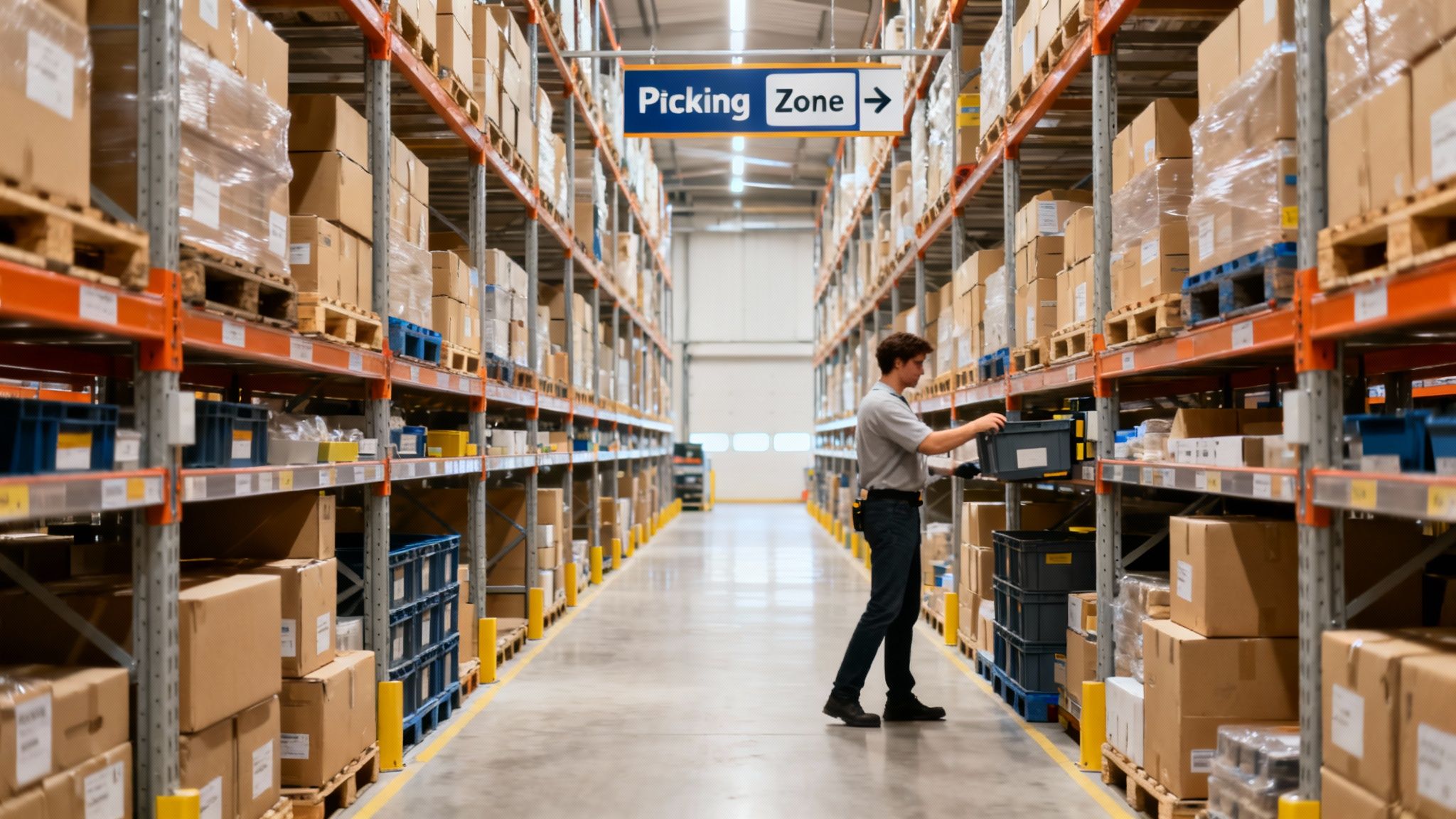
Think of your warehouse layout as a silent partner in your operations. It can quietly drive profits or, just as easily, become a major source of loss. The physical design dictates everything about how your people and products move. A smart layout cuts down on travel time, prevents frustrating bottlenecks, and keeps your team humming. A poor one, on the other hand, just creates chaos, wastes time, and sends labor costs soaring.
The biggest productivity killer in any warehouse? Picker travel time. It’s a fact that this often eats up more than half of all labor hours. Every extra step a worker takes to hunt down an item is a direct hit to your bottom line. So, the guiding principle here is simple: design for the shortest possible path from A to B.
This goes way beyond just having neat rows of shelving. It’s about being strategic—thinking critically about product placement and how work actually flows. When you organize your space logically, you’re not just storing things; you're building a high-performance fulfillment machine.
The Foundation Of A Smart Layout
Getting your layout right starts with a few core ideas. When used together, these principles slash wasted motion and help you get the most out of every square meter.
- Strategic Slotting: This is all about putting your best-sellers in the best spots. Place your highest-velocity items—the products that fly off the shelves—in the most accessible locations. Usually, this means close to the packing stations and at a comfortable waist level to minimize bending and reaching.
- Logical Zoning: Carve up your warehouse into distinct zones for each stage of the process: receiving, quality control, storage, picking, packing, and shipping. This creates a clear, one-way path for your inventory, stopping the traffic jams that happen when inbound and outbound flows get tangled up.
- Safety and Accessibility: Clear, wide aisles are non-negotiable. They need to be free of clutter so staff and equipment like forklifts can move around safely. Don't underestimate the power of good lighting and clear signage, either—they're crucial for preventing accidents and cutting down on errors.
The Real Cost Of Inefficient Space In The UAE
The need for a sharp layout is even more critical when you consider the competitive real estate market in the region. The latest market intelligence shows an incredibly tight industrial and logistics market in the UAE, with Grade-A warehouse occupancy hitting an average of about 95%. Prime rents have shot up, with reports showing increases of around +18% in Dubai and +13% in Abu Dhabi year-on-year. This pressure makes every single square meter of your facility incredibly valuable. It's a massive incentive to design for denser storage and get more out of the space you have. You can dig deeper into these market trends on cushwake.ae.
An unorganized warehouse is more than just messy—it's expensive. In a market where rents are on the rise, wasted space is wasted money. An optimized layout allows you to store more and ship faster within the same footprint.
By taking the time to plan your layout properly, you don't just boost daily efficiency. You build a scalable foundation that can support your business as it grows. You make better use of the space you pay for, reduce costly picking errors, and create a safer, more productive environment for your entire team. This strategic approach to logistics in warehouse design is a critical investment in your operational success.
Connecting Warehouse Operations To Customer Experience
Let's be honest: your warehouse isn't just a place to store boxes anymore. It’s the engine room of your customer experience. Every promise you make about fast, accurate delivery is either kept or broken on your warehouse floor. For customers in the UAE and across the GCC, speed isn't a luxury; it's the standard.
Think about it. A picking delay or a simple packing mistake isn't just an operational hiccup. It’s a direct hit to your customer's trust. The moment an order arrives late or wrong, all the goodwill you built through great marketing and a smooth checkout process starts to evaporate. Your warehouse performance is a customer experience metric, plain and simple.
Bridging The Gap With Modern CX Platforms
The smartest businesses get this. They don't see their warehouse and customer support teams as separate entities. Instead, they build a bridge between them by integrating their Warehouse Management System (WMS) directly with a modern customer experience (CX) platform.
This connection creates a seamless flow of information that keeps customers in the loop, automatically.
- Proactive Order Updates: Imagine your customer getting an instant WhatsApp or SMS notification the second their order is picked, packed, and out for delivery. No more guessing.
- Fewer "Where Is My Order?" Calls: These proactive updates slash the number of WISMO ("Where Is My Order?") calls, which are a huge drain on your support team's time and resources.
- Self-Service Tracking: Customers get a direct link to track their package, putting them in control and giving them the transparency they expect.
This kind of integration is crucial for unifying your entire operation. If you're looking at ways to manage customer relationships, it's worth exploring systems that can support this. For more ideas, take a look at our guide on the best CRM for small business to see what's possible.
Managing Escalations When Things Go Wrong
Of course, no system is perfect. Packages get lost, items get damaged, and sometimes delivery instructions are just plain tricky. When automation can't solve the problem, the issue needs to be handed off to a human agent—and this is a make-or-break moment.
The goal here is to transform a potential logistics disaster into a moment that actually strengthens the customer's loyalty.
This is where a support solution built for the unique demands of the MENA market comes in. Take a look at this unified agent desktop, designed for handling conversations from any channel.
A system like this gives agents the full picture. They see the customer's entire history in one place, so they can jump in and solve the problem without making the customer repeat their story.
For businesses here in the region, a tool like CXMfast AI—an on-premise and cloud contact center with enterprise-level features and native Arabic support—is indispensable. It ensures that when a delivery goes sideways, your customer support shines, protecting your brand and turning a bad situation into a good one.
Got Questions About Warehouse Logistics? We Have Answers.
If you're trying to get a handle on warehouse logistics, especially in the fast-moving MENA market, you're not alone. Lots of questions pop up as businesses grow. Here are straightforward answers to the ones we hear most often.
Where Do I Even Start When Trying To Improve My Warehouse?
The first move, without a doubt, is to take a hard look at your current setup. You can't fix what you don't understand.
This means walking the floor and mapping out every single step—from the moment a truck backs up to your dock to the point a package is handed off to a courier. Start simple by tracking a few key metrics, like how accurate your order picking is or how long it takes to get new inventory onto a shelf (dock-to-stock time). This simple data-gathering exercise will shine a spotlight on your biggest slowdowns and give you a clear, fact-based plan before you spend a single dirham on new tech.
Is Warehouse Automation Just for Big Companies? Is It Too Expensive for an SME in the UAE?
Not at all. When people hear "automation," they often picture a massive, fully robotic warehouse, which is understandably daunting for a smaller business. But automation isn't an all-or-nothing game.
An SME can see a fantastic return by starting with the basics. A solid Warehouse Management System (WMS) and some simple barcode scanners can work wonders, slashing errors and making your team much more efficient. These first steps not only improve your operations right away but also build the business case for bigger investments down the road, like conveyor belts or even Autonomous Mobile Robots (AMRs).
How Much Does Bad Warehouse Logistics Really Hurt My Business?
Sloppy logistics in warehouse operations isn't just a minor headache; it's a problem that infects your entire business, hitting both your reputation and your profits.
Think about it: it leads directly to delayed shipments and wrong orders, which kills customer trust and makes your return process a costly nightmare. Internally, you're flying blind with bad inventory numbers, leading to stockouts (which means lost sales) or overstocking (which means cash tied up in products that aren't moving). It also drives up your labor costs because your team is constantly putting out fires and redoing work. In the end, it makes you less competitive and puts a hard ceiling on how much you can grow.
What’s the Real Difference Between a WMS and an ERP?
It’s about scope. An Enterprise Resource Planning (ERP) system is the big-picture software for your whole company—it handles everything from finance and HR to sales and marketing. A Warehouse Management System (WMS), on the other hand, is a specialist. It’s laser-focused on one thing: making your warehouse run like a well-oiled machine.
A WMS gives you incredibly detailed control over receiving, storing, inventory tracking, picking, packing, and shipping. While most ERPs have a basic warehousing module, it’s just not the same. If your fulfillment is even moderately complex, you need the powerful, specialized tools a dedicated WMS brings to the table.
For a closer look at these and other operational technologies, you might want to join one of our upcoming webinars and events.

Read Our latest
Lorem ipsum dolor sit amet, consectetur adipiscing elit.