For sales leaders in the MENA region, moving from manual, one-off outreach to a predictable, automated system is a major growth hurdle. This is where CRM email sequences for outbound sales become your most powerful tool. They are more than just a string of messages; they are the intelligent core of your entire outbound strategy, designed for the unique business landscape of the UAE, Saudi Arabia, and the broader GCC.
Building Your Automated Outbound Sales Engine
If you’re running a business in the UAE or Saudi Arabia, you know that relying on sporadic follow-ups and manual tracking in spreadsheets doesn't work. It’s a recipe for missed opportunities, inconsistent messaging, and a sales pipeline that feels more like a gamble than a reliable system.
The solution is an automated outbound engine built directly inside your CRM. Think of it as the central nervous system for your sales operation. This engine uses CRM automation for B2B growth to orchestrate all your sales and marketing workflows. It connects the first email to a perfectly timed follow-up and, crucially, integrates other channels like WhatsApp and SMS to create a seamless journey for your prospect.
To build this correctly, you need a strong foundation based on four essential pillars.
Core Components of a High-Performing Outbound Sequence
Nailing these four components ensures your outbound engine is not just automated but genuinely effective and tuned into the nuances of the local market.
The Core Components of Your Engine
Building this engine means focusing on four essential pillars that must work together. If you neglect one, the entire structure becomes ineffective.
Smart Segmentation: This is about dividing your prospect list into specific, meaningful groups based on data in your CRM—like industry, company size, or past interactions. It’s the difference between a generic mass email and a targeted, relevant message.
Precise Timing and Cadence: This determines when and how often you reach out. A solid cadence might be an email on day one, a follow-up on day three, and a quick WhatsApp message on day seven if there’s no response. The goal is to be persistent without being intrusive.
Deep Personalization: Using dynamic CRM fields like
{{first_name}}and{{company_name}}is the baseline. Real personalization goes deeper by referencing a prospect’s specific challenges, a recent company announcement, or their professional goals. This makes automated outreach feel entirely one-to-one.Multi-Channel Integration: In the MENA region, business is conducted across multiple platforms. Your CRM sequence must be able to switch from an email to a WhatsApp message or an SMS reminder seamlessly, meeting prospects on the platforms they use daily. If you're looking for more ways to fill your pipeline, we cover several strategies for generating high-quality digital marketing leads in another guide.
I’ve seen it firsthand in the MENA market: businesses that switched to automated CRM email sequences saw a staggering 42% increase in lead conversion rates compared to those still using manual outreach. This shift isn't just about efficiency; it's about getting fundamentally better results. You can read more about the regional economic outlook from the World Bank to understand the landscape.
Architecting Your Sequence Flow and Logic
Now we move from theory to designing a sequence that actually gets replies. Think of this process less like writing emails and more like mapping out a strategic conversation. Before a single word is typed, you need a clear blueprint of the entire journey a prospect will take.
For B2B sales in the MENA region, an 8 to 10-step sequence spread over 25 to 30 days is a highly effective rhythm. This cadence is persistent enough to stay on their radar but respectful of their time, giving them space to consider your offer without feeling pressured.
Defining Your Touchpoints and Timing
A great sequence is a multi-channel conversation. The timing—the space between your touchpoints—is just as important as the messages themselves. Contacting prospects too frequently makes you seem desperate; waiting too long makes them forget you.
Here’s a practical cadence for the MENA market:
- Day 1: The initial, highly personalized email.
- Day 3: A follow-up email that adds a new piece of value.
- Day 7: Another value-add, perhaps sharing a relevant case study or quick tip.
- Day 11: If emails aren't getting opened, switch channels. A short, professional WhatsApp message can cut through the noise.
- Day 15: Back to email with another relevant insight.
- Day 21: The "breakup" email. This professionally closes the loop and often gets a surprisingly high response rate.
This flow mirrors how business actually gets done in Dubai and Riyadh, blending formal and informal channels. Using the right tool is crucial; you can find a solid rundown of the best CRM for small business setups that can handle this kind of sophisticated logic.
Building Smart Logic with Triggers and Conditions
This is where your CRM becomes a strategic partner. The real power of automation comes from building intelligent logic into your sequences. It’s not a straight line; it's a dynamic decision tree that reacts to what your prospect does (or doesn't do).
Think of it as setting up "if this, then that" rules. For example: 'If a prospect opens an email three times but doesn’t reply, then tag them as 'highly engaged' and send a case study follow-up.' Suddenly, you're not just sending messages; you're having a responsive, automated conversation.
These conditional triggers make your follow-ups feel timely and relevant. You can build workflows that automatically pivot based on their actions, which is what separates a basic email tool from a true sales engine.
This diagram perfectly captures the choice you're making: stick with high-effort manual outreach or embrace a smarter, automated flow powered by your CRM.
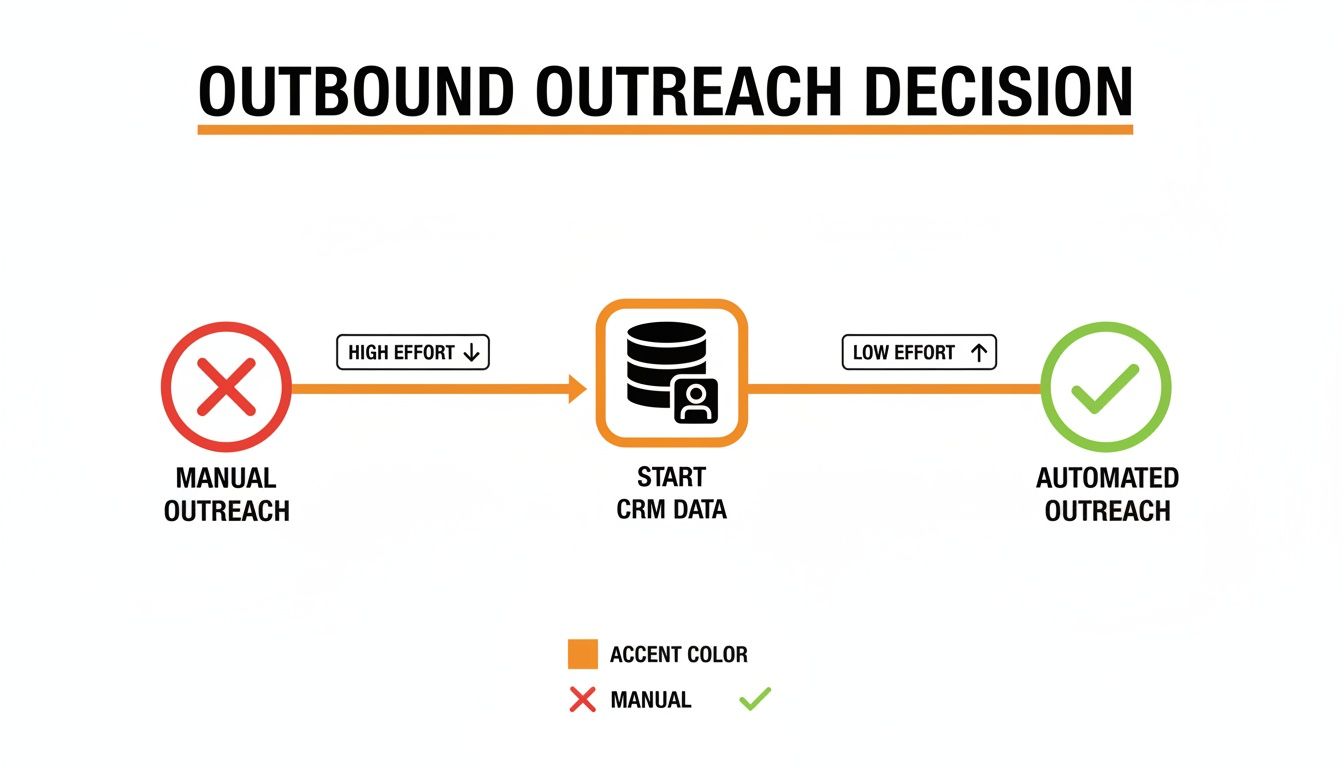
As you can see, automation isn't about being lazy. It’s about removing repetitive tasks so your sales team can focus their energy on conversations with genuinely interested leads.
Weaving in WhatsApp and SMS for MENA Markets
If your outbound strategy in the MENA region is email-only, you are leaving opportunities on the table. WhatsApp and SMS aren't just add-ons; they are essential channels that must be woven directly into your sequence logic.
Here’s a practical example:
- Trigger: A prospect hasn't opened your first two emails after five days.
- Action: The CRM automatically sends a pre-written, polite WhatsApp message.
- Example Message (English): "Hi {{first_name}}, just sent you an email about streamlining operations at {{company_name}}. Is this the right channel to connect?"
- Example Message (Arabic): "مرحباً {{first_name}}، أرسلت لك بريداً إلكترونياً بخصوص تحسين العمليات في {{company_name}}. هل هذه هي القناة الأنسب للتواصل؟"
This single step is incredibly powerful because it meets people where they already spend their time. By building these cross-channel rules into your sequence architecture, you create a more resilient and adaptive outreach system, dramatically boosting your odds of starting a real conversation.
Writing Emails That Actually Get a Reply (Especially in a Bilingual Market)
Your sophisticated automation is worthless if the emails themselves are generic and uninspired. A great workflow sending weak messages will fail every time. To succeed with outbound sales in a bilingual market like the MENA region, your copy needs to be direct, valuable, and culturally aware.
The words you choose—from the subject line to the final sign-off—are what build trust and earn you a conversation. Every email in your sequence has a specific job, whether it's to spark curiosity, offer a genuine insight, or professionally follow up.
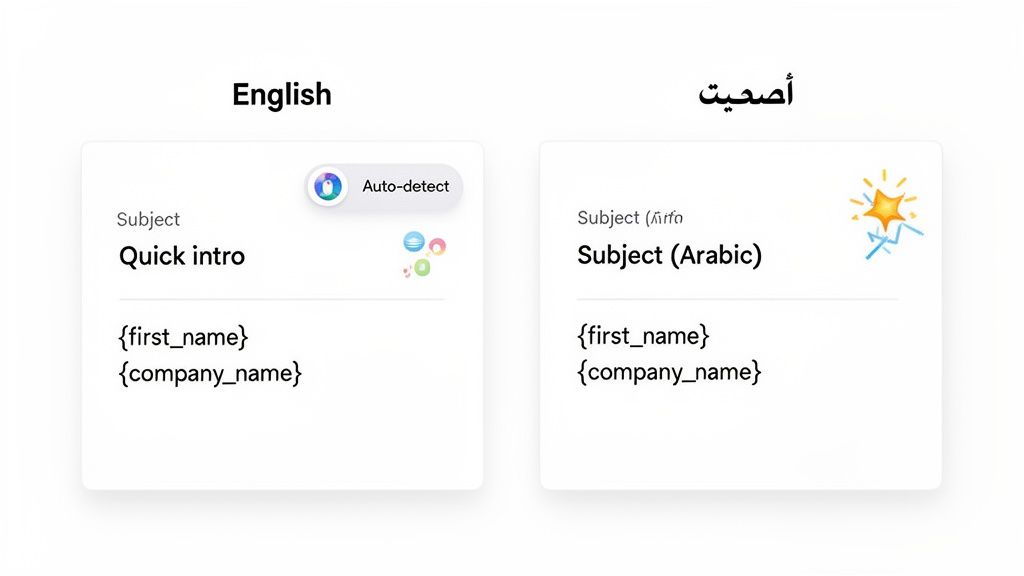
Should I Write in English or Arabic?
This is a common question for sales leaders in the GCC. The answer isn't "one or the other." It's about building a system smart enough to adapt to your prospect's preference.
Your CRM is the engine for this. The best practice is to add a "Preferred Language" field to every contact profile. This single piece of data unlocks powerful automation.
The CRM checks the language field and automatically sends the Arabic version of your email to contacts marked 'Arabic' and the English version to everyone else. It's a small technical step, but it shows respect from the very first interaction and significantly improves engagement.
For the first cold email, leading with English is usually a safe default for B2B communication in the UAE and KSA. However, your system must be ready to pivot. If a prospect replies in Arabic, your sales rep must immediately update their language preference in the CRM. This ensures all future automated messages respect their choice and continue the conversation in Arabic.
Personalization Is More Than Just a Name
In a crowded inbox, "Dear Sir/Madam" is an instant delete. Real personalization makes your automated outreach feel human. It proves you’ve done your research, not just that you know how to use a mail merge.
This is where dynamic fields (or merge tags) in your CRM email sequences for outbound sales become critical.
- {{first_name}}: The absolute minimum requirement.
- {{company_name}}: Shows you’re focused on their business.
- {{job_title}}: Lets you frame your message around their specific role and challenges.
- {{industry}}: Helps you use industry-specific language and reference relevant pain points.
When you combine these, you can create opening lines that are impossible to ignore. Compare "I'd like to introduce our services" to "Hi {{first_name}}, knowing you’re the Head of Operations at {{company_name}}, I imagine you're constantly looking for ways to boost efficiency in the logistics sector." That second one gets read. For teams looking to build out a library of these, professional content marketing copywriting services can provide the templates and frameworks to do this at scale.
Using AI to Write Killer Opening Lines
Manually researching every single prospect for a unique hook is not scalable for a busy outbound team. This is where AI tools can act as a powerful research assistant for your sales reps.
Modern AI-powered sales tools can scan a prospect's LinkedIn profile, recent company news, or press releases to generate hyper-relevant opening sentences. These are not generic platitudes; they are specific, timely hooks you can feed directly into your emails.
Here’s how the workflow looks:
- Import a prospect list into your CRM and run it through an AI enrichment tool.
- The tool generates a custom opening line for each person (e.g., "Saw the recent article about {{company_name}}'s expansion into Riyadh...").
- This unique sentence is saved in a custom field, such as
{{icebreaker}}. - Your email template then simply starts with
{{icebreaker}}.
This gives you the efficiency of automation combined with the personal touch of one-to-one research. You can send hundreds of emails, yet each one starts with a unique, relevant opener that shows you’ve paid attention and increases your chance of getting a reply.
Go Beyond Email: Weaving in WhatsApp and AI Voice
In the MENA region, running an outbound sales campaign on email alone is a strategic error. Your email sequence becomes truly effective when you integrate the channels your prospects use every day. Think of email as the opening act; the real results come when it partners with WhatsApp, SMS, and even AI voice.
This isn’t about sending more messages. It’s about building a smart, multi-channel system where each touchpoint logically follows the last. If an email is buried in a crowded inbox, a well-timed WhatsApp message can bring your conversation to the top of their screen.
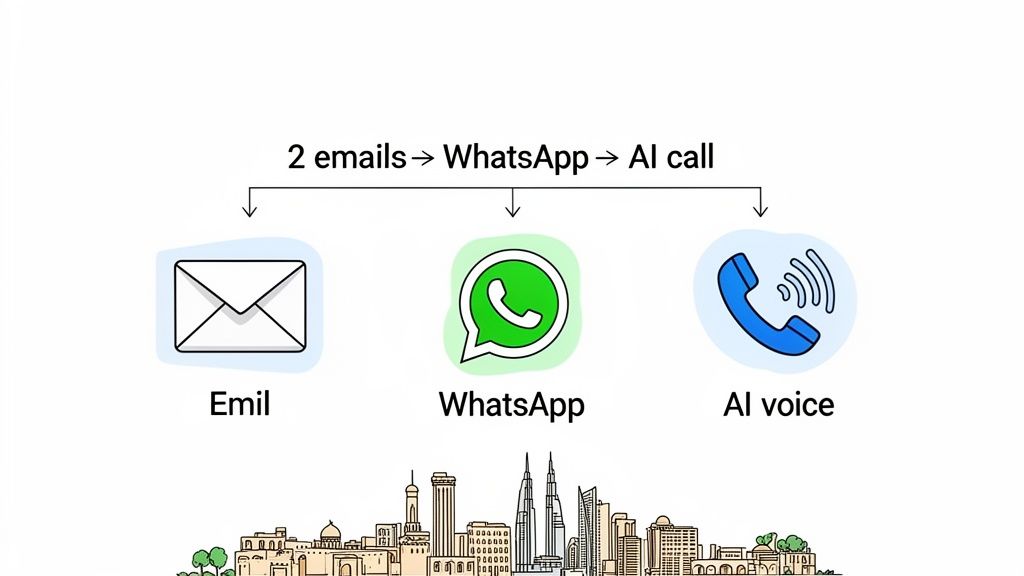
From a Buried Email to a Live WhatsApp Chat
Here's a practical workflow you can build inside your CRM.
Imagine a prospect has received two personalized emails but hasn't opened either one. Sending a third email is unlikely to change the outcome. Instead, your automation can pivot channels.
This is where WhatsApp becomes a game-changer. The logic is simple but powerful:
- Trigger: The prospect hasn’t opened
Email 1orEmail 2after five business days. - Condition: A valid mobile number exists in the CRM.
- Action: The CRM automatically sends a pre-written WhatsApp message.
The key is to make the message helpful, not pushy. Something like: "Hi {{first_name}}, I sent a note to your email about [topic]. Figured this might be an easier way to connect. No worries if the timing isn't right." It’s far less intrusive than a cold call and meets them on their preferred communication channel—their phone.
Using AI Voice to Act on High-Intent Signals
Now, let's consider a high-intent lead. Imagine a prospect not only opens your email but also clicks a specific link to your case study or pricing page. This is a clear buying signal, and you need to act on it immediately.
Instead of just queuing up another email, you can have an AI voice agent take action. The workflow looks like this:
- Trigger: A prospect clicks the link
[your-website.com/pricing]in any email. - Action 1: The CRM instantly tags the contact as "High-Intent."
- Action 2: The system triggers an AI voice call with one clear goal: book a demo.
The AI agent can be scripted to sound natural and professional: "Hello {{first_name}}, this is [Your Name]'s assistant from [Your Company]. I saw you were just looking at our solutions, and I wanted to see if you had 15 minutes for a brief demo with a specialist next week." Suddenly, your automation isn't just sending messages—it's actively setting appointments. Getting these systems dialed in is what a good AI automation agency does best.
The numbers back this up. Data shows that integrated CRM email sequences in outbound sales drive a 5.3x increase in qualified opportunities for MENA-based B2B teams. We’ve also seen automated sequences boost pipeline generation by 61%. Top-performing companies are converting 34% of their marketing-qualified leads into sales-qualified ones with this multi-channel approach.
Automating and Measuring Your Outbound Performance
You've designed a brilliant multi-channel sequence. Now it's time to bring it to life and turn it into a lead-generating machine. The goal isn't to "set it and forget it," but to launch, measure, and continuously refine your approach based on real-time data from the MENA market.
Activating your sequence inside a modern CRM like SalesMfast or GoHighLevel is often a visual process. You start with a trigger—such as "Add a new lead to this list"—and then you drag and drop the next steps: "Wait 2 days," "Send Email 1," and "If no reply after 3 days, send WhatsApp Message A." This visual workflow makes complex automation clear and manageable.
Fine-Tuning Performance with A/B Testing
Once your sequence is running, the real work begins. The most powerful tool for optimization is A/B testing, where you test one variable at a time to see what connects with your audience. High-performing outbound systems are built on data, not assumptions.
Stop guessing what works and start testing:
- Subject Lines: Test a direct, benefit-driven subject line ("Improving {{company_name}}'s logistics efficiency") against a more intriguing one ("A question about your operations in Dubai").
- Calls-to-Action (CTAs): Does a "soft" CTA like asking for interest outperform a "hard" CTA like requesting a 15-minute call?
- Sending Times: Test sending emails at 9:30 AM on a Sunday versus 11:00 AM on a Monday to pinpoint the engagement sweet spot for the GCC workweek.
By isolating just one change per test, you get clear evidence of what drives results. You can then apply those learnings across all your campaigns, systematically improving your outreach.
The Metrics That Truly Matter for MENA Sales Leaders
Vanity metrics like "total emails sent" are meaningless. To understand the health of your CRM email sequences for outbound sales, you need to focus on numbers that tie directly to revenue. For sales leaders in the MENA region, a handful of key performance indicators (KPIs) tell the whole story.
We’ve seen firsthand how optimized CRM email sequences can deliver staggering results in the AE region, with some campaigns hitting a 317% ROI. More than that, sequences with an average of four well-timed touchpoints have slashed sales cycle times by 27%, cutting the journey from 45 down to just 33 days. For more on regional trends, PwC's Mid-Year Update for the Middle East offers some great insights.
This impact only happens when you track the right metrics.
Here are the four essential metrics for your CRM dashboard:
- Open Rate: Your first hurdle. It indicates if your subject lines and sender reputation are strong enough.
- Reply Rate: The true measure of engagement. It shows how many prospects were compelled enough by your message to respond.
- Positive Reply Rate: A crucial layer on top of reply rate. This metric separates genuine interest ("Tell me more") from noise (objections, unsubscribes), giving you a real signal of lead quality.
- Meetings Booked: The ultimate goal. This metric ties your outbound efforts directly to pipeline growth.
Let’s quickly break down what these metrics tell you and how to act on them.
Key Metrics for Measuring Sequence Success
Monitoring these KPIs arms you with the data to make smart decisions. You can see exactly where a sequence is falling short and fix it. This approach empowers you to pause what isn't working, double down on what is, and build a truly high-performing sales engine. To go deeper on this measurement-focused approach, understanding how a performance marketing company thinks can provide excellent frameworks.
Frequently Asked Questions About Outbound Sequences
When business owners and sales managers in the MENA region start building their first outbound sequences, the questions are always practical. It’s about moving from theory to what actually works on the ground. Let's tackle the most common questions with direct, actionable answers.
These aren't academic questions; they get right into the operational details of managing CRM email sequences for outbound sales while respecting local business culture.
How Many Emails Should Be in an Outbound Sequence?
For most B2B campaigns targeting the MENA market, the sweet spot is between 5 and 8 touchpoints spread over three to four weeks. This gives you enough runway to get noticed without becoming a nuisance. The key is to make every touchpoint offer genuine value—don't just send another "just checking in" message. A shorter sequence might work for a time-sensitive offer, while a longer, slower cadence is better for nurturing colder leads.
Can I Mix Arabic and English in the Same Email Sequence?
Yes, and you should. This is a critical part of getting GCC outreach right. Add a ‘preferred language’ field to your CRM for every contact. Your sequence can then run on a simple ‘if/then’ rule: if the language field is ‘Arabic,’ send the Arabic version; otherwise, send the English one. Avoid mixing languages within a single email, as it can appear unprofessional. If you're emailing someone for the first time, English is a safe default. If they reply in Arabic, your team must update the CRM field immediately to ensure all future automated messages are in their preferred language.
What Is the Best Time to Send Outbound Sales Emails in the GCC?
Our data for the GCC consistently shows the best engagement happens from Sunday to Thursday, between 9:00 AM and 12:00 PM. You’ll often see another small spike around 4:00 PM as people wind down for the day. Avoid sending your first email on a Friday morning or late Thursday afternoon. However, the most reliable source of truth is your own data. Use your CRM’s analytics to see when your audience is opening emails and fine-tune your schedule accordingly.
How Do I Prevent My Sales Emails From Going to Spam?
Keeping your emails out of the spam folder is non-negotiable. First, handle the technical basics: authenticate your sending domain with SPF, DKIM, and DMARC records. If you're using a new email account, you must warm it up by sending a small number of emails and slowly increasing the volume over a few weeks. Next, personalize your emails using multiple data points from your CRM to avoid looking like a generic blast. Finally, keep your lists clean by verifying them regularly, and always include a clear unsubscribe link. This isn't just good practice—it's required to comply with regulations like the UAE's PDPL.
At SMOrchestra, we build the AI-powered sales and marketing systems that help MENA businesses grow predictably. We design and operate the outbound, CRM, and multi-channel workflows that turn cold outreach into closed deals.

Read Our latest
Lorem ipsum dolor sit amet, consectetur adipiscing elit.