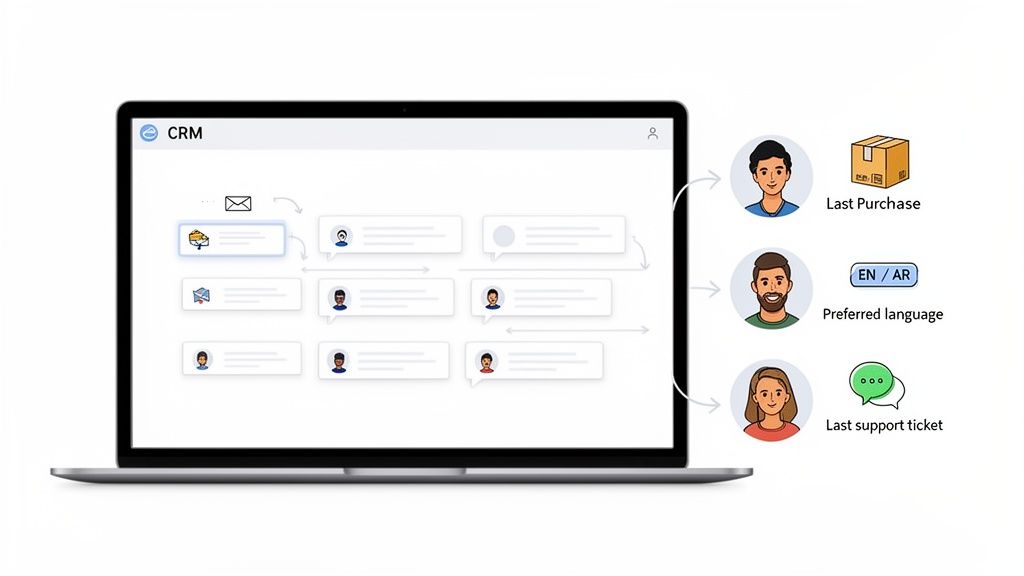
Think of CRM personalization as a live, automated system, not a one-off mail merge. It's about tapping directly into your CRM to use real-time contact data—their purchase history, preferred language, and on-site behavior—to shape every outbound email, WhatsApp message, and SMS. For businesses in the MENA region, this allows you to create genuinely relevant communication in both Arabic and English that feels less like a marketing blast and more like a targeted sales workflow.
Moving Beyond Mail Merge to True Personalization
Manual email tricks are a massive time-sink. We've all been there, spending hours exporting CSV files and wrestling with uploads just to drop a {{first_name}} tag into an email. It’s a static, outdated process where the data is stale the moment you hit "export."
A modern CRM flips this script. It replaces manual list preparation by dynamically inserting contact data, behavior, and segmentation details directly into your outbound campaigns. Instead of you manually preparing lists, your system does the heavy lifting, using live data to build communications that are genuinely personal and perfectly timed for your sales and marketing workflows.
The Shift from Static Data to Live Triggers
The game-changer is moving from a static data pull to a continuous, live connection between your customer data and your outbound channels. This isn’t just about sending a smarter email; it’s about creating an entire engagement system that reacts to your customer in real time.
Here’s what that looks like in a practical workflow for businesses across the MENA region:
- Last Purchase History: An e-commerce store in Dubai can automatically send an email or a WhatsApp message showcasing accessories that complement a customer’s recent purchase. No manual work needed.
- Preferred Language: A B2B tech firm in Riyadh can send follow-up materials in Arabic or English based on the language preference saved in the contact's CRM profile, ensuring crystal-clear communication.
- Support Interactions: If a customer just had a support issue resolved, the CRM can automatically pause promotional emails for a few days. This prevents you from sounding tone-deaf and shows you're paying attention.
This is about building a system that reflects an ongoing relationship with each customer. Your sales and marketing teams can finally scale relevance without having to scale their workload.
Trying to manage this manually is a recipe for error. A proper CRM workflow handles it all behind the scenes, checking conditions and pulling the right data in milliseconds. To grab your audience’s attention, check out this Ultimate Guide to Personalized Subject Line Optimization.
It's clear the old ways don't cut it. Let's break down why a modern CRM workflow is so far ahead of the traditional mail merge approach.
Manual Tricks vs Automated CRM Personalization
The table says it all. You're either working with a snapshot from the past or engaging with your customer in the present moment.
Automating Relevance Across Channels
The real power of CRM-driven personalization is that it doesn’t stop at email. The same rich data and logic can trigger workflows across the channels your customers actually use, like WhatsApp and SMS. For any business operating in the region, orchestrating these touchpoints is non-negotiable.
This is where combining your CRM with AI-powered systems becomes incredibly effective. You can see exactly how an AI automation agency designs these integrated workflows to fuel real growth. This system ensures that whether a customer gets an email, a WhatsApp notification, or an SMS, the message is always coherent, relevant, and feels written just for them.
Building a Foundation with Smart Segmentation
Real personalization begins deep inside your CRM with intelligent, actionable segmentation. For any business owner or sales leader in the MENA region, this is the engine that separates communication that truly connects from generic noise that gets ignored.
Forget static lists built on simple demographics like city or age. The power is in creating dynamic segments that update automatically based on customer behavior, purchase history, and engagement data. These aren't lists you have to manually update; they're smart, self-updating groups that ensure your campaigns always hit the right people with the right message, in the right language.
Moving Beyond Basic Demographics
As your business scales, so does the need for sharper communication. Sending a single marketing blast to your entire database isn't just inefficient—it's counterproductive. The aim is to build segments that mirror your actual business scenarios and customer journeys.
This is where a properly configured CRM becomes a game-changer, helping you graduate from basic lists to powerful, automated audiences.
Let’s look at practical examples of dynamic segments for your MENA operations:
- High-Value Customers in KSA who prefer Arabic: This segment pulls together purchase data (total spend), location, and language preference. Any offer you send this group needs to be in flawless Arabic and reflect their VIP status.
- Leads in Egypt who viewed the pricing page but haven't booked a demo: This is pure behavior-based segmentation that flags high-intent prospects. They don’t need another generic newsletter; they need a targeted follow-up, maybe a quick WhatsApp message from a sales rep offering to chat.
- Abandoned Carts in Dubai over 500 AED: A classic e-commerce segment, this pinpoints customers on the verge of a significant purchase. The automated follow-up can be triggered within an hour, perhaps with a compelling reason to complete their order.
Building Segments Based on Behavior and Intent
The most potent segments capture what a customer intends to do. They aren't based on who the customer is, but on what they do. This requires your CRM to be connected to your ecosystem, tracking key interactions across your website, support channels, and previous campaigns.
Imagine you're a B2B tech company in Riyadh. You could create a segment for leads who downloaded a specific whitepaper on cloud security and also have a high lead score. Instead of hitting them with a standard sales email, this group gets a personal invitation to a webinar on the same topic. It shows you're paying attention and offering value before asking for the sale.
Your CRM shouldn't just be a digital address book; it needs to be an intelligence hub. Every click, purchase, and interaction is a data point you can use to craft a more relevant customer experience.
The rapid adoption of these systems across the region tells a clear story. The MEA Customer Relationship Management (CRM) market hit a staggering USD 3,917.9 million in 2024, a surge driven by the growing demand for personalized strategies. While big enterprises have led the charge, SMEs are the fastest-growing adopters, quickly putting CRM to work for better customer insights in key economies like Saudi Arabia and Egypt. You can find more details about this growing CRM market trend on Grand View Research.
Practical Segmentation for Sales and Marketing Workflows
Let's ground this in reality. How does segmentation directly fuel your sales and marketing workflows?
For Your Sales Team:
- The Segment: Leads marked as "Hot" who haven't replied in 3 days.
- The Workflow: Automatically trigger a plain-text follow-up email that looks like it came directly from the assigned salesperson. It feels personal and cuts through the "marketing" clutter.
For Your Marketing Team:
- The Segment: Customers who've bought from you more than three times in the last six months.
- The Workflow: Instantly add them to a "VIP" list that gets early access to new products and exclusive offers, perhaps delivered straight to them via WhatsApp.
By building these smart segments, you're laying the groundwork for all the advanced CRM personalization we're about to cover. This isn't about sending more messages—it's about automatically sending the right ones to the right people.
Using Dynamic Content and Behavioral Triggers
Once you’ve sorted your audience into smart segments, you can make your outreach strategy come alive. This is where you stop manually building dozens of different email versions. Instead, you create one master template that intelligently customizes itself for every person on your list using dynamic content and behavioral triggers.
Think about an e-commerce email. Imagine the main image automatically changing based on what a customer was just browsing—sneakers for one person, formal shoes for another. Or a B2B follow-up where a specific case study only appears for leads in the finance industry. That’s dynamic content. It allows one campaign to feel like a thousand unique, one-to-one conversations.
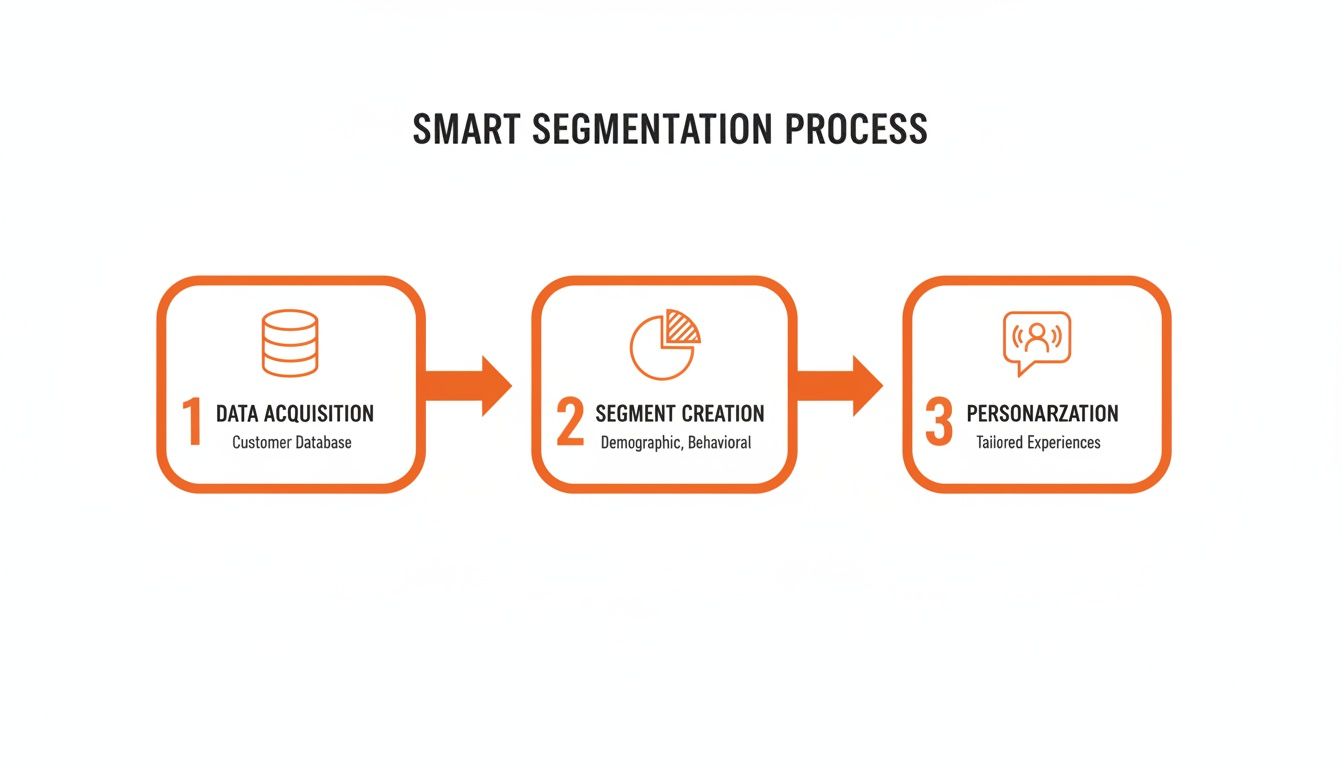
This isn't a single action, but a complete workflow where your CRM data fuels segmentation, which in turn powers truly relevant messaging.
Activating Workflows with Behavioral Triggers
While dynamic content decides what your contacts see, behavioral triggers decide when they see it. These are rules you set up in your CRM to kick off an automated action when someone does something specific. Your communication shifts from being a static broadcast to a responsive, real-time dialogue.
Here are a few practical scenarios that work for businesses in the MENA region:
- Website Engagement: A prospect visits your pricing page twice in a week but never books a demo. This behavior can trigger an automated workflow that sends a simple, plain-text email from a sales manager asking if they have any questions. It’s timely, personal, and more powerful than a generic newsletter.
- Post-Purchase Follow-up: A customer in Jeddah buys a new software subscription. Your CRM can automatically trigger a sequence: first, an immediate confirmation email in Arabic, followed three days later by a WhatsApp message with a link to a quick-start video guide.
- Cart Abandonment: A shopper in the UAE adds items to their cart but doesn't check out. Within an hour, they receive an automated email showcasing the exact products they left behind, maybe with an incentive to complete their purchase.
These automated workflows are crucial for maintaining momentum. We dive deeper into these sequences in our guide on creating follow up reminder emails that convert leads.
Using Dynamic Content Blocks for Bilingual Campaigns
For any business operating across the GCC, juggling communications in both Arabic and English is a daily reality. This is where dynamic content blocks are a game-changer. Instead of managing separate email lists and campaigns for each language, you can build a single, intelligent template.
The system just needs to check the "Preferred Language" field in a contact's CRM profile. From there, it automatically inserts the correct language block—whether that’s for the headline, the body copy, or the call-to-action button.
This approach goes beyond simple translation; it's true localization. You can adjust the tone, cultural references, and even imagery to resonate perfectly with either an Arabic-speaking or English-speaking audience, all within one automated workflow.
The demand for this level of personalization is huge. Across the Middle East and Africa, 30% of customers prefer brand interactions that include relevant recommendations based on their past behavior. A UAE-based brand can achieve a 2X increase in email open rates just by implementing this kind of personalized, bilingual communication.
Examples of Dynamic Content in Action
Let's break down how this might look inside a real email:
By layering these elements, a single email template can generate thousands of unique variations, each feeling crafted specifically for the recipient. This is the core of smart outbound marketing today. For those looking to go deeper, exploring concepts like Dynamic Creative Optimization (DCO) can push these results even further.
Integrating Personalization Across Email, WhatsApp, and SMS
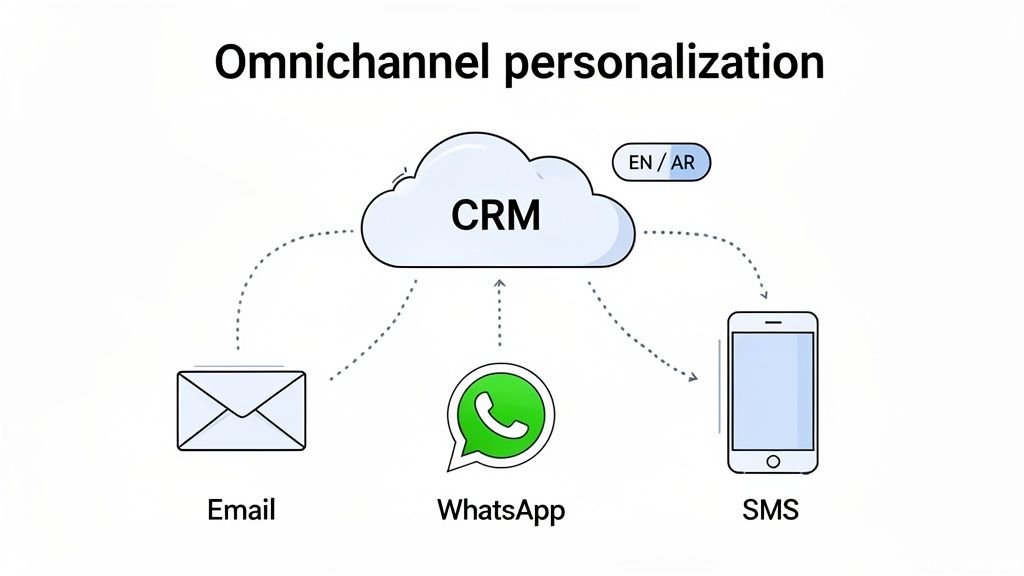
Your customers aren't just in their email inboxes. Their journey is fluid, jumping between email, WhatsApp, and SMS. If you're only focused on email, you're leaving gaps in your communication and missing opportunities to connect where your audience is actually paying attention.
An integrated approach, with your CRM as the central hub, is the only way to create a customer experience that feels connected. The goal isn't just to blast messages across different platforms; it's to have them work together, so each interaction builds on the last.
Systemizing the Multi-Channel Customer Journey
True omnichannel personalization is about building smart, automated workflows. This is where your CRM stops being a database and becomes the brain of your operation, sending the right message on the right channel based on what a customer does. This is worlds away from running three separate, siloed campaigns.
Here’s what this looks like in practice for a sales or marketing team:
- The Email Opener: A high-value lead in your CRM gets a personalized email laying out a proposal. This is your professional, detailed touchpoint.
- The WhatsApp Nudge: Your CRM watches for an interaction. If that email sits unopened for 24 hours, it automatically triggers a friendly WhatsApp message. Something like, "Hi [First Name], just sent over the proposal. Let me know if you have any quick thoughts. Happy to chat." It’s personal, direct, and hard to ignore.
- The SMS Alert: Once the deal is signed, your CRM pulls data from your logistics system to fire off an automated SMS update: "Your order #[Order Number] is on its way and will arrive tomorrow."
Notice how this sequence is hands-off. The CRM is making decisions based on live data, eliminating the need for manual follow-up reminders. It's a system built for efficiency and relevance, which is critical for turning your hard-won digital marketing leads into long-term customers.
Navigating Arabic and English Nuances Across Platforms
In the MENA region, language is a huge part of personalization, and you can’t treat every channel the same. An approach that works for a formal English email will feel clunky in a casual Arabic WhatsApp chat.
Your CRM should be your tool for managing these nuances systematically. By setting up dynamic content blocks that pull from a "Preferred Language" field, you can ensure your automated messages always land with cultural awareness.
A direct translation is never the answer. The tone, formality, and even the emojis can change everything. A smart multi-channel strategy respects these differences, making sure a message in Arabic feels authentically Arabic, not like a copy-paste from an English template.
Think about how you tailor your approach for each platform:
- Email: This is your space for formal language, detailed information, and official documents like proposals and contracts.
- WhatsApp: Go for conversational, immediate follow-ups. Messages should be shorter, more personal, and can adopt a friendlier tone, especially in Arabic.
- SMS: Keep it for urgent, high-priority notifications like delivery updates, appointment confirmations, or one-time security codes.
Building a Unified Experience
Ultimately, you want to design a customer journey where every message feels like part of a single, intelligent conversation. When a customer gets a WhatsApp message that references an email you just sent, it shows you're paying attention to them as an individual. That's the kind of experience that builds trust.
And it’s something you simply can't fake without a powerful CRM orchestrating the entire flow.
By integrating personalization across email, WhatsApp, and SMS, you stop thinking in one-off campaigns. Instead, you build a responsive communication engine that meets customers where they are, speaks their language, and delivers what they need, right when they need it.
Measuring Success and Optimizing Your Strategy
Personalization is more than a feel-good tactic. If you can't prove it's working, it's just a time-sink. You need to move past surface-level stats like open rates. An open rate just tells you the subject line worked, not whether the message spurred action.
For any sales leader or operations manager, the real question is: is this making us money? We need to connect personalized outreach to tangible business results. Are deals closing faster? Are we getting more quality leads? Are customers sticking around longer? If you can't answer "yes," something needs to change.
Key Metrics for Measuring Personalization ROI
To get a clear picture of what’s working, you have to focus on the numbers that track real behavior and business impact. These metrics will help you justify the investment in personalization and show you where to tweak your workflows.
This table breaks down the essential KPIs to track for your CRM-driven personalization.
Focusing on these KPIs gives you the hard data you need to prove the value of your efforts and make smarter decisions.
A Practical Framework for A/B Testing
Gut feelings are great, but data is better. A/B testing is the most reliable way to figure out what your audience actually responds to. It lets you stop guessing and start making decisions based on hard numbers.
By setting up structured tests, you can systematically improve every part of your outreach. This is what sets high-performing teams apart—they are constantly in a loop of testing, learning, and improving.
Here are a few high-impact A/B tests particularly relevant for businesses in the MENA region:
- Arabic vs. English Subject Lines: If emailing a bilingual audience, test which language gets more opens and clicks. A tech buyer in Dubai might prefer English, while an e-commerce shopper in Riyadh responds better to Arabic. The only way to know is to test.
- Dynamic vs. Static Content: Send one version of an e-commerce email with a dynamic block showing product recommendations based on browsing history. Send another with a simple, static banner for a single hero product. Then, see which one drives more clicks and revenue.
- Personalized CTA vs. Generic CTA: Compare a call-to-action like "Book your demo, Ahmed" against the standard "Book a Demo." That small touch can often lift conversion rates because it feels like you're speaking directly to them.
By constantly testing, you’re not just optimizing campaigns; you're building a playbook for what truly connects with your customers. This process is also your best defense against mistakes, which is why it's so important to prevent outbound email mistakes with approval workflows to keep everything running smoothly.
Optimizing your strategy isn't a one-time project. It's a continuous cycle: measure what matters, test your ideas, and fine-tune your approach based on what the data tells you. This disciplined process is how you ensure your personalization efforts deliver real, measurable growth.
Common Questions We Hear About CRM Personalization
Even with the best strategy, getting into the weeds of CRM personalization brings up questions. As a business leader in the MENA region, you’re not looking for textbook answers; you need practical advice for your real challenges.
Here are the most common questions we get, with straight-to-the-point answers.
"How Much Data Do I Actually Need to Start Personalizing?"
Less than you think. You don’t need a perfectly populated CRM from day one. The trick is to start small with a specific goal and focus only on the data that gets you there.
Forget waiting for "perfect" data. Start with what you have right now.
- For language preferences: All you need is a single field: 'Preferred Language'. Now you can send campaigns in Arabic or English to the right people.
- For e-commerce: Start with purchase history. That one data source is a goldmine for product recommendations, repurchase reminders, and creating VIP segments.
- For B2B: Basic details like company size or industry are more than enough to start tailoring your outreach and making your first impression count.
Pick two or three of these high-impact data points and build your first automated campaigns around them. You can get more sophisticated later.
"Can This Be Fully Automated, or Is It Going to Be a Ton of Manual Work?"
The end goal is 100% automated execution, but the strategy behind it will always be human.
There's an upfront setup phase where your team’s expertise is crucial—defining segments, designing dynamic templates, and mapping out automation rules. But once you flick the switch, the system should run itself. It will trigger the right message on the right channel based on customer actions without you lifting a finger.
Your day-to-day work shifts from the repetition of sending campaigns to high-level strategy. You’ll spend your time looking at performance, finding new ways to segment, and tweaking messages for better results.
The CRM does the heavy lifting, freeing up your team to think bigger.
"What Are the Biggest Mistakes People Make When Personalizing for Arabic Audiences?"
The most common mistake is just feeding English copy into a translation tool and calling it a day. Arabic is a nuanced language, and a clunky, literal translation doesn't just sound awkward—it instantly kills your credibility.
Another huge blunder is overlooking the technical side of right-to-left (RTL) text. If your email platform doesn't properly support RTL, your layout will break, resulting in an unreadable, unprofessional mess.
To get it right, you must:
- Work with native Arabic speakers to write copy that resonates culturally and feels natural.
- Confirm your email platform fully supports RTL layouts for the entire email.
- Use CRM data to segment by country (e.g., KSA vs. Egypt) if you need to tailor messaging to specific dialects.
"How Does AI Really Fit into All This?"
Think of AI as a turbocharger for your personalization strategy. It takes the good work you’re already doing and makes it smarter, faster, and more effective, especially as you scale. AI is brilliant at sifting through massive amounts of customer data to spot patterns a human analyst could easily miss.
It's not here to replace your strategy; it’s here to make it more powerful.
- Predictive Segmentation: AI can analyze behavior to predict who is most likely to purchase, which customers are at risk of leaving, and who your most valuable clients are.
- Content Automation: It can suggest hyper-personalized subject lines, write product descriptions based on browsing habits, or even draft entire email variants for you to approve.
- Send-Time Optimization: AI can analyze when each individual is most likely to open an email and schedule the send for that precise moment, dramatically boosting your open rates.
At SMOrchestra, we build the AI-powered sales and marketing systems that turn these best practices into reality for MENA businesses. We design and operate the CRM, WhatsApp, and email workflows that generate leads and close sales predictably. To see how we can build a systemized growth engine for your business, visit https://smorchestra.com.

Read Our latest
Lorem ipsum dolor sit amet, consectetur adipiscing elit.