If you’re still relying on web forms and email follow-ups to capture leads in the MENA region, you're leaving money on the table. Your customers in the UAE, KSA, and across the GCC aren't waiting by their inbox; they're living on WhatsApp, and that's where your sales conversations need to happen.
Moving to a WhatsApp-first sales funnel isn't just a minor tweak. It’s a fundamental operational shift to meet your buyers exactly where they are, right at their moment of peak interest, and sync every interaction directly into your CRM.
Where Your Current Sales Funnel Is Breaking Down
When a potential customer in Dubai or Riyadh clicks your ad, they're ready to talk. Forcing them to fill out a clunky web form, wait for an email, and then engage in a slow back-and-forth is a broken process that kills momentum. This entire model is built on the flawed assumption that your customer operates on an email-centric schedule, which simply isn't the reality for high-value engagement in the MENA region.
Think about your sales team's workflow. How much time do they waste chasing leads who never open their emails or answer calls from unknown numbers? While they're doing that, those same high-intent prospects are already deep in conversation with your competitors on WhatsApp, getting instant answers and moving toward a deal.
Why Email and Forms Are Failing in the GCC
The problem is a massive disconnect between your sales process and your customer's communication habits. A lead who clicks an ad for a high-value product is ready to engage now. Routing them through a legacy system is like putting their enthusiasm on ice.
- You're Ignoring Most of Your Leads: A 20% email open rate is considered good, but what about the 80% of leads who never even see your message? They’re just gone.
- Conversations Are Stale on Arrival: The lag time between a form submission and a sales reply can be hours, if not days. By then, the lead's urgency has vanished, and so has your opportunity.
- The Experience Feels Impersonal: Automated emails and generic forms are transactional. They don't build the rapport and trust required to close significant deals in this market.
This is where integrating your channels becomes crucial. As we've discussed in our guide on multi-channel outbound campaigns for MENA businesses, a cohesive strategy is key, and WhatsApp is the conversational anchor that ties it all together.
The single biggest point of failure in most MENA sales funnels is the moment a customer expresses interest. Instead of immediately engaging them in a conversation, we send them to a form and promise to "get back to them." This is the digital equivalent of asking a customer to leave your store and wait for you to call them later.
The Numbers Don't Lie: WhatsApp Is King
In the MENA region, WhatsApp isn't just another app; it's the default communication layer for business. Yet, most sales funnels are still stubbornly built around email.
Recent data shows WhatsApp has a staggering 79.6% reach among the UAE population, making it the most dominant platform by a huge margin. Over 80% of people in the UAE use it daily.
Now, compare that to your sales metrics. Email campaigns get a ~20% open rate on a good day. WhatsApp messages? They see a ~98% open rate. The operational advantage couldn't be clearer.
This isn't just about reach; it's about ingrained behavior. People in the region are conditioned to use WhatsApp for important, time-sensitive communication. By not offering a direct path to a WhatsApp chat, you’re signaling that your business is slow and inconvenient. Switching to a WhatsApp-first model closes this gap instantly, turning high-intent clicks directly into active sales conversations that feed right into your CRM pipeline.
Mapping Your Bilingual WhatsApp Customer Journey
Switching to a WhatsApp-first funnel is a complete rethink of how you interact with a potential customer from the first click. You're moving away from a static, one-way form and into a dynamic, two-way conversation designed to capture, qualify, and book a lead inside the app they use every day.
The entire workflow kicks off the moment someone shows interest—maybe they tap a Click-to-WhatsApp ad on Instagram or scan a QR code at a trade show. That first tap is the digital handshake. It gives you permission to engage and immediately pulls them into a pre-designed chatflow built for one thing: qualifying them and syncing that data to your CRM.
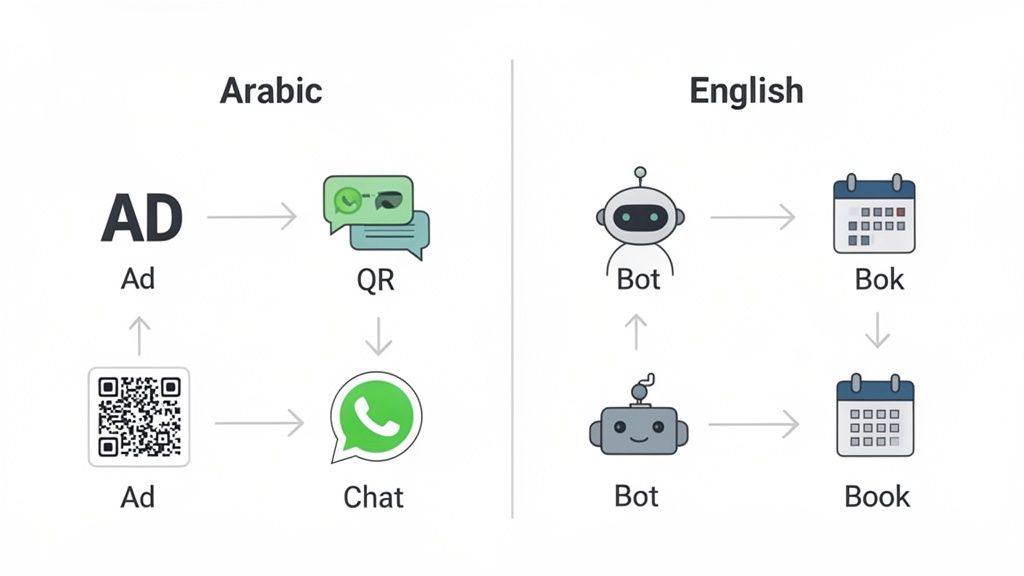
This infographic drives home the difference between the old, clunky web form funnel and the streamlined, high-engagement WhatsApp model.
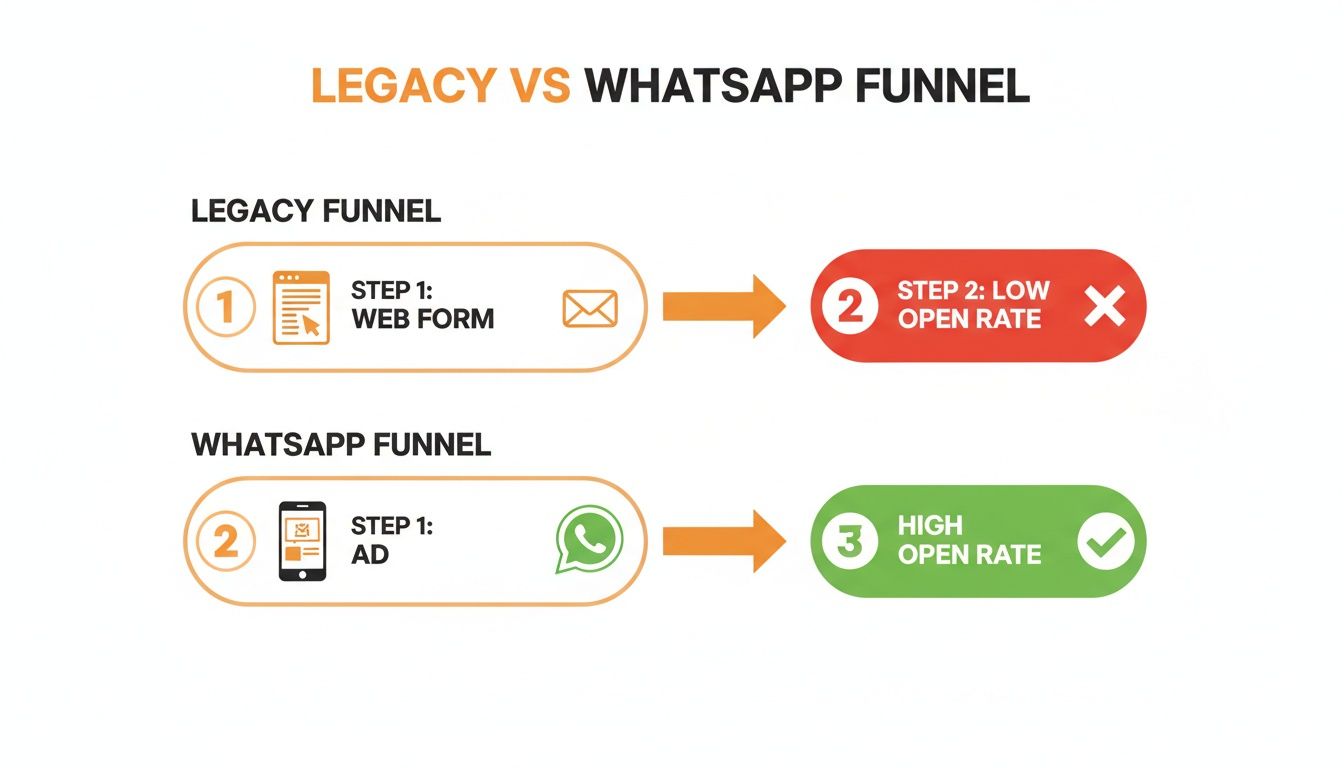
The instant, 90%+ open rates on WhatsApp cut out the biggest leak in traditional funnels: the email inbox, where most of your leads go to die.
Architecting for Arabic and English Workflows
In the MENA region, a single-language funnel is a non-starter. You must be able to handle both Arabic and English speakers from the very first message. This goes beyond simple translation; it requires two parallel, culturally-aware conversational paths.
Your first automated message should always be a simple language choice. Something like, "Welcome! For English, press 1. للعربية، اضغط ٢" is perfect. This one click routes the user into the right workflow, ensuring every question, prompt, and calendar link that follows is in their native tongue.
This initial split is crucial for two reasons:
- It’s respectful. You're meeting the customer on their terms, which makes for a much more comfortable and natural start to the relationship.
- It’s practical. This action instantly tags the lead in your CRM with their language preference, allowing for automated routing to the correct Arabic or English-speaking sales team.
To make this clear, let's break down how each stage functions in a bilingual setup and syncs with your CRM.
Bilingual WhatsApp Funnel Stages and Actions
This table shows how every single user interaction becomes a data point, progressively building a rich profile of your lead directly within your CRM, all without a human lifting a finger.
The Automated Qualification Sequence
Once the language is set, the automated sequence pulls out the same critical info your old web form did, but it does it conversationally. Think of this as a series of simple, one-tap questions. For a deeper look at generating interest, check out our guide on capturing digital marketing leads.
The best WhatsApp qualification flows feel less like an interrogation and more like a helpful concierge guiding the user to the right solution. Each question should be a single message, making it easy for the user to reply quickly.
Let's walk through a real-world example. Picture a Dubai real estate developer running a Click-to-WhatsApp campaign for a new luxury villa project.
Real Estate Qualification Flow Example:
- Welcome & Language:
Welcome to Emaar Properties. For English, reply 1. للعربية، اضغط ٢.(User selects 1) - Initial Triage:
Thanks! Are you interested in purchasing a property for yourself, or are you an agent?(User taps button: 'For myself') - Budget Qualification:
Great. To help us find the perfect match, could you indicate your approximate budget? [Under 5M AED] [5M-10M AED] [10M+ AED](User taps button: '10M+ AED') - Needs Assessment:
Excellent. Are you primarily looking for a villa or a penthouse apartment?(User taps button: 'Villa') - Conversion & Handover:
We have several stunning villas that match your criteria. Would you like to schedule a private viewing with one of our senior property advisors? [Book Viewing] [Ask a Question]
In just five messages, the bot has captured the lead's language, buyer type, budget, and property interest.
This data is synced in real-time to the CRM. The contact is automatically tagged as a "High-Value Buyer," and the deal record is moved to the "Qualified Lead" pipeline stage. If the user clicks "Book Viewing," they get a calendar link. If they click "Ask a Question," the chat is instantly routed to a live agent who has the full conversation history for context.
This entire process unfolds instantly, 24/7. No lead is ever left waiting. You've just turned your funnel from a passive data-entry form into an active, intelligent system that qualifies, segments, and tee's up sales on autopilot.
Connecting WhatsApp to Your CRM Pipeline
A WhatsApp funnel that doesn't talk to your CRM isn't a funnel—it's just another chat app creating manual work. The entire point is to make WhatsApp a smart front door for your sales pipeline, where every interaction automatically updates a contact, moves a deal, and triggers the next action in your sales process.
This is where the WhatsApp Business API is non-negotiable. The free Business app is fine for a one-person shop, but the API is what enables deep, automated connections to systems like your CRM. Think of it as the essential bridge between the customer's chat and your operational database.

This connection works through triggers and webhooks. A trigger is a specific event in the chat—a customer taps a "Yes" button or finishes a sequence. A webhook is the digital messenger that instantly sends the data from that event over to your CRM. For a more technical deep-dive on setting this up, you can see how to integrate WhatsApp with CRM and truly elevate your customer conversations.
Building Real-Time Automation Triggers
Forget about manually creating a new lead every time a message pops up. Your system should handle that instantly. The first, most basic job for your integration is to determine if you're talking to someone new or an existing contact.
- New Numbers: The system should automatically create a new contact record in the CRM, often pulling the name from their WhatsApp profile.
- Existing Contacts: It should log the new conversation under their existing record, avoiding a messy, duplicate-filled database.
Once that's established, you can build smarter rules based on the conversation's content.
The real power isn't just capturing the lead; it's capturing their intent in a structured way. An answer to a qualifying question isn't just text—it's a data point that should update a specific field in your CRM.
Imagine a prospect answers your budget question by tapping a button for "1M-2M AED." That single tap should fire off a webhook that instantly updates the Budget field on their deal record in your CRM. Better yet, it can automatically change the deal stage from New Lead to Qualified, all without human intervention.
Mapping Conversation Data to Custom Fields
To solve the headache of losing context between chat and sales, you need to set up your CRM to store the key information gathered on WhatsApp. This means creating custom fields that mirror the questions your chatbot is asking.
Here’s a practical look at how this mapping works for a B2B SaaS company:
With this setup, your sales reps get a clean, organized summary of exactly what the prospect needs before they even join the conversation. They don't have to waste time scrolling through the entire chat transcript to get up to speed.
Solving Common Integration Headaches
A poorly planned integration can quickly create more problems than it solves. Focus on getting these two things right from the beginning.
1. Preventing Duplicate Contacts
Your integration's golden rule: the phone number is the unique identifier. Before creating any new contact, the system's first job must be to search for an existing record with that same number. It's a fundamental check that keeps your database clean and reliable.
2. Automated Lead Assignment
Having a manager manually assign every incoming lead is a massive bottleneck. Your CRM automation should handle it. You can create rules to route leads based on the data you've already collected—for instance, leads who choose Arabic get sent to your Arabic-speaking team, while those from a specific campaign go straight to the rep managing that vertical.
When you connect these systems correctly, your WhatsApp-first sales funnel for MENA goes from being a simple chat tool to a high-powered engine for your entire pipeline. Nailing this technical foundation is essential for scaling sales without drowning in chaos.
Automating Lead Qualification and Appointment Booking
Once WhatsApp is connected to your CRM, you can build automation rules that qualify leads, understand their needs, and book them for an appointment—often before anyone on your team even sees the notification.
This isn't about replacing your sales reps. It's about making them more efficient by handing them warm, high-intent prospects who have already been vetted. They can then focus on closing deals, not chasing dead ends. Your funnel stops being a passive bucket for contacts and becomes an active, intelligent system that engages leads in Arabic or English the second they show interest.
Crafting Intelligent Qualification Flows
A good automation flow should feel like a helpful conversation, not an interrogation. The goal is to gather the same critical information your best salesperson would ask, but using simple, one-tap questions. Each response a user gives should trigger a specific action in the background, building out their profile and guiding them down the funnel.
Let's walk through two common scenarios in the MENA market.
Scenario 1: The High-End Retailer
A luxury fashion brand in Dubai wants to instantly identify potential VIP clients who message them on WhatsApp and route them straight to a personal shopper.
- Trigger: A customer scans a QR code inside the store and starts a chat.
- Message 1 (Bilingual): "Welcome to our VIP service. For English, reply 1. للعربية، اضغط ٢."
- User Action: They select English.
- Message 2 (Qualification): "Thank you. Are you interested in our new collection, private styling, or exclusive events?"
- User Action: They tap a button for "Private Styling."
- Message 3 (Intent): "Our personal shoppers are ready to assist. Are you looking to book a session this week?"
- User Action: They tap "Yes, this week."
Behind the Scenes: The combination of "Private Styling" and "Yes, this week" is the key. The system immediately tags this contact in the CRM as a
Hot VIP Leadand notifies the personal shopping team. A human can now jump into the conversation seamlessly.
Scenario 2: The B2B SaaS Company
A SaaS company in KSA needs to qualify leads for its enterprise software, ensuring only decision-makers from the right-sized companies get a demo with a senior account executive.
- Trigger: A prospect clicks a "Request Demo" ad on LinkedIn.
- Message 1 (Bilingual): "Thanks for your interest in our platform. For English, reply 1. للعربية، اضغط ٢."
- User Action: They select Arabic.
- Message 2 (Qualification - Arabic): "رائع. ما هو حجم شركتكم؟ [1-50 موظف] [51-200 موظف] [+201 موظف]" (Great. What is your company size?)
- User Action: They tap "51-200 employees."
- Message 3 (Role - Arabic): "ممتاز. ما هو دوركم في الشركة؟ [صاحب قرار] [مستخدم] [ابحث فقط]" (Excellent. What is your role? [Decision Maker] [User] [Just researching])
- User Action: They tap "صاحب قرار" (Decision Maker).
Behind the Scenes: This sequence qualifies the lead on two crucial data points. The system updates the CRM, assigns the lead to the mid-market sales team, and automatically sends a calendar link for the right account executive. If they had selected "ابحث فقط" (Just researching), they would have been added to a nurturing email sequence instead.
For a deeper dive, our guide on lead scoring and auto-routing in CRM breaks down the mechanics of setting up these kinds of rules.
From Qualification to Booked Meeting
The final piece of the automated puzzle is turning a qualified lead into a scheduled appointment. The handover from the bot to the calendar must be frictionless. Right after the final qualifying question, your automation should present a clear call to action.
You can offer a couple of paths here:
- Direct Booking: Send a direct link to a scheduling tool like Calendly, already configured for the correct sales rep. This is perfect for high-intent, fully qualified leads who are ready to talk.
- Agent Handover: Include a button like "Chat with an expert now." This pauses the automation and routes the conversation, along with its full history, straight to a live agent.
To dig deeper into how chatbots can elevate your sales and support, check out this excellent guide on AI chatbot for small business. These tools are the foundation for building the smart, responsive flows that modern customers in the MENA region now expect.
By designing these logic-driven pathways, your WhatsApp-first sales funnel for MENA becomes an engine that doesn't just capture leads, but intelligently qualifies and prepares them for your sales team, cutting your sales cycle down dramatically.
Measuring and Optimizing Your WhatsApp Funnel
Building your automated WhatsApp funnel is the first step. The real growth happens when you start digging into the data to see what’s actually working and what isn't.
The goal is to move beyond simply having conversations and start measuring how efficiently those conversations turn into qualified leads and, ultimately, revenue.
How to Measure What Matters in Your Funnel
To get a real sense of your funnel's health, you need to track a few key performance indicators. These are the numbers that tell the full story, from the moment a prospect messages you to the point they become a paying customer.
- Cost Per Qualified Lead (CPQL): This is your most important metric. It tells you exactly how much you're spending to get a lead who fits your ideal customer profile (right budget, right industry, right decision-maker). A high CPQL is a red flag that your ad targeting or your chatbot’s qualification questions are off the mark.
- Conversation-to-Booking Rate: Of all the leads your bot qualifies, what percentage actually book a meeting with your sales team? If this number is low, it could mean there’s too much friction in your scheduling process, or your call-to-action isn't compelling enough.
- Funnel Drop-Off Points: Where are people abandoning the conversation? By tracking which specific question in your automation causes users to stop replying, you can pinpoint the exact source of friction. If everyone bails when you ask about their budget, you know that question needs to be rephrased or moved.
A Simple Framework for A/B Testing
You can't improve what you don't test. Instead of making random changes, you need a structured approach. The key is to test one element at a time so you know exactly what’s driving the results.
A great place to start is your welcome message. It’s the first impression and has a huge impact. Try running two versions for a week—one with a friendly, informal tone and another that’s more direct and professional. Do this in both Arabic and English and see which one gets more people to reply and start the qualification flow.
Remember, the goal of A/B testing in a WhatsApp funnel isn’t just to get more replies. It's about the quality of the conversation that follows. A message that gets tons of responses but very few qualified leads is actually a failure.
Once you’ve optimized your opener, move on to your qualification questions. You could experiment with the order or change the format. Instead of asking an open-ended question like "What's your budget?", try offering pre-defined buttons like "[<50K AED]", "[50K-100K AED]", and "[100K+ AED]". This makes it easier for the user to respond and gives you clean, structured data for your CRM. If you're curious about the technical side of setting this up, understanding how an AI automation agency designs these data-driven systems can be incredibly insightful.
Building your sales funnel around WhatsApp in the UAE isn't just a gimmick; it's about meeting your customers where they already are. Data from the GCC shows that WhatsApp is a core part of daily life, with over 80% of residents in the UAE using it every single day. This isn't just a local trend, either. Globally, more than 175 million people message a business on WhatsApp daily, reflecting a massive shift towards conversational commerce that is especially pronounced in the MENA region. You can get the full breakdown on this trend from the excellent analysis by DigitalNexa.
Answering Your Top Questions About MENA WhatsApp Funnels
When you start digging into a WhatsApp-first strategy, the same practical questions always pop up. Let's cut through the noise with straight answers based on what we see working every day across the MENA region.
What's The Real Difference: WhatsApp Business App vs. The API?
Think of the standard WhatsApp Business App as a digital corner shop. It’s perfect for a single person on one phone manually handling a few chats. It’s a great starting point, but it hits a wall fast. You can't connect it to your CRM, and you definitely can't build any real automation.
Now, the WhatsApp Business API is the industrial-grade toolkit. This is what you need to build a proper, scalable sales machine. The API is the bridge that connects WhatsApp to your CRM, lets you deploy smart chatbots, and allows your entire sales team to work from a single, shared inbox. It’s built to handle thousands of conversations at once.
To put it simply: for any serious automation, lead qualification, and CRM integration, the API isn't just an option—it's the only choice. The free app just wasn't designed for the demands of a structured sales process.
How Do We Handle Opt-In And Compliance The Right Way In MENA?
Getting opt-in right is non-negotiable. You can't just guess or assume someone wants to hear from you on WhatsApp; they have to give you clear permission first.
The cleanest and most effective way to do this is through a user-initiated action. This is where a potential customer takes the first step. For example, they might:
- Click a "Chat on WhatsApp" button on your social media ad.
- Scan a QR code at an event or on your packaging.
- Tap a WhatsApp chat link on your website or in an email.
Any of these actions counts as clear consent for that specific conversation.
But what if you want to send a proactive message? For that, you need explicit opt-in. The most common way to get this is with a simple checkbox on a web form that says something like, "I agree to receive updates and offers via WhatsApp." And always, always give them an easy way out. A simple instruction to reply with "STOP" or "إلغاء" is all it takes.
Can We Actually Automate The Entire Sales Process?
Technically, yes, but that’s not the smartest way to do it. You absolutely should automate the top and middle parts of your funnel—this is where the magic happens. We're talking about the heavy lifting: capturing new leads 24/7, asking initial qualifying questions, and even scheduling the first call. This is where automation delivers a massive return.
However, the most successful WhatsApp funnels in MENA are built on a hybrid model. The goal isn't to replace your sales team; it's to make them exponentially more effective.
The best systems use automation for all the repetitive, time-sucking tasks and then trigger a seamless bot-to-human handover at just the right moment. This is usually when a lead is flagged as high-intent or asks a nuanced question that needs a human touch.
Think of your bot as the world's best sales assistant. It filters out the tire-kickers, pre-qualifies the serious buyers, and gathers all the essential information. Then, your human salesperson steps into a warm, fully-briefed conversation, ready to close. It’s this blend of speed and personal connection that makes the whole system so incredibly powerful. You free up your best people to focus only on conversations that drive revenue.
At SMOrchestra, we don't just talk about this stuff—we build it. We design and operate the AI-powered sales and marketing engines that help MENA businesses scale. From the CRM integration to the WhatsApp workflows, we turn ad clicks into qualified meetings and closed deals.

Read Our latest
Lorem ipsum dolor sit amet, consectetur adipiscing elit.